
-

Communicating Psychological Science: The Lifelong Consequences of Early Language Skills
“When families are informed about the importance of conversational interaction and are provided training, they become active communicators and directly contribute to reducing the word gap (Leung et al., 2020).”
-
Your Native Tongue Holds a Special Place in Your Brain, Even if You Speak 10 Languages
Most people will learn one or two languages in their lives. But Vaughn Smith, a 47-year-old carpet cleaner from Washington, D.C., speaks 24. Smith is a hyperpolyglot—a rare individual who speaks more than 10 languages. In
-
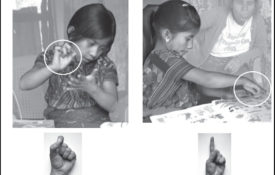
The Self-Taught Vocabulary of Homesigning Deaf Children Supports Universal Constraints on Language
Researchers compared how young homesigners—deaf children without access to an established sign language—and English-, Spanish-, and Chinese-speaking adults describe the use of tools such as paintbrushes and knives.
-
New Content From Current Directions in Psychological Science
A sample of articles on conceptual clarification, language acquisition, insights from deep neural networks, how to reduce academic procrastination, improve learning, craving, and more.
-
What’s in a Word? Computational Modeling Puts the Science of How We Learn Language to the Test
Language, whether spoken or read, is a tool that is constantly changing and growing, but research demonstrates that it may still be possible to pin down how it functions at its core.
-
New Content From Current Directions in Psychological Science
A sample of articles on brain and learning, handedness in primates, cognitive modeling and large-scale digital data, language, blame, credibility in psychological science, musical synchrony, innovations in clinical science and assessment.
