
From Memory and Plasticity to Collective Cognition and AI
Convention plenaries dive deep into the study of the human mind
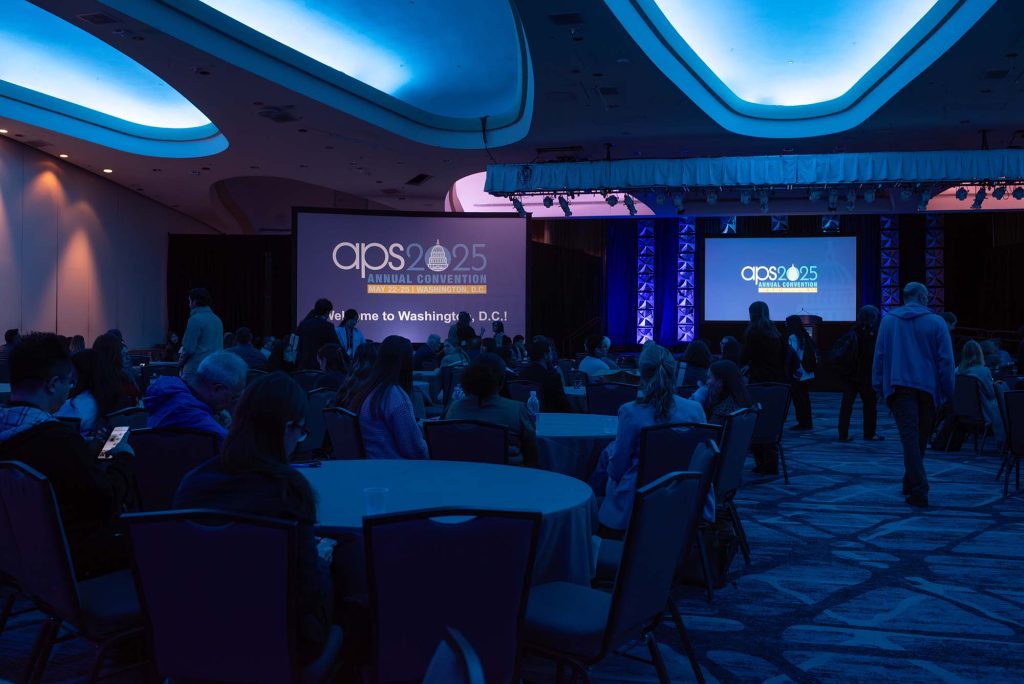
Groundbreaking research on the mechanisms of emotional memory and brain plasticity, the dynamics of collective cognition, and psychological science’s intersection with artificial intelligence (AI) were all on display at the 37th APS Annual Convention in May. Here is a summary.
Emotional Memory
In the opening keynote address at the Washington, D.C. convention, APS Fellow Elizabeth Kensinger shared her work on emotional memory, emphasizing how the brain constructs, stores, and retrieves emotionally charged experiences. Memory is more than a simple recording device; it’s a dynamic builder of personal history, the Boston College cognitive psychologist said.
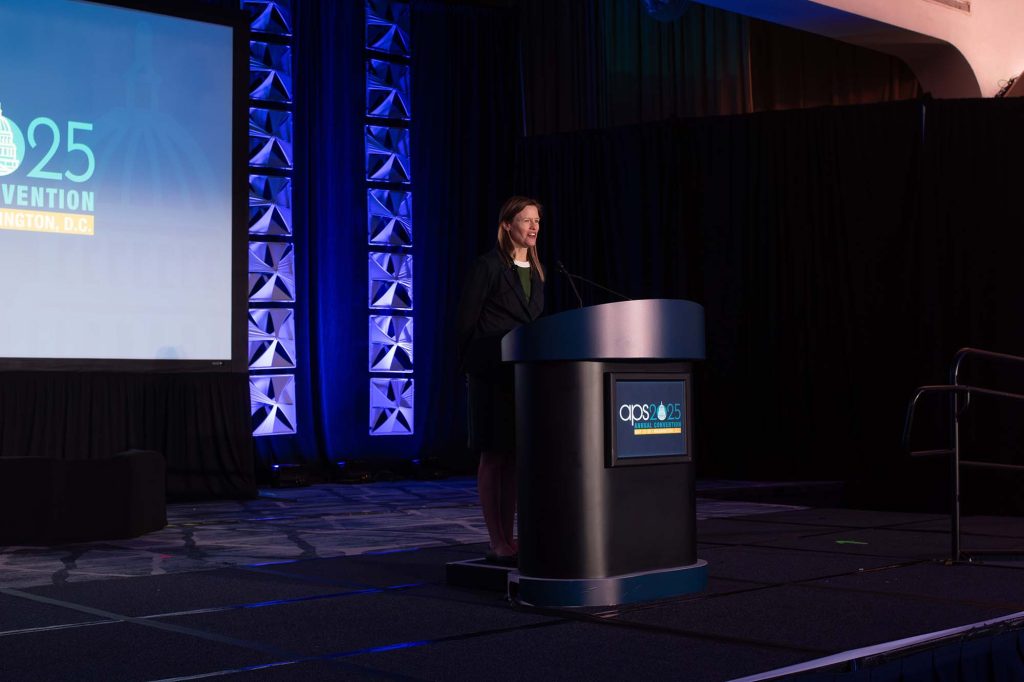
Brain regions such as the hippocampus, prefrontal cortex, and amygdala collaborate to encode memories, while sleep and retrieval processes reshape them over time, she explained.
She highlighted “emotional memory trade-offs,” in which the emotionally weighty elements of an experience are remembered more vividly over time than contextual details. This trade-off reflects how we adaptively focus our cognitive resources on what feels most urgent or meaningful, she explained.
In conditions such as Alzheimer’s disease, disruptions to the amygdala and medial temporal lobe (a brain region involved in declarative memory) undermine patients’ ability to retain emotionally significant information. Her early research, replicated in many studies, found that individuals with Alzheimer’s often forget positive and negative emotional experiences.
The research also revealed age-related shifts. Older adults increasingly retain positive aspects of past experiences rather than dwelling on the negative aspects. These findings point to memory not just as a cognitive process but as a tool for psychological well-being.
“The majority of our autobiographical memories are emotional,” Kensinger said. “We also know that how we frame those memories can have large impacts on our mental health. Many affective disorders really have at their core, alterations in how emotional moments are being remembered. So, I think there are tremendous clinical implications as well as basic science implications.”
Developmental Plasticity
APS William James Fellow Elissa Newport (Georgetown University) presented her decades-long research on developmental plasticity and the brain’s ability to reorganize after early injury. Focusing on children who experienced strokes around the time of birth, Newport and her colleagues discovered that even children who suffer severe damage to typically language-dominant areas of the brain’s left hemisphere go on to develop normal language abilities. Neuroimaging and language tasks show that children with left hemisphere injuries, for example, often relocate language functions to the right hemisphere, she explained. And when certain areas of the right hemisphere are damaged, functions such as emotion processing and visual-spatial skills develop in the left hemisphere.

“This is not a pattern of recovery that you see in adults, and we do not know how long it lasts into childhood,” she said, noting that her lab is seeking a grant to investigate the duration of this pattern of recovery.
By studying the mechanisms that allow children’s brains to reroute cognitive functions, scientists may eventually design new interventions for adults who suffer strokes, Newport said.
Collective Cognition
Memory and cognition are not purely individual pursuits. In a panel on collective cognition, chaired by APS Board Member Angela Gutchess of Brandeis University, researchers examined how social interactions affect memory formation and problem solving. APS Past President Suparna Rajaram (Stony Brook University, The State University of New York) outlined her extensive research on collective memory.

People commonly assume that collaboration enhances memory, but Rajaram’s lab studies consistently reveal “collaborative inhibition,” a phenomenon first reported in a 1997 study. Collaborative inhibition occurs when groups of people recalling something together often remember less than the combined output of individuals recalling separately. Prior research has attributed this to retrieval disruption, where one person’s recall sequence interferes with another’s.
“I can come into a recall situation having organized what I studied in a particular idiosyncratic way based on my cognitive history,” she said, “and when you recall something that doesn’t align with what I was going to recall, you disrupt me and I disrupt you. And as a result, each one of us is recalling less when we are collaborating.”
However, certain forms of collaboration—such as reconfiguring group members between recall sessions—can offset this inhibition by providing opportunities for re-exposure to previously forgotten information, she said.
Rajaram has extended her findings to more ecologically valid settings by studying how people recall shared autobiographical events, demonstrating that collaborative recall not only aligns memories but also enhances their emotional positivity over time.
Robert L. Goldstone (Indiana University Bloomington) presented experimental research on how groups coordinate to solve problems through role differentiation rather than mere synchronization. His lab has demonstrated how groups perform better when members adopt complementary roles that balance responsiveness and stability. His research emphasized the importance of specialization within groups, showing that such division of cognitive labor leads to more efficient, fair, and stable solutions, especially in complex or high-stakes tasks.
Nancy J. Cooke, a human systems researcher at Arizona State University, discussed applied team cognition in emergency response, military operations, and other high-stakes systems. Drawing from synthetic task environments modeled after real-world scenarios, she challenged the traditional shared cognition model, which assumes that teams function best when all members share the same knowledge. Instead, Cooke introduced her theory of “interactive team cognition,” emphasizing that it is the dynamic interactions—how information is communicated, coordinated, and adapted—that drive team performance. Her studies showed that teams exposed to training in which they face disruptions and must adapt accordingly performed better than teams trained through rigid procedural methods.
The panelists also discussed how their findings on human teamwork might translate into designing effective human-AI teams. Cooke and Goldstone argued that machines should be designed to complement rather than replicate human abilities. Rajaram added that memory contagion effects observed in human-to-human interactions also occur in human-robot collaborations, raising important considerations for the integration of AI in group settings.
Language, Brains, and Machines
A symposium moderated by L. Robert Slevc, (University of Maryland, College Park) explored the rapidly evolving intersection between psychology, neuroscience, and AI, focusing on large language models (LLMs) such as GPT.

Alexander Huth (University of Texas) presented his lab’s work using LLMs to decode brain activity during natural language processing. By recording fMRI data while participants listened to podcasts, his team trained models that could accurately predict—and even reconstruct—participants’ perceptions of speech content.

Laura Gwilliams of Stanford University delved into how LLMs can illuminate the brain’s handling of context. Her research showed how bidirectional context informs language comprehension. In language processing, bidirectional context involves understanding the meaning of a word or phrase by looking at the words preceding and following it. This mirrors how models like GPT process text, highlighting parallels between machine learning algorithms and human cognition.

Anna Ivanova (Georgia Institute of Technology) distinguished between formal linguistic competence (grammar, syntax) and functional competence (world knowledge, physical reasoning). While LLMs excel at linguistic form, they continue to struggle with grounded understanding of real-world knowledge—especially in domains involving physical and spatial reasoning. This tension underscores both the promise and limits of using AI as a model for human cognition, she said.
Feedback on this article? Email [email protected] or login to comment.



APS regularly opens certain online articles for discussion on our website. Effective February 2021, you must be a logged-in APS member to post comments. By posting a comment, you agree to our Community Guidelines and the display of your profile information, including your name and affiliation. Any opinions, findings, conclusions, or recommendations present in article comments are those of the writers and do not necessarily reflect the views of APS or the article’s author. For more information, please see our Community Guidelines.
Please login with your APS account to comment.