
Member Spotlight: 2025 APS Spence Award Recipient Chaz Firestone on the Foundations of Perception

Image above: Firestone and the members of the Perception & Mind Laboratory, 2024.
Chaz Firestone is a cognitive psychologist and associate professor in the Department of Psychological and Brain Sciences at Johns Hopkins University, where he directs the Perception & Mind Laboratory. Firestone is one of seven recipients of the 2025 Janet Taylor Spence Award for Transformative Early Career Contributions.
Learn more about Firestone and the six other Spence Award recipients.

Your research focuses on how perception interacts with the rest of the mind. What led to your scientific interest in this subject?
I wish I had a compelling “research is me-search” story to share here—a young boy stirred to understand his own nearsightedness or something—but the truth is that I was exposed to these problems in college and have been in love with them ever since. Growing up I never quite had a favorite subject in school; I loved my math and science classes, but I also adored English, history, and philosophy, and I dreaded having to pick just one. Cognitive science managed to tie everything together for me. That you could take something as personal and private as a mind and study it as a scientific object just fascinated me to no end, and it continues to do so today.
Perception research in particular draws on such a diversity of skills and domains. Just a single day in the lab may invite you to do some computer programming, graphic design, intuitive observation of the world around you, anthropology, geometry, philosophy, and even spend time as a guinea pig in your own experiments (since the phenomena we study can often be experienced directly). And you get to apply the conceptual and methodological rigor of psychophysics to some of the deepest questions we have about ourselves: the determinants of conscious awareness, the role of nature vs. nurture in shaping who we are, how our particular point of view structures our experience of the world, and even the nature of our capacity to represent the world in the first place.
One of those questions is the relation between perception and other cognitive processes. Your visual system is hooked up to the rest of your mind, which uses what you perceive to make decisions, form categories, lay down memories, and motivate actions. This interface between perception and other forms of mental processing is really a frontier of sorts, both in cognitive science as a discipline—which has become increasingly focused on these connections—and also in the mind itself, particularly the “border” between perception and higher cognitive processing. I have been especially interested in phenomena located at that border. What information can cross it? (Can higher-level cognition reach down into visual processing and change what we see?) What characterizes the territory on either side? (Do perception and cognition represent the world in fundamentally different ways?) And which phenomena fall where? (Do we perceive properties like causality, agency, complexity, absence, or time in the same way we perceive properties like color, shape, and motion?) Those are all questions that have directly inspired projects in my lab, and it has been exciting to pursue them and sometimes even catch glimpses of an answer.
What are some highlights of your research? What has it shown?
Over the last decade or so, my collaborators and I have been exploring the interaction between perception (roughly, what we see) and cognition (roughly, what we think). We’ve approached this theme from a few different angles.
Here’s one. It’s probably a truism by now that we “see what we want to see,” but a longstanding project of mine has been to build an empirical and theoretical case that this truism isn’t so true after all. Instead, there is a very strong sense in which perception is insulated against influence from higher-level cognition. It’s actually not so hard to get your intuition on board with this idea. For example, think of the last time you saw a compelling visual illusion—say, two patches of color that look different even though they’re really the same, like this one where the dark surface on top is actually the same as the lighter surface beneath it (cover up the middle bit and see for yourself).
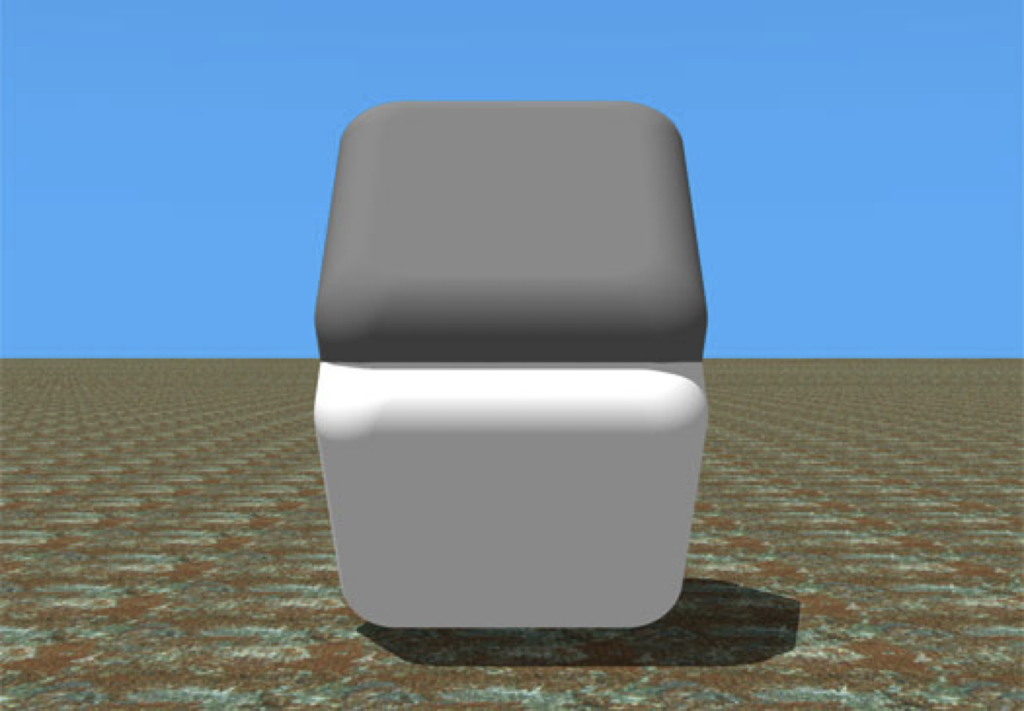
Images like these make our jaws drop. But notice something else: Once you pick your jaw up and take a second look, the illusion remains! You know the two patches are the same, and yet they keep looking different. Why? This kind of phenomenon suggests that perception operates autonomously in some important sense; it doesn’t listen to (and maybe can’t even hear) what’s happening in the rest of your mind. I was first captured by this idea as an undergraduate student and have returned to it over and over in the years since. My favorite recent example is a new paper with Dorsa Amir, a brilliant cultural psychologist at Duke University: Together we dug through over 100 years of scholarship—as well as findings from comparative psychology, developmental ophthalmology, computational modeling, and philosophy—to explore how our cultural upbringing may (or may not) shape how we see the world. At stake are fundamental questions about how our minds are structured and organized.
Now, this perspective might make it seem like perception lives on some lonely island in the mind, telling us how big, bright, or far away things are but not doing much else. But another line of research in my lab has challenged this idea, too. Whereas our work has suggested that perception is affected by higher-level cognition much less than many researchers have thought, we’ve also made the case that perception itself delivers to cognition much richer representations than has been traditionally assumed. Beyond properties like size, shape, or brightness, our work suggests that the visual system itself processes higher-level properties such as physical forces, alternative possibilities, time, and even artistic style, which show similar processing signatures as more traditionally studied visual properties. If that’s right, then perception is actually up to something a bit more interesting than what our textbooks tend to tell us. Our most recent thinking on these issues can be found in a paper written by a former postdoc in the lab, Alon Hafri. Not only does it review a bunch of high-level properties that may be part of visual processing, but it also lays out a methodological and theoretical framework for taking this idea in new directions.
What new or expanded research are you planning to pursue?
One of the great privileges of running a lab is following the interests of the different researchers who join it. Many lab members have come in with big questions of their own, and it has been an absolute joy to pursue those questions together. When it comes to new and recent projects, for example, my current graduate student Sholei Croom brought our lab in an entirely new direction with a project on what Sholei has dubbed “epistemic action understanding”—the capacity to look at another person’s actions and infer what information they are trying to acquire (e.g., watching someone shake a box to figure out what’s inside of it). Another project, led by my newest graduate student Tal Boger, explores the perception of artistic style from the perspective of visual psychophysics. I never could have imagined my lab would move in these directions—in Sholei’s case I didn’t even grasp that this direction existed—but it’s been so rewarding and even edifying to explore these new frontiers. I can’t wait to see where this work goes next.
One theme I’m especially excited about is engagement with questions arising from the philosophy of perception. I have a bit of graduate training in philosophy and have stayed close to my philosopher friends and colleagues over the years. But two collaborators who really poured rocket fuel on that interest are Jorge Morales (a former postdoc with a PhD in philosophy) and Ian Phillips, a faculty colleague who has effectively become the co-principal investigator of my lab. While working with us at Johns Hopkins, Jorge pursued an extremely rich project on the nature of visual perspective, laid out a deep and beautiful research program at the intersection of philosophy and psychology, and then went on to start an interdisciplinary lab of his own straddling both fields. Ian has been an official and unofficial advisor to several of my students and has added so much depth and rigor to the lab’s work. I honestly couldn’t imagine a more productive collaborative relationship with a colleague. With our former student Makaela Nartker, we’ve explored a foundational question about visual awareness. (Spoiler: It turns out that you see more of that famous “gorilla” than previously thought!). And with our current student Rui Zhe Goh—who is completing Johns Hopkins’ first ever joint PhD in philosophy and psychology—we made an empirical contribution to a longstanding philosophical literature on the perception of absences (specifically, the question of whether we can literally hear silence). I look forward to deepening our lab’s philosophical connections even further in the years to come.
What is the biggest challenge you have encountered in your career so far?
I’ve been very lucky in my career and haven’t faced nearly the same challenges that some of my peers have. I’m thankful for this and don’t take that privilege lightly. One continued challenge moving forward is how best to support the people around me, especially the members of my research group. Labs don’t come with instruction manuals for how to run them, and even if they did it would be hard to give one-size-fits-all advice—a huge part of effective advising is meeting each of your trainees where they are and figuring out what they need from you in order to flourish. I aspire to meet that challenge as best as I can, and also to guide and support my students as they navigate challenges of their own.
What practical advice would you offer to student researchers who want to be in your position someday, especially those who are interested in perception, attention, or cognitive science as a whole?
I think it’s important—not to mention intellectually rewarding—to read widely, educate oneself about the foundations of one’s field, and glean insights from neighboring disciplines. Cognitive science is a quintessentially interdisciplinary field, so it’s no surprise that some of the most exciting research embodies this interdisciplinary spirit. In my own lab, the projects that have been the most productive, successful, and just plain interesting have tended to be those that were informed by another field, such as philosophy, computer science, linguistics, developmental psychology, anthropology, and even art history. This can allow you to see connections and opportunities that others might miss, and it can also help you avoid various conceptual errors and missteps that have ensnared our predecessors.
At the same time, leaning too heavily on past literature can narrow your focus and even stifle creativity. Psychology, after all, is the study of our own minds and experiences, and I think it’s important to take that seriously. Perception might be the best example of all: It’s hard to think of an activity more familiar than perceiving the world around us. Compared to eating, sleeping, walking, reading—even reasoning and deliberating—we spend more time seeing, hearing, and feeling than just about anything else. But perception research often doesn’t look like those familiar experiences. If you find yourself unable to break free of what’s come before you, take a walk around the block and just notice what you see and hear. Some of our lab’s most exciting projects have come from everyday experiences that we realized weren’t well represented in textbooks.
Professionally, I think an underemphasized determinant of success in our field is to have peers and advisors who will be champions for you and your ideas. I’ve been fortunate to have people in my life who advocated for me and gave me the confidence to pursue ambitious projects where success was not at all a given. One way in which this remains true is through my colleagues here at Johns Hopkins. Maybe everyone thinks they have the best colleagues, but I really do—just the most wonderful, warm, brilliant group of department-mates who show genuine interest in each other’s work and help to make it better. Some of the more out-there projects in our lab would have been really challenging to pursue if not for the support and trust of my colleagues. And that’s now something I try to pass down to my own students. More than once has a prospective lab member told me that they see our research group as a home for somewhat funky ideas that others might not take as seriously or give a fair shake. I have absolutely loved hearing that and hope it remains true. If you have a creative idea about the mind that you feel may be underappreciated, come to Johns Hopkins and we’ll be your champions.
Feedback on this article? Email [email protected] or login to comment.


APS regularly opens certain online articles for discussion on our website. Effective February 2021, you must be a logged-in APS member to post comments. By posting a comment, you agree to our Community Guidelines and the display of your profile information, including your name and affiliation. Any opinions, findings, conclusions, or recommendations present in article comments are those of the writers and do not necessarily reflect the views of APS or the article’s author. For more information, please see our Community Guidelines.
Please login with your APS account to comment.