
Presidential Roundtable Explores DEI Across Borders
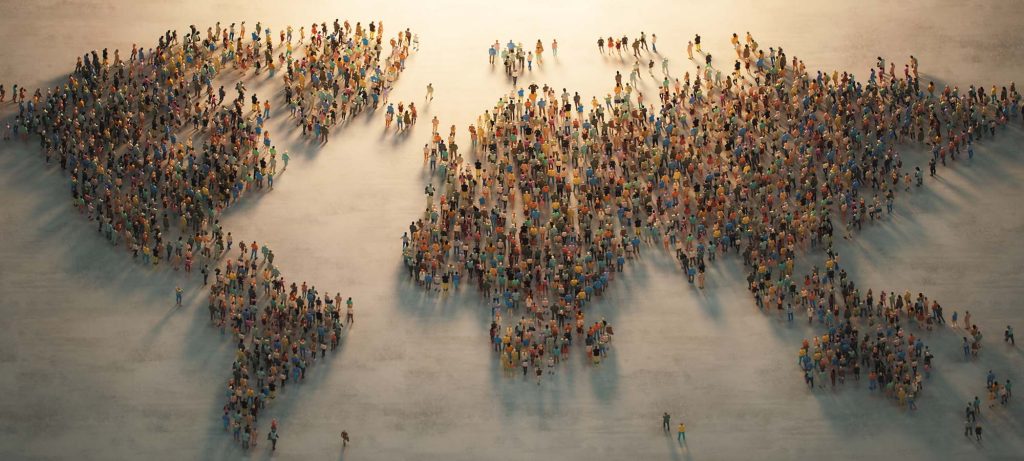
Diversity, equity, and inclusion (DEI) are ideals that span the globe, but their implementation is anything but uniform.
Scholars from Europe, the United Kingdom, and the United States shared different perspectives on DEI in the Presidential Roundtable at the 37th Annual APS Convention in May in Washington, D.C. The panelists discussed how DEI operates—and struggles—across national and cultural contexts.
Although DEI has largely been associated with race and gender equality, it also encompasses class, sexuality, and disability, APS President Randi Martin said. The session’s four speakers—three of whom joined virtually from overseas—highlighted how local context profoundly shapes DEI efforts.
Rosa Rodríguez-Bailón, a social psychologist at the University of Granada in Spain, discussed findings on the mistrust, status anxiety, and weakening social connectedness that increasing income and wealth disparities have fueled. Her team’s research suggests that the mere perception of inequality erodes social trust and reinforces individualism. In societies perceived as highly unequal, individuals tend to embrace more independent, self-focused identities, with less interest in communal goals or relationships.
“Perceived economic inequality,” she warned, “makes us more distant from one another.”
To foster social cohesion, DEI efforts must look beyond income statistics and address the subjective experience of inequality, Rodríguez-Bailón said.
Mustafa Özbilgin, Associate Dean of Equity and Inclusion at Brunel Business School in London, examined how ignorance—not just lack of knowledge, but willful and strategic ignorance—shapes DEI policy. Özbilgin contrasted evidence-based approaches to DEI with those driven by dogma, populism, and political convenience.
Though scientists have increasingly provided rigorous data on inequality and inclusion, Özbilgin warned that many policymakers—especially those in privileged positions—still operate from a position of ignorance.
Using the example of LGBTQIA+ inclusion in military forces, he emphasized how some societies frame DEI as a threat, while others embrace it as a human asset. To counteract ignorance-led policy, Özbilgin advocated for strategies that involve marginalized communities in shaping the research and initiatives that affect them.
Felicia Henderson, a Paris-based lecturer at INSEAD Business School, offered an on-the-ground look at how U.S.-style DEI practices are received abroad. Since 2020, she’s observed a surge in European companies trying to broaden their DEI agendas, often under pressure from U.S. headquarters. But this globalization of DEI frequently sparks resistance in the form of one phrase: “We are not the United States,” she said.
This pushback, Henderson explained, stems from “reactance,” or the desire to protect national autonomy, and “identity threat,” where local cultures feel judged by U.S. standards.
“Reducing the perceived Americanness of DEI can help preserve a sense of autonomy and honor,” she explained, urging U.S.-based researchers to consider how their work might be interpreted—or resisted—when exported abroad.
Kunalan Manokara, a social psychologist and postdoctoral fellow at Duke University, discussed how social class shapes identity, emotion, and inclusion in academia. Drawing from research conducted across India, Europe, and North America, Manokara detailed how social class affects self-esteem, the adoption of global identities, and even the emotional expressions considered appropriate or normal across class lines.
For example, wealthy individuals are often associated with emotions like pride and triumph, while poor individuals are expected to show gratitude or humility, he noted. These stereotypes can stifle social mobility and reinforce class-based bias, he said. His research also demonstrated how people from higher classes are more likely to dehumanize those at the bottom rung.”
Manokara concluded with a personal reflection on the structural barriers faced by scholars from disadvantaged backgrounds. Citing university programs in Australia, Canada, and the Netherlands that attempt to close these gaps, he urged institutions to pursue systemic solutions—and called on younger scholars to find and use their voices to promote DEI.
Feedback on this article? Email [email protected] or login to comment.



APS regularly opens certain online articles for discussion on our website. Effective February 2021, you must be a logged-in APS member to post comments. By posting a comment, you agree to our Community Guidelines and the display of your profile information, including your name and affiliation. Any opinions, findings, conclusions, or recommendations present in article comments are those of the writers and do not necessarily reflect the views of APS or the article’s author. For more information, please see our Community Guidelines.
Please login with your APS account to comment.