
Member Spotlight: 2025 Spence Awardee Julia Leonard on Celebrating Children’s Progress
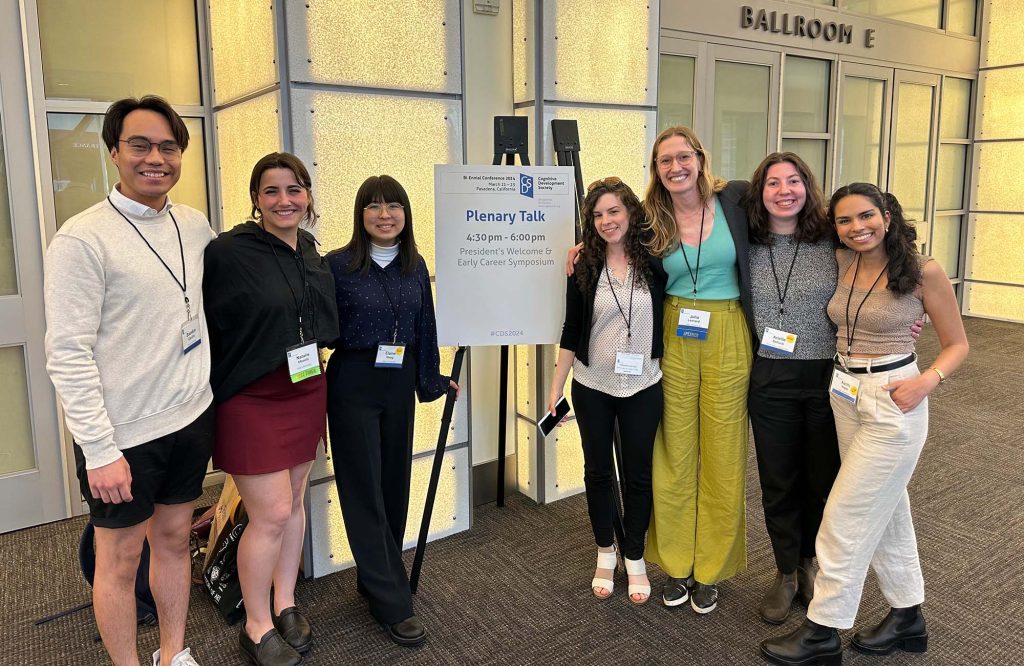
Image above: Leonard’s lab gathered for a photo after she spoke at the Cognitive Development Society’s Bi-Ennial Conference, 2024.
Assistant Professor of Psychology at Yale University and 2025 APS Janet Taylor Spence Award recipient Julia Leonard’s research focuses on seeking to understand how children approach learning, their capacity to overcome challenges, and the factors that underly their effort allocation.
Learn more about Leonard and the six other Spence Award recipients.
Your research focuses on the cognitive, neural, and computational representations underlying children’s effort-allocation decisions. What led to your scientific interest in this subject?
Whenever I am asked this question, I like to give a different answer because I don’t have a singular origin story. Rather, the inspiration for my science comes from many sources. Today, I’ll tell you a “research is me-search” story.

I entered graduate school intending to study how the developing brain supports cognition and emotion. Like many, I quickly realized that graduate school was different than undergrad: Instead of feeling a sense of completion and success after getting an A on an assignment, I was spending hours in the lab teaching myself the technical skills required to delve into the unknown and realizing that progress was extremely slow and rewards were sparse. This shift made me question what kept me—and my fellow graduate students—motivated to keep going with our science. That curiosity led me to start running developmental psychology experiments exploring how children learn what is worth their effort, and these experiments ended up launching my career.
What are some highlights of your research? What has it shown?
Learning requires effort, but we cannot try hard at everything. When children face challenges, they must decide whether to persist or move on. These decisions matter—overcoming obstacles builds the skills needed for independence and capability in adulthood.
Much research on children’s persistence focuses on traits. What predicts whether a child will wait for a second marshmallow or demonstrate strong executive function? Early in my career, I followed this approach, attempting to replicate and extend a parenting intervention designed to improve executive function. However, I think our replication failed in part because it did not consider the factors that might motivate a parent or child to behave a certain way (Romeo & Leonard et al., 2022).
My research now takes a different approach—instead of focusing on traits, I focus on the decision process underlying effort allocation. In other words, what might compel a child to put in effort? I have found that children calibrate their efforts based on whether they think they are likely to succeed, as well as the associated utility (costs vs. rewards) of their actions. Children gather this information through both social interaction and first-hand experience. For example, children learn about their probability of success by watching whether adults’ hard work leads to success (Leonard et al., 2017; Leonard et al., 2019), and by paying attention to their past performance (Leonard et al., 2022). Children learn about the value of their effort by observing what behavior adults praise (Leonard et al., 2021) and reward (Wang et al., 2024), as well as what tasks adults take over and do for children (Leonard et al., 2021).
But children often don’t face challenges alone—caregivers are nearby, making their own decisions about how to guide children. Should they let a child struggle or step in to help? Like children, caregivers also adapt their efforts according to their child’s probability of success and the utility of their actions. For example, we found that parents are less likely to take over a task when they believe their child can learn from doing it on their own (Shachnai et al., 2024). We have a lot of ongoing work in this area, so stay tuned!
Importantly, understanding this decision process can help us identify effective interventions to encourage children’s persistence when it matters most. My work suggests that we can model effort leading to success, celebrate children’s progress, and step back by reminding ourselves of all the things children can learn by facing a challenge on their own.
What new or expanded research are you planning to pursue?
I have two directions I am really excited about. The first concerns children’s optimism. Decades of research in developmental psychology have revealed that young children are overly optimistic about their capabilities and that this optimism fades with age (Leonard & Somerville, 2024), yet no one knows why! I am interested in why young children are so optimistic and what this means for how they select and persist through challenges.
The second research direction I am excited about concerns incentive structures. Despite decades of research showing that extrinsic rewards—such as grades—undermine intrinsic motivation, we continue to use them to assess children’s performance. Our recent work finds that before children even enter the classroom, they already find performance-based rewards demotivating, even when accompanied by praise for their effort (Wang et al., 2024). If we want children to stay engaged in the learning process, we must rethink the practice of grading students based on performance. In my lab, we are exploring innovative incentive structures that not only motivate children to learn but also foster enjoyment in the process.
What is the biggest challenge you have encountered in your career so far?
Experiments failing. Conducting studies with children is especially demanding. I just returned from setting up a new experiment at a museum where we run many of our studies. After five exhausting hours of working with children, I know how frustrating it can be to put in so much effort only for things not to go as planned.
Early in your career, every experiment feels high stakes. When your first study doesn’t work, it’s easy to think, “I’m a failure! I must not be cut out for science!” But what I have learned with time is that this failure is critical to success in science: A failed experiment often reveals something unexpected, guiding the next step in the research.
What I think is really hard with all the failure and rejection in academia is finding any signal that you are doing something right. As I said in the beginning, rewards are sparse in academia. You really have to enjoy the process of discovery and appreciate the wins when you get them. I also find that having colleagues who can give you honest feedback and support is invaluable.
What practical advice would you offer to student researchers who want to be in your position someday, especially those who are interested in education, children, cognitive/developmental processes, or neuroscience as a whole?
Find a good environment to grow in. Try to work in a lab exploring questions that excite you but also try to work with people who encourage and enrich your efforts. And if you are not getting the support you need, take the initiative to seek it elsewhere. Last year, I joined a writing group for new professors, which has been invaluable both as a resource and as a community. Being happy and feeling supported are really necessary ingredients for persisting through the challenges in academia.
Feedback on this article? Email [email protected] or login to comment.
Leonard, J.A., Cordrey, S., Liu, H.S., & Mackey, A.P. (2022). Young children calibrate effort based on the trajectory of their performance. Developmental Psychology, 59(3).
Leonard, J.A., Garcia, A., & Schulz, L.E. (2020). How adults’ actions, outcomes, and testimony affect preschoolers’ persistence. Child Development, 91(4).
Leonard, J.A., Lee, Y., & Schulz, L.E. (2017). Infants make more attempts to achieve a goal when they see adults persist. Science, 357(6357), 1290-1294.
Leonard, J.A., Lydon-Staley, D.M., Sharp, S., Liu, H.Z., Park, A.T., Bassett, D.S., Duckworth, A.L., & Mackey, A.P. (2021) Daily fluctuations in young children’s persistence. Child Development, 93(2).
Leonard, J.A., Martinez, D.N., Dashineau, S., Park, A.T. & Mackey, A.P. (2021). Children persist less when adults take over. Child Development, 91(4).
Leonard, J.A. & Sommerville, J.A. (2024). A unified account for why optimism declines in childhood. Nature Reviews Psychology, 4, 35-48.
Romeo, R.R.*, Leonard, J.A.*, Robinson, S.T., Mackey, A.P., West, M.R., & Gabrieli, J.D.E. (2021). Replication and extension of a family-based training program to improve cognitive abilities in young children. Journal of Research on Educational Effectiveness, 14(4), 792–811.
Shachnai, R., Asaba, M., Hu, L., & Leonard, J. A. (2025). Pointing out learning opportunities reduces overparenting. Child Development, 96(2), 679-690.
Wang, E., Radovanovic, M., Sommerville, J. & Leonard, J.A. (2024). Practice what you preach: Consistent messages about the value of effort foster children’s persistence. Proceedings of the 46th Annual Conference of the Cognitive Science Society.



APS regularly opens certain online articles for discussion on our website. Effective February 2021, you must be a logged-in APS member to post comments. By posting a comment, you agree to our Community Guidelines and the display of your profile information, including your name and affiliation. Any opinions, findings, conclusions, or recommendations present in article comments are those of the writers and do not necessarily reflect the views of APS or the article’s author. For more information, please see our Community Guidelines.
Please login with your APS account to comment.