
Member Spotlight: 2026 Spence Awardee Emily Finn on the Unique Patterns of Brain Activity
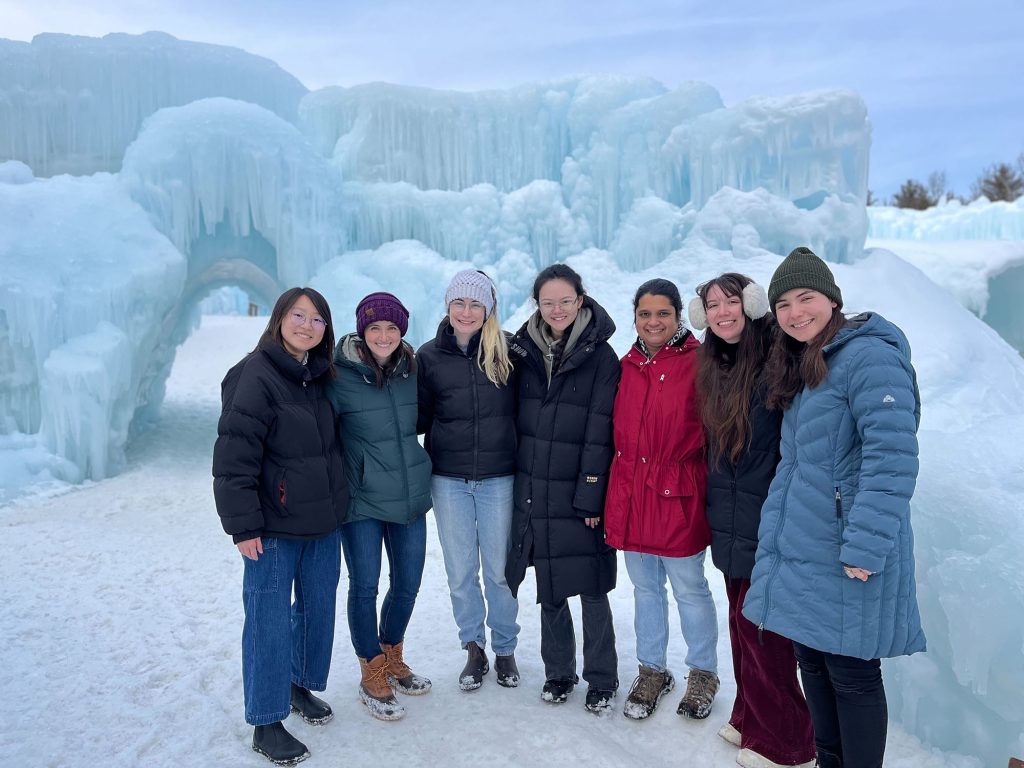
Image above: The FINN Lab surviving the New Hampshire winter.
Assistant Professor Emily Finn’s research focuses on individual variability in brain activity and behavior, especially as it relates to appraisal of ambiguous information under naturalistic conditions. The Observer’s Digital Content Manager Lou Willwood talked to the 2026 APS Janet Taylor Spence Award recipient about her work discovering that brain scans could be used to identify individuals, the challenges and excitement of pushing into new scientific territory, and the importance of studying the questions that most interest you.
Learn more about Finn and the five other Spence Award recipients.
Your research focuses on variability in brain activity and behavior. What led to your scientific interest in this subject?
Early on in graduate school, my colleagues and I made the somewhat surprising discovery—basically by accident—that individual people could be identified by their functional brain scans regardless of what they were doing while being scanned, making patterns of brain activity akin to a fingerprint.
Although this finding was exciting to us and many others at the time, funnily enough, when you stop and think about it, it was really only surprising from a methodological perspective, as the dogma up until that point was that fMRI was largely too noisy of a technique to draw reliable inferences at the single-subject level. After all, at a conceptual level, we already knew that everyone is different—and we already had even better ways of identifying them, including by their DNA, their actual fingerprints, or just by looking at them!
To me, the most exciting part of that discovery was not necessarily that functional brain scans could reliably identify people, but rather that there was information embedded in someone’s pattern of whole-brain functional connectivity that could be used to predict out-of-scanner behavior, including cognitive abilities like fluid intelligence and sustained attention, as well as certain personality traits. Since then, I’ve been largely focused on across- and within-person variability in brain activity as it relates to behavior—in other words, the behavioral consequences of these differences we’re seeing in the brain.
What are some highlights of your research? What has it shown?
One major goal of our work is to understand how and why different people arrive at different interpretations of the same experience, by characterizing how people interpret inherently ambiguous scenarios as a function of their traits, states, beliefs, and prior experiences. We have found, for example, that personality traits such as paranoia affect how an ambiguous social narrative is perceived both neurally and behaviorally, and have identified neural event segmentation as one candidate mechanism by which people may form different interpretations of the same experience. More recently, we have begun to pinpoint how the same person can change their interpretation, by examining how and where shifts in neural representations of the same information can signal shifts in subjective experience of that information. Finally, by adopting the perspective that “socialness is in the eye of the beholder,” we have shown that using participant (as opposed to experimenter) labels for classic social-animation stimuli explains more variance in brain activity and reveals that social signals are detected earlier in the brain’s functional hierarchy than previously thought.
Our lab has also been part of a larger movement toward using “naturalistic stimuli” such as movies and stories in functional neuroimaging studies. We have used these paradigms to reveal not only shared principles of cognition (such as how brains unscramble information in a nonlinear narrative), but also nuanced individual differences, by developing techniques such as inter-subject representational similarity analysis (IS-RSA) to recover brain-behavior relationships while people experience audiovisual narratives. More broadly, given mounting evidence that naturalistic paradigms outperform resting state for many applications, I have argued for a move away from rest as the dominant acquisition state and toward the adoption of dynamic, engaging paradigms for both small- and large-scale neuroimaging studies.
What new or expanded research are you planning to pursue?
At this point, we and others have convincingly established that different people, or even the same person at different times, can come to different interpretations of the same high-level social information, and that there are signatures of these divergences in brain activity as people are experiencing the information. But it’s been tough to pinpoint exactly why that happens—which particular features of the stimulus and/or the person experiencing it drive these divergences. In our ongoing work, we are carefully measuring and manipulating some of these features to test specific mechanistic hypotheses. Our long-term goals are two-fold: At a societal level, understanding divergent interpretations of shared information could inform interventions to reduce polarization, and at an individual level, learning how to nudge people toward more adaptive interpretations could have important implications for mental health.
Another line of work that is brand new for us is trying to understand if and how artificial intelligence can successfully model, or at least recapitulate, idiosyncrasies in natural human intelligence. While AI is a powerful tool, given the way it is currently trained, one worry is that increasing dependence on AI might serve to homogenize human thought. We hope to understand how to create (in the case of AI), preserve (in the case of natural intelligence), and promote healthy levels of variability in all forms of cognition, including human-machine interactions.
What is the biggest challenge you have encountered in your career so far?
It’s commonly said that scientists exist along a spectrum from “exploit” to “explore”: exploiters become deep experts in one topic and continue to make impactful contributions in that area for all or most of their career, while “explorers” tend to flit around a bit more between topics that may seem only loosely related to one another. At the population level, the scientific enterprise benefits from a healthy mix of styles; I personally consider myself pretty far down the “explore” end of the spectrum. While this keeps things fun and interesting, it also leaves me feeling like a fish out of water more than I care to admit, as I am often trying to learn entire new literatures while already knee-deep in a study (or a grant). These days, it’s usually my graduate students and postdocs who are pushing me into new scientific territory based on whatever they are interested in. It’s exhilarating, but it can be tough to keep up, and there’s never as much time to read as one would like!
What practical advice would you offer to student researchers who want to be in your position someday?
Follow your own personal curiosity! Yes, it’s important to be aware of the current thinking and trends within your particular subfield, but you should never try to optimize solely for what you think everyone else will be most interested in. If there’s something you find interesting, but no one is really working it, that could be a great opportunity to carve out your own niche. Plus, I truly believe that this career is only worth doing if you are working on questions that you are genuinely passionate about (at least most of the time). As psychologists and neuroscientists, we are students of the deepest questions about human thoughts, feelings, and behaviors, so research inspiration can strike at any time (at social gatherings, during difficult conversations, while daydreaming in the shower)—be open and ready for it!
Feedback on this article? Email [email protected] or login to comment.



APS regularly opens certain online articles for discussion on our website. Effective February 2021, you must be a logged-in APS member to post comments. By posting a comment, you agree to our Community Guidelines and the display of your profile information, including your name and affiliation. Any opinions, findings, conclusions, or recommendations present in article comments are those of the writers and do not necessarily reflect the views of APS or the article’s author. For more information, please see our Community Guidelines.
Please login with your APS account to comment.