
Member Spotlight: 2026 APS Spence Awardee Yuan Chang Leong’s Pursuit to Understand the Brain
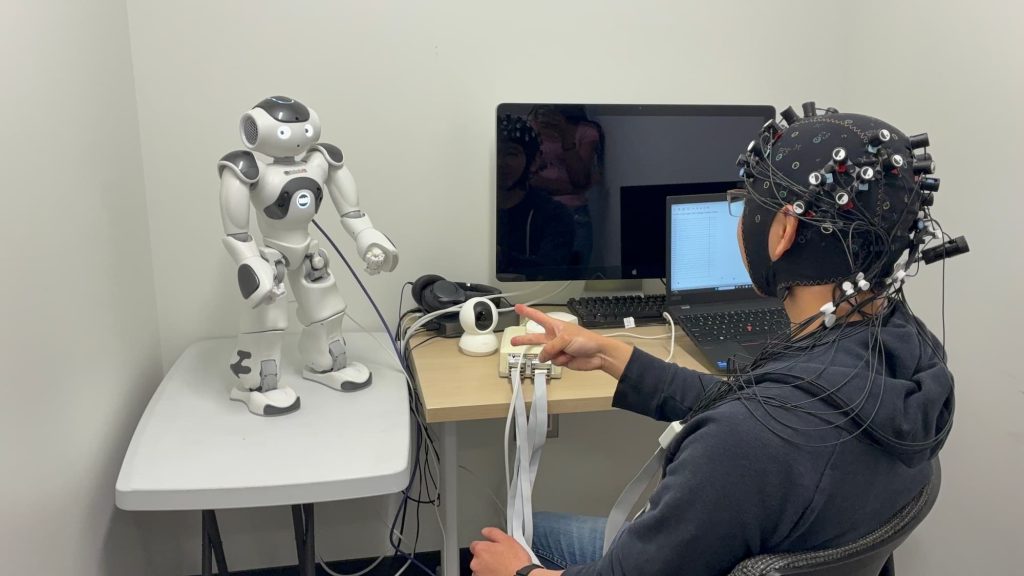
Image above: YC playing rock, paper, scissors with a NAO robot while having his brain activity measured using fNIRS. Photo credit: Jadyn Park.
Yuan Chang (YC) Leong is an assistant professor at the University of Chicago, where he leads the Computational Affective and Social Neuroscience Laboratory. His research focuses on how both affect and social context construct subjective experience. The Observer’s Lou Willwood talked with YC about what got him started, the opportunities and challenges of working in an interdisciplinary field, and the power of collaboration.
Learn more about Leong and the five other Spence Award recipients.
Your research focuses on how our goals, needs, and desires affect our perception of the physical and social world. What led to your scientific interest in this subject?

In Akira Kurosawa’s 1950 classic Rashomon, the death of a samurai is retold through multiple, mutually incompatible accounts. Each narrator offers a version of what happened colored by their motives, desires, fears, and beliefs. The film is gripping not simply because we are left wondering what really happened, but because each telling reveals the mind of the person doing the telling.
Rashomon captures something that has always fascinated me. How we perceive and interpret any given situation is not just a function of the objective information out there in the world, but also what we as individuals bring to it. Two people can watch the same movie, hear the same political speech, or have the same social interaction, yet notice different things, remember different details, and draw different conclusions. In that sense, our response to the world reveals as much about who we are as it does about the world itself.
How can we move from observing that people see the world differently to understanding how those differences arise in the mind and brain? Early in my academic career, I became very excited by the possibility that tools from cognitive neuroscience and computational modeling could help us peer into the “mind of the beholder.” I was especially drawn to approaches that allowed us to study people in contexts that more closely resemble everyday situations, where people make sense of rich, unfolding experiences, such as watching a film, listening to a story, or interpreting a social interaction.
That scientific interest continues to guide my work today. I want to understand why the same experience can lead some people to flourish and thrive, while others struggle or respond negatively. Ultimately, I hope this work can help us understand not only how people construct their own subjective realities, but also how we might create conditions that help people interpret their experiences in ways that support well-being, connection, and more adaptive behavior.
What are some highlights of your research? What has it shown?
Does wanting to see something make people more likely to see it? This has been a longstanding and sometimes controversial question in psychology, in part because it is difficult to distinguish changes in perception from changes in how people report what they perceive. Using neuroimaging, we found that motivating participants to see one interpretation of an ambiguous image strengthened the corresponding neural representation. In other words, motivation did not simply bias participants’ reports; it also influenced how the brain encoded the visual environment. Over the next few years, I worked to characterize the neural and computational mechanisms of “motivated seeing,” showing how it relates to fluctuations in arousal, patterns of brain activity, and individual differences.
When people learned about this research, they often drew a connection to political polarization, but I felt that the connection was imprecise. To say that people “see what they want to see” in politics is a useful metaphor, but it does not tell us much about the underlying mechanisms. In one study, we used fMRI to scan conservatives and liberals as they watched the same real-world news videos. We found evidence of “neural polarization,” in which participants with opposing attitudes showed divergent neural responses to the same content. We hypothesized that this neural polarization reflected, in part, divergent semantic representations, such that the same words or sentences can carry different meanings. For instance, “we must keep our communities safe” can mean something different across the political spectrum. In ongoing work, we found that greater semantic divergence in a video clip was indeed associated with stronger neural polarization.
More recently, my lab has been studying why emotional experiences become enduring memories, and how they continue to influence our thoughts and behavior long after they occur. In particular, we found that emotional moments during a narrative were associated with increased cohesion across brain networks, which in turn predicted how well participants subsequently remembered those moments. This suggests that emotion may help encode memories by bringing different brain systems into a more coordinated state as an experience unfolds.
What is the biggest challenge you have encountered in your career so far?
My research is situated at the intersection of social and affective neuroscience, cognitive neuroscience, affective science, social psychology, and cognitive science. I find that interdisciplinarity exciting, but it has also required learning to speak across different intellectual traditions. Each field has its own language, assumptions, standards of evidence, methods, and community of scholars. I am still learning how to “code-switch” between fields, communicate my work in ways that resonate across disciplinary boundaries, and become a genuine participant in multiple intellectual communities.
What new or expanded research are you planning to pursue?
I am excited to keep pushing my research toward richer and more naturalistic settings. One direction my lab is pursuing is the use of functional near-infrared spectroscopy (fNIRS), a cost-effective, non-invasive, and mobile neuroimaging method. Unlike fMRI, which requires participants to remain still and isolated, fNIRS makes it possible to scan multiple brains at once while people speak, gesture, and respond to one another naturally. For example, we are currently scanning romantic partners as they have conversations with each other, allowing us to study how emotions, goals, and social dynamics unfold during personally meaningful exchanges.
What practical advice would you offer to student researchers who want to be in your position someday?
Create opportunities to be exposed to new ideas. Read consistently, attend conferences when possible, and take advantage of the many talk series that are now available online. Attend local talks, including seminar series in your home department or at nearby institutions, and consider inviting speakers to give virtual talks. I know graduate school is busy, and it can be tempting to skip these things to focus on your own work, but it is important to keep a broad perspective, stay up-to-date with new developments in the field, and find connections in the work of others. You never know where inspiration will come from.
Find good mentors and collaborators. I have been fortunate to work with my undergraduate mentors, Yael Niv and Uri Hasson, my PhD advisor, Jamil Zaki, my postdoctoral advisor, Mark D’Esposito, and many other collaborators who have enriched my work. Good mentors and collaborators do more than teach you methods or help with projects. They expand the kinds of questions you ask, sharpen how you think, and make science feel like a shared intellectual pursuit.
Anything else you would like to add?
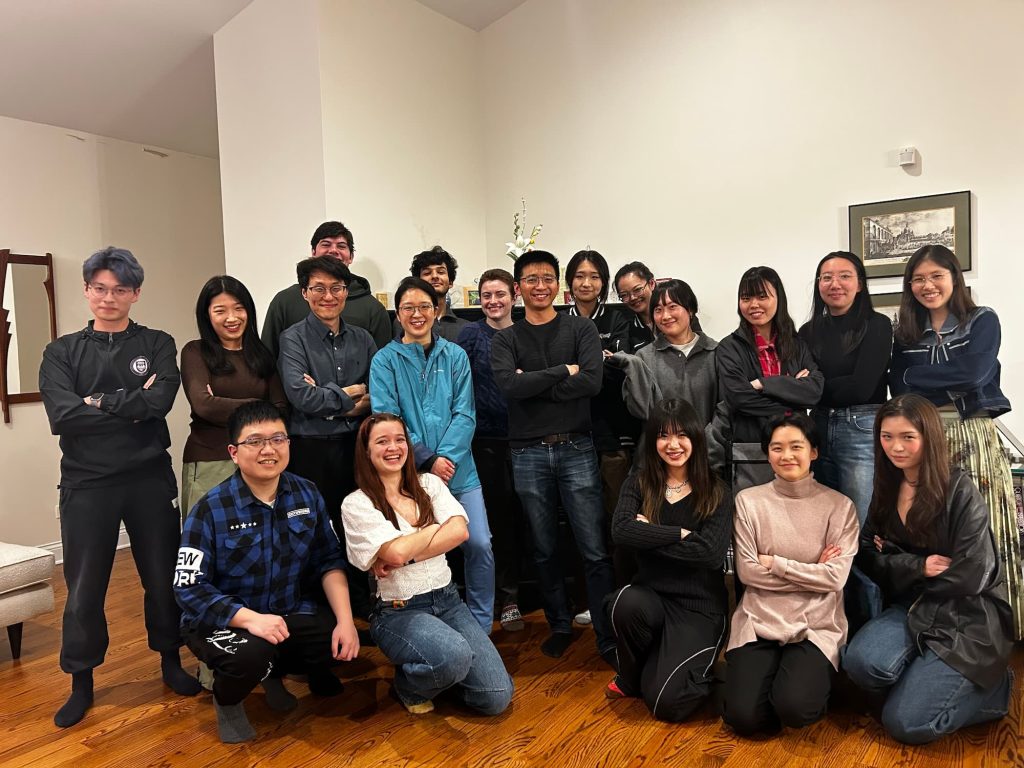
I am deeply honored to receive the Janet Taylor Spence Award. Awards like this are meaningful not only because they recognize individual work, but because they reflect the efforts of many people. My research reflects the joint contributions of mentors, collaborators, and outstanding students and lab members. I am especially grateful to the people in my lab, whose ideas, persistence, and curiosity continually push the work in new directions.
Feedback on this article? Email [email protected] or login to comment.



APS regularly opens certain online articles for discussion on our website. Effective February 2021, you must be a logged-in APS member to post comments. By posting a comment, you agree to our Community Guidelines and the display of your profile information, including your name and affiliation. Any opinions, findings, conclusions, or recommendations present in article comments are those of the writers and do not necessarily reflect the views of APS or the article’s author. For more information, please see our Community Guidelines.
Please login with your APS account to comment.