
Making APS Conventions Work for You
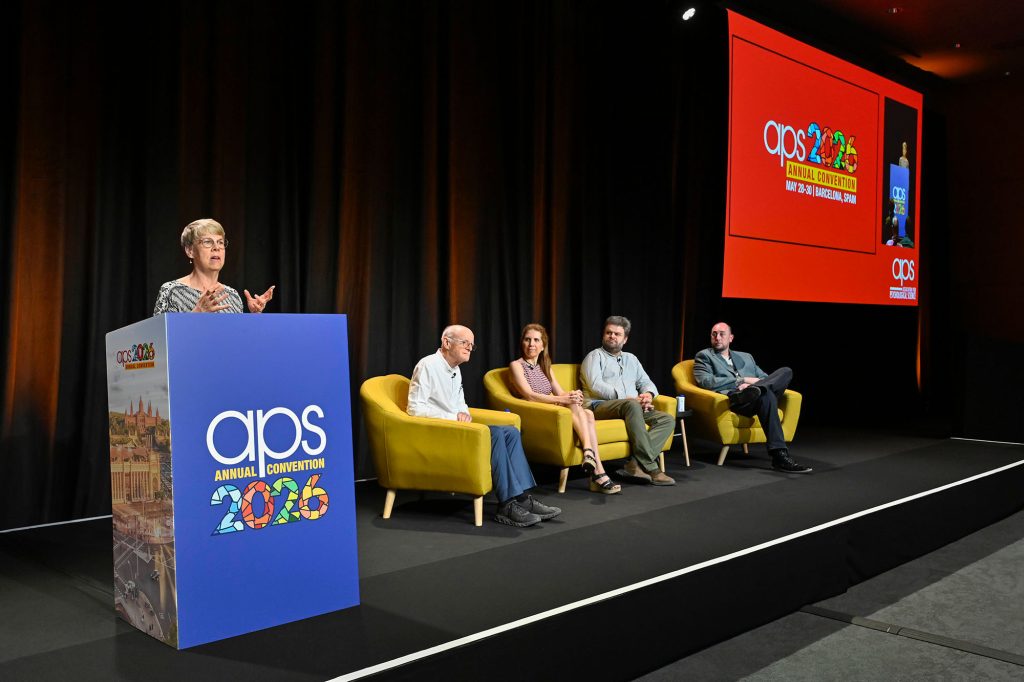
Thank you to everyone who attended the Barcelona meeting, our first international APS convention. We’re committed to holding more international meetings going forward, and I enjoyed hearing many of your thoughts at the meeting about how APS can better serve its membership. In this, my first column as APS president, I want to share some of those ideas as we begin planning the next annual convention in Seattle (May 27–29, 2027), and to open a dialogue about what would make our conventions something members look forward to attending each year.
Broadening the research conversations
One of the things I appreciated about the 2026 convention in Barcelona was the introduction of the Integrative Science Symposia (ISS). These sessions were designed to explore complex scientific questions through the lens of different domains of psychology and the broader behavioral sciences, paired with flash talks tied to each ISS theme. You can find the list of topics covered at the meeting here.
I found these sessions engaging to watch, as speakers who often didn’t know each other brought the methods and theories of their own research area to bear on the same question. Hearing these different perspectives pushed me to think harder about the wider range of issues within each topic and the measurement challenges we share across subfields. It also highlighted how differently we interpret and report statistical significance and effect sizes, and how much psychology still struggles to move beyond highly selected, nondiverse convenience samples.
We plan to continue having ISS sessions at the 2027 convention. I hope we can also discuss how often we’re studying the same phenomena from different angles, which is a strength but also a challenge when we try to communicate our findings to the public, who may not appreciate how differently a developmental scientist and a clinical scientist might approach the very same question. What other ways could convention programming help bridge these different methodological traditions?
Controversies and solutions
I talked with a few people at the meeting about what makes a convention session genuinely worth attending. Conventions are great for socializing and connecting with colleagues from around the world, but what is unique enough that you’d come specifically to see it presented? A common answer was a controversial topic discussed openly, or findings from a major replication effort, or one of the many team science studies presented for the first time. This struck me as a compelling idea, as long as the goal is to advance the science on a topic and identify clear next steps. I’m currently designing a Presidential Symposium, “Beyond the Panic: What the Evidence Says About Social Media and Well-Being,” in that same spirit. Could we build programming around symposia like this into something more lasting for the membership: a published summary, a working group, an ongoing initiative that grows out of the conversations we have at the convention?
Workshops
Our methodological workshops remain very popular, and they’ll continue in 2027. We’re also considering other workshop formats that might be useful. A new addition to the 2026 convention was Industry Day, addressing the fact that many of our members seek employment outside academia. Seattle’s strong industry and tech presence make the 2027 meeting a natural opportunity to expand on that experience. What workshop topics related to nonacademic or academic-adjacent careers (e.g., research center leadership) would interest you most?
Professional development
Similar to the workshops, we’d like to introduce more professional development programming at the 2027 meeting. Other societies have run activities like “Lunch With the Leaders,” where a small group of scholars sits together for an informal ask-me-anything session. I’m considering having lunch with leaders each day of the convention, with each lunch targeting a different career stage so that students, early career scholars, and mid-to-late-career scholars each get dedicated time in small groups. Would you come to a lunch like this?
Scientific reports summarizing psychological issues
Some conversations with the APS Board and editors have explored using the convention to focus on a single topic in psychological science, with symposium programming introducing it and offering different perspectives. We’d then set aside additional time for interested members to begin outlining a scientific report covering what we know, what we don’t know, what we need to know, and how we’ll get that information. The goal is a consensus document, shared with our scientific community as well as the broader public, that we would publish in one of our existing journals. What are your thoughts on a consensus report like this?
Next steps
If any of these ideas interest you, please use the comment section to share your thoughts or reach out to me or APS directly at [email protected]. We want to build the kind of association our members want to participate in, one that offers products genuinely useful to the field and helps move the science forward. We want our meetings to feel valuable enough to attend on their own merits because of the scholarship and connections you gain there. Please join the conversation, and I hope to see you in Seattle next May!
Feedback on this article? Email [email protected] or login to comment.



Comments
The standard conference mode is for members to present their own research. However tons of research already exist, and they need to be integrated in topic-based reports in order to solve real-world problems. Presenting scientific reports on real-world questions is quite innovative for a conference. Summarizing research is a rather neglected undertaking, which is also considered low-value. One reason is that academics teach and research their interests. They rarely have to solve real-world problems.
Interestingly, I spent most of my career doing just that. As a senior education specialist at the World Bank, I looked for solutions on speeding up basic skills in low-income populations. For that, I have monitored research summaries daily for over 30 years. I wrote many research reviews and books, outlining implications from studies (e.g. perceptual learning of shapes, critical size and spacing of letters in reading speed, numerical cognition). And solutions encompass multiple psychology fields.
So I would very much welcome scientific reports summarizing psychological issues for a consensus document. Of course, these are quite time-bound. One new study may explain or change conclusions, as I have found.
Thanks for the feedback, Helen. I think consensus documents, especially as an outcome of our meetings, are a very interesting idea.
APS regularly opens certain online articles for discussion on our website. Effective February 2021, you must be a logged-in APS member to post comments. By posting a comment, you agree to our Community Guidelines and the display of your profile information, including your name and affiliation. Any opinions, findings, conclusions, or recommendations present in article comments are those of the writers and do not necessarily reflect the views of APS or the article’s author. For more information, please see our Community Guidelines.
Please login with your APS account to comment.