
Member Spotlight: 2026 Spence Awardee Andrew Grotzinger on the Genetic Links Between Psychiatric Disorders
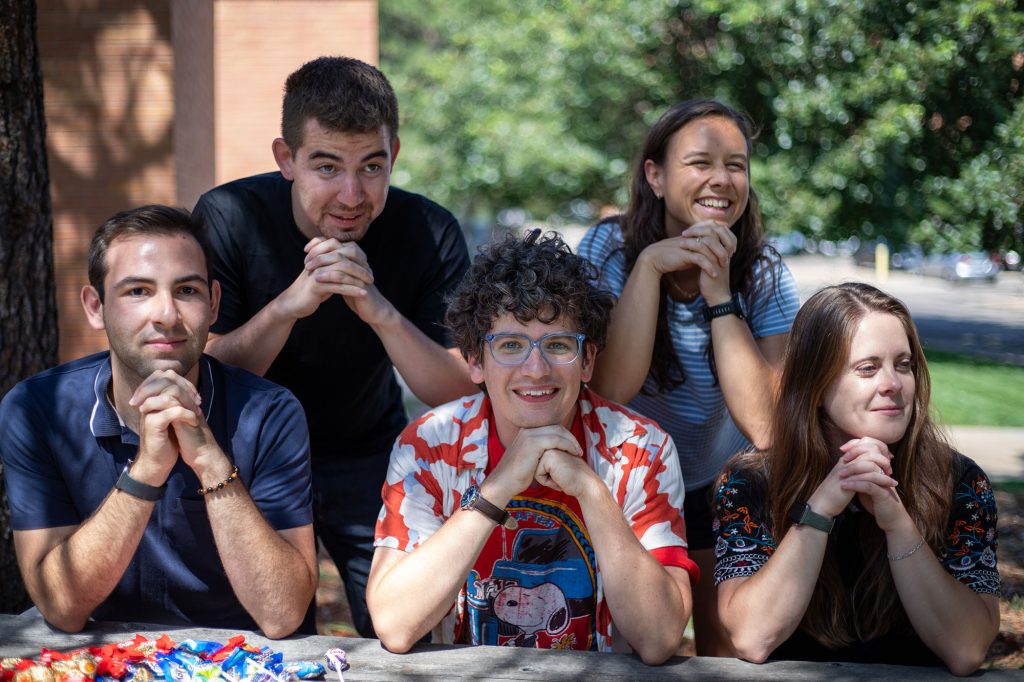
Image above: Grotzinger and lab members of the P-Badger Lab, University of Colorado Boulder.
Andrew Grotzinger is an assistant professor in the Department of Psychology and Neuroscience and principal investigator at P-Badger Lab at the University of Colorado Boulder, where he works to better understand genetic overlap in psychiatric and neurodegenerative disorders. The Observer’s Lou Willwood asked the 2026 Janet Taylor Spence Award recipient a few questions about getting started during the “genomics revolution,” the future of psychiatric genetics research, and the importance of continuing to ask questions.
Learn more about Grotzinger and the five other Spence Award recipients.
Your research aims to understand the genetic signal for psychiatric and neurodegenerative conditions. What led to your scientific interest in this subject?
As I think it can be for so many in academia, the road to my current interests is a winding one. After graduating with my bachelor’s in psychology, I worked in an eating disorders lab as a research coordinator where I worked on studies that included measures of hormone levels and brain imaging. This sparked a more general interest in understanding the biological correlates of mental health. From there, I applied to work largely in other eating disorders labs, in addition to one genetics lab at the University of Texas at Austin where I ended up going for my clinical psychology PhD. When I joined the lab in 2015, it was largely focused on applying the classical twin design, which uses different levels of familial relatedness to estimate genetic and environmental contributions to child and adolescent psychiatric and cognitive outcomes. This was a particularly exciting time to be entering the genetics field as a graduate student as it was arguably at, or near, the inflection point for the genomics revolution, where directly measuring our DNA was rapidly dropping in cost.

As a result of this, the lab started collecting saliva samples to also genotype (measure the DNA) the twins coming into the lab. As other labs began collecting their own DNA, two things started to become clear in the genetics research field. First, human traits are genetically complex, with each trait associated with thousands of genetic variants with tiny effects. Second, many of these genetic variants affect multiple traits. As a result of this genetic complexity and overlap, my current research interests began to fully crystalize into developing and applying methods to understand and characterize the emergent genetic signal across psychiatric and neurodegenerative outcomes.
What are some highlights of your research? What has it shown?
One of the most exciting aspects of my research program has been applying developed methods to model genetic overlap across psychiatric disorders. Through my clinical training I had an opportunity to see first-hand that psychiatric disorders often present together. That is, most individuals will meet diagnostic criteria for multiple disorders in their lifetime. To be able to then look at the emergent signal from our DNA and find that the majority of the genetic signal is shared across disorders reflected an exciting opportunity to begin to understand what I was seeing in the clinic.
It also added new insight in that DNA can act as a statistical bridge across independent participant samples. This has allowed for estimating the genetic correlation between conditions like bipolar disorder and schizophrenia. These are diagnostically exclusionary of one another, so their comorbidity rate is by definition 0—but we now know that these are two of the most genetically correlated psychiatric disorders. Others and I have also incorporated single-cell gene-expression data from brain tissue to identify the specific cell types where this genetic risk sharing is enriched, finding, for example, that the overlapping genetic signal across bipolar disorder and schizophrenia is largely concentrated in excitatory neurons.
What new or expanded research are you planning to pursue?
I see my research program and the field of psychiatric genetics progressing along two main future avenues. Most importantly, this includes increasing the global representation reflected in our genetics participant samples. Regrettably, and as with many areas of psychological research, participants in current genetic studies predominantly reflect individuals of European-like genetic ancestry. This gap in representation is starting to diminish thanks to ongoing global efforts, but researchers, funders, and publishers need to continue to prioritize increasing diversity in participant samples to ensure this gap is closed as quickly as possible.
An additional area for growth reflects adding more nuance to the traits analyzed in our genomic studies. Genomic studies require thousands, ideally hundreds of thousands, of research participants to be well-powered for statistical analysis. To obtain these sample sizes, psychiatric geneticists were initially restricted to analyzing the differences in DNA between individuals who do and do not have a disorder (e.g., depression). Yet, clinicians and researchers alike understand that the same psychiatric disorder can have vastly different presentations across individuals. For depression, it could onset in childhood or very late in life, may be characterized by gaining or losing weight, or by sleeping too much or too little. It stands to reason that divergences in clinical presentations within a disorder may be reflected in differing associations with our genetic code.
In 2026, we are now at a point where genetic sample sizes are so large that we can start to stratify participant samples on the basis of different clinical characteristics to statistically evaluate these research questions. I believe this reflects one of the most promising routes toward precision medicine, where we aren’t just understanding the genetic signal for the disorders in our diagnostic manuals, but are now going a step further to understand what clinical presentations may be tagging a different biology, and potentially requiring a different intervention.
What is the biggest challenge you have encountered in your career so far?
I think one of the toughest things for many researchers early in their career is learning their limits. For most of us, we enter this job from a place of passion and intellectual curiosity, and so the idea of saying no to an opportunity, collaboration, or project can feel like closing an unnecessary door. At some point, I found myself involved in so many different projects that an inverse association began to take shape between the number of commitments I had and my level of excitement for each project. The challenge was taking a step back and being realistic about what I could commit to going forward so that I could maintain the enjoyment I had for what had previously never felt like a “job” in the true sense of the word.
What practical advice would you offer to student researchers who want to be in your position someday?
This is ideally meant to be a lifelong career and so treat it as such. This is a marathon not a sprint, so be sure to take time to take care of yourself and develop interests outside of academia. This not only helps prevent burnout, but it makes you a better researcher (more human error tends to happen when analyses are done through bloodshot, sleepless eyes!).
I would also advise researchers at any career stage (undergraduate, graduate, postdoc, and beyond) to be comfortable with not having all the answers and, correspondingly, to keep asking questions. I think concerns around impression management can quickly get in our way and thereby stymy our intellectual curiosity and ongoing growth. Even within our very specific subfields, there are hundreds of research articles being published every year (at least!) and new methods coming out.In the modern era, research is constantly moving at an exciting pace. With that said, you are never going to be able to keep up with it all by yourself, so lean on the smart colleagues around you who may have had time to do a deeper dive into that one research article you didn’t have time to read.
Feedback on this article? Email [email protected] or login to comment.



APS regularly opens certain online articles for discussion on our website. Effective February 2021, you must be a logged-in APS member to post comments. By posting a comment, you agree to our Community Guidelines and the display of your profile information, including your name and affiliation. Any opinions, findings, conclusions, or recommendations present in article comments are those of the writers and do not necessarily reflect the views of APS or the article’s author. For more information, please see our Community Guidelines.
Please login with your APS account to comment.