
Chatbots Are Like Potato Chips: Understanding Loneliness in the Digital Age
We are talking to each other in person less and to chatbots more. Are these changes in our social interactions contributing to the current loneliness epidemic?
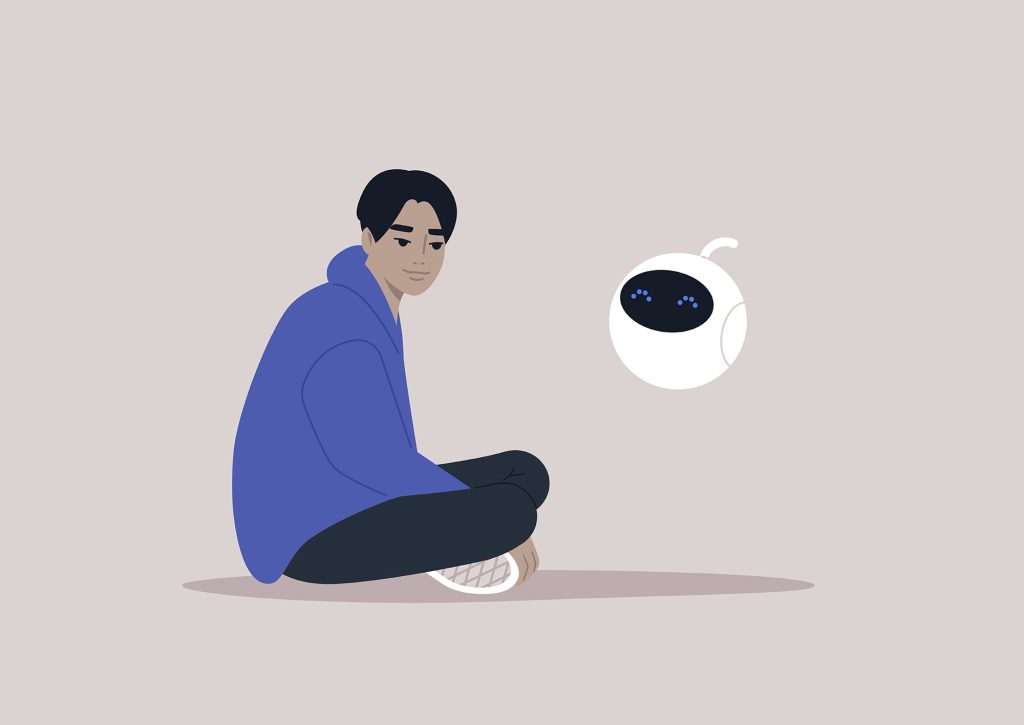
Speaking less • Lonelier with chatbots • New frameworks for the new era • People, not potato chips
Quick Take
- The long-term effects on mental health are unclear as we turn to chatbots and other forms of AI for social interaction.
- People are speaking less to each other offline, at a rate of 300 fewer daily words each year, and many people turn to chatbots to ease loneliness.
- Because more social interactions have moved online, methods to study and identify psychological phenomenon, like social anhedonia, need to be updated to include online interactions with both humans and AI.
Even as smartphones and digital devices change so much of how we do things—ordering food through an app, attending remote meetings over Zoom, avoiding boredom with the constant companion in our pocket—the wide-ranging effects of how they have changed our interactions sometimes seem unbelievable.
When Valeria Pfeifer, an assistant professor at the University of Missouri-Kansas City, calculated how many words people spoke in a day, the number was so drastically different from 15 years before, she assumed she had made a mistake. But when she dug into the data, she realized the finding was accurate.
In 2023, the U.S. Surgeon General warned that we are currently experiencing a loneliness epidemic, where a loss of connection to others is leading to poor health outcomes. People are talking to real humans less and less, and relying on chatbots for companionship may only increase loneliness.
In this new landscape, evaluating and researching social interactions and conditions like social anhedonia—a lack of pleasure and reward from social contact and reduced motivation to engage socially—requires accounting for the differences between online and offline interactions, as well as the differences between online interactions with humans and with artificial intelligence. In the current loneliness epidemic, psychological scientists are trying to make sense of how our social lives have changed, what the consequences are, and what should be done about it.
“Everybody has felt this in their daily lives. Things have changed a little bit, but it’s [been] really difficult to pinpoint it,” said Pfeifer.
Speaking less
Pfeifer was analyzing data on gender differences in talkativeness, part of an effort to replicate an earlier study with a much larger sample. But when she ran the stats and got an estimate of how many words people spoke on average each day, it was much lower than the estimate from the original 2007 study. Thinking she made a mistake, she reran everything but ended up with the same number.

“Well, that’s a testable hypothesis,” she recalled thinking. “We ended up running a model that used that data to estimate whether or not we’ve lost words over time.”
The data came from 22 studies that included over 2,000 participants aged 10 to 94 who carried around an electronically activated recorder to randomly capture short intervals of audio samples. When Pfeifer reanalyzed the data, she found that each year from 2005–2019, people spoke an average of 338 fewer words per day. The results were published in a 2026 Perspectives on Psychological Science paper.
“We were really kind of surprised by it, because if you look at the number—338 spoken words per day—that doesn’t seem like a lot,” said Pfeifer. But “it adds up every single year. And so, we’ve lost 28% of our spoken conversations. That’s a lot to be losing. That’s basically a third down from what we’ve had.”
Adding those words up over the course of a year means people speak 120,000 fewer words each year. Pfeifer speculated that technology is driving a lot of the change. A proportion of those lost words are being typed instead, as phone calls are replaced by text messages and work conversations have moved to messaging apps instead of being face to face. This study was conducted prepandemic, and COVID-related changes to work settings may have escalated this loss even more.
This may affect both social connections and psychological well-being.
“We think the typed conversations are not qualitatively or quantitatively the same as the spoken conversations,” Pfeifer said. “There is this sort of emotional psychological well-being aspect to it. You build trust and rapport and so on when you have face-to-face conversations, and that doesn’t happen to the same degree in typed conversations.”
With spoken conversations, you have more channels of communication, such as the tone of voice, gestures, facial expressions, and the surrounding environment. Spoken conversations also require more continuous involvement and attention: You can’t just step away or forget what the person said and then look it up in the chat history. As a result, digital conversations aren’t as good for building social relationships and trust and don’t deliver the positive emotions we associate with face-to-face interactions, said Pfeifer.
“We may be contributing to a broader mental health crisis where maybe by not having these face-to-face interactions, we’re losing connection with others,” she said. “Having more conversations is linked to higher psychological well-being, so having fewer conversations very likely implicates having lower psychological well-being, which could relate to the loneliness epidemic that we’re currently facing.”
Conversations with chatbots take it one step further. In face-to-face conversations with people, there is vulnerability and the risk of saying something the other person may not like. With chatbots, there are all the flaws of typed conversations plus the agreeable and affirmative nature chatbots often take, which reduces vulnerability and risk.
“It’s optimized to create some positive social engagement, but at the same time, it’s not the real social engagement that you have in a spoken conversation,” said Pfeifer.
Lonelier with chatbots
Elizabeth Dunn, a psychology professor at the University of British Columbia, and her graduate student Dunnigan Folk, now a postdoctoral researcher at the University of Pennsylvania, looked into the effects of these chatbot conversations for a 2026 paper in Psychological Science. They surveyed 2,000 adults from the United States, the United Kingdom, Canada, and Australia on their chatbot use and feelings of loneliness four times over the course of a year. The exploratory study examined people’s natural chatbot use and found that increasing chatbot use even in small amounts made a difference on measures of loneliness.

“When people become lonelier, they seem to be more inclined to turn to AI for companionship. That piece of it is very intuitive to folks,” said Dunn. “What is more surprising and important is that turning to AI for companionship appears that it can, in turn, potentially exacerbate feelings of loneliness.”
Folk and Dunn examined two different domains of loneliness: emotional isolation and social connection. They found that chatbot use affected these two domains differently depending on how stable each tends to be. Feeling emotionally isolated predicted increases in social chatbot use, and increased chatbot use led to increased emotional isolation four months later. By contrast, social connection is a more stable trait. While feeling less socially connected predicted increases in social chatbot use, chatbot use did not predict significant decreases in social connection, suggesting that more deeply rooted aspects of loneliness are harder to shift in either direction.
More content by Dunn: Communicating Psychological Science: Why You Should Write an Op-Ed—and How to Start
“We wouldn’t necessarily expect it to reshape our whole self-image. We would expect the changes to be relatively subtle,” said Dunn. “Where we see the effect of this… technology use showing up is more in terms of people’s feelings of emotional isolation than on their more stable self-image.”
An important aspect of the study was that it captured the longer-term consequences of chatbot use. Other studies, including some of Dunn’s own, have found that people experience social connection, rapport, and positive feelings immediately following an interaction with a chatbot, findings that may seem to conflict with these results (Folk, Yu, and Dunn, 2024).
“Just because chatbots make you feel good in the moment, which is the easy, low-hanging fruit, the easy thing to test, doesn’t mean that they’re great over the long term,” said Dunn.
In a different 2026 paper, Dunn found that chatbots do have a benefit: They can help lower barriers to having difficult conversations with real humans (Maheshka, 2026). Participants were asked to think about a tough conversation they needed to have with someone. Half the participants prepared for this conversation using AI while the other half had an irrelevant interaction with AI. People who practiced the conversation with AI were more likely to go on to actually have the conversation in real life. Additionally, the often overly positive and supportive nature of chatbots did not affect the participants’ ratings of the real-life conversations, even if they played out differently.
“What seems to be really helpful is just getting people ready to figure out how they’re going to start the conversation,” said Dunn.
For severely lonely people, it remains unknown whether chatbots are helpful. These at-risk populations may be more vulnerable to increased social isolation because of chatbots.
“This is really an urgent question, especially as it’s so appealing to tech companies, for example, to start rolling out these products with the best of intentions that may genuinely be helpful for people, but could also be harmful,” said Dunn. “We just desperately need this research to figure it out.”
In another study, Dunn found that when university students were randomly assigned to either interact with a supportive chatbot or interact with a random student or to write in a journal, loneliness decreased most when interacting with another student (Li, 2026). Interacting with the chatbot was no better than journaling.
“I think of chatbots as being like potato chips. If you’re starving and what you have available is some chips, eat them,” said Dunn. “Similarly, if you’re really deprived of companionship and you feel like you need some support, I don’t think it’s a terrible idea to turn to chatbots, but again, thinking of them as potato chips, not letting them replace better forms of social nourishment.”
New frameworks for the new era
Because of the new ways people interact, both online and with chatbots, methods to study and diagnose psychological phenomenon related to socializing need to be amended to include online interactions. In a 2026 article in Current Directions in Psychological Science, Raymond Chan (Chinese Academy of Sciences) and his coauthors argue that social anhedonia needs to be reconceptualized for this new era.
“The digital era might have fundamentally reshaped the landscape of social interaction in humankind, which primarily encompasses two forms of online engagement—online human-to-human communication and human-to-artificial intelligence interaction,” the authors wrote.
Some people who have a lack of interest in face-to-face socializing may have no problem interacting with other humans online. Others may shun in-person social gatherings but willingly engage with AI agents. This leads to new questions about social anhedonia in the digital era: Can it be extended to include a lack of pleasure from online interactions? Do the underlying mechanisms differ across in-person, online, and AI interactions? What are the implications for people with offline social anhedonia who enjoy interacting online?
To begin to address these questions, the authors created a new framework that includes both online and offline interactions. The framework defines social anhedonia as the avoidance of engagement in online interactions with humans or face-to-face social interactions, affecting both decontextualized (such as reacting to smiles) and contextualized (such as real-life social scenarios) situations.
“This framework should be able to address the important issues of online-versus-offline differentiation and contextuality in social reward processing, as well as to embrace the drastic changes in social encounters in the contemporary digital era,” they wrote.
Assessments also need to be updated.
“One of the key limitations of current assessment instruments lies in the disproportionate focus on offline social scenarios, with minimal coverage of online social pleasure experiences,” the authors wrote.
Virtual reality may be a way to both better assess social anhedonia and treat it. Virtual reality technology can simulate both online and offline interactions to help identify social anhedonia and the altered processes underlying it. It can also be customized to the individual’s type of social anhedonia. For example, people who struggle with offline interactions but are comfortable online could be gradually exposed to AI-augmented virtual reality programs that help promote pleasure from in-person social interaction and increase motivation for engaging socially.
People, not potato chips
Pfeifer is hopeful that putting a number to the words lost can help increase everyone’s motivation to engage more socially and take steps to talk a bit more with neighbors, colleagues, and even strangers.
“It’s in our hands to have 338 words a day more that we speak, maybe [by] having one more conversation or maybe extending a conversation that we’re already having,” she said.
Dunn also hopes that her work is a warning about relying too much on chatbots to fend off loneliness.
“We need to be thoughtful about adopting chatbots as our companions,” she said. “Potato chips are very tasty. I like eating potato chips. It’s the longer-term consequences where we might worry.”
Feedback on this article? Email [email protected] or login to comment.
References
Chan, R., Wang, L., Wang, Y., & Lui, S.S.Y. (2026). Revisiting social anhedonia: Beyond monolithic assessment and interventions. Current Directions in Psychological Science.
Folk, D., & Dunn, E. (2026). How does turning to AI for companionship predict loneliness and vice versa? Psychological Science, 37(4), 276–286.
Folk, D., Yu, S., & Dunn, E.W. (2024). Can chatbots ever provide more social connection than humans? Collabra: Psychology, 10(1), 1-17.
Li, R., Folk, D., Singh, A., Ungar, L., & Dunn, E. (2026). Is a random human peer better than a highly supportive chatbot in reducing loneliness over time? Journal of Experimental Social Psychology, 125, Article 104911.
Maheshka, C., Folk, D., & Dunn, E. (2026). Harnessing artificial intelligence to facilitate difficult conversations. Social Psychological and Personality Science, 0(0).
Pfeifer, V. A., & Mehl, M. R. (2026). Sliding into silence? We are speaking 300 daily words fewer every year. Perspectives on Psychological Science, 0(0).



APS regularly opens certain online articles for discussion on our website. Effective February 2021, you must be a logged-in APS member to post comments. By posting a comment, you agree to our Community Guidelines and the display of your profile information, including your name and affiliation. Any opinions, findings, conclusions, or recommendations present in article comments are those of the writers and do not necessarily reflect the views of APS or the article’s author. For more information, please see our Community Guidelines.
Please login with your APS account to comment.