
APS Teaching Fund Supports Projects on Training, Memory, and New Therapy Approaches
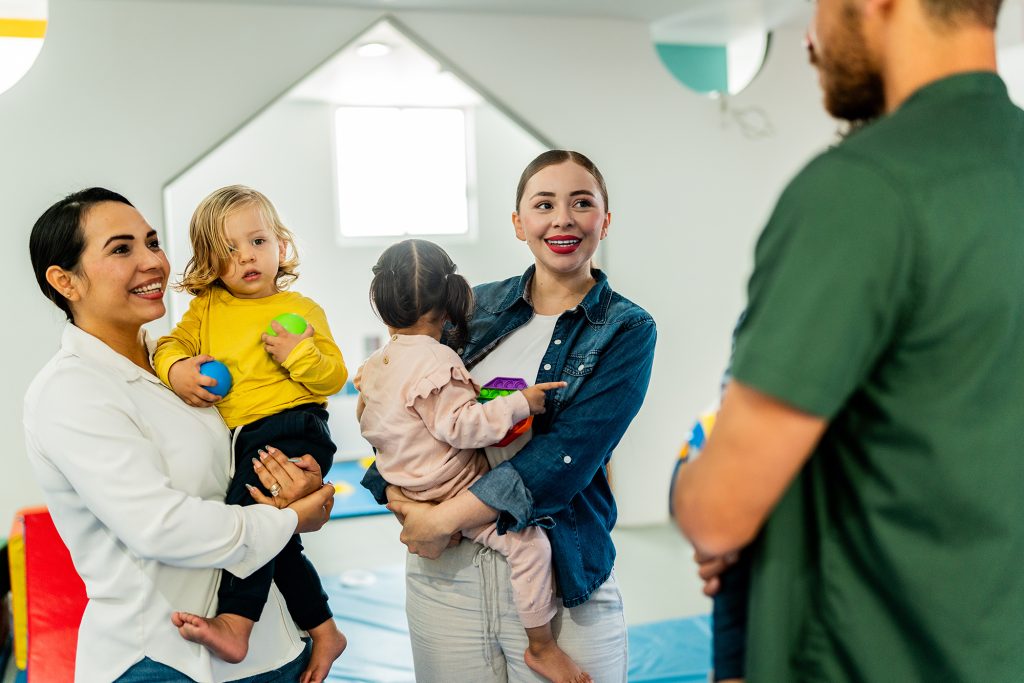
Three psychology professors will receive funds to support new projects in fall 2026. Projects will teach the science of memory, train undergraduates to deliver clinical interventions, and present a reflective model for viewing therapeutic processes with young people.
The APS Fund for Teaching and Public Understanding of Psychological Science was established with the support of the David and Carol Myers Foundation to enhance the teaching and public understanding of psychological science for students and the public in the United States, Canada, and worldwide.
The fund enables APS to offer grants that advance the teaching and public understanding of psychological science and supports the APS David Myers Distinguished Lecture on the Science and Craft of Teaching Psychological Science presented at each APS Annual Convention.
The fund is currently accepting applications for new projects. Applications are due March 1 and October 1 each year. For more information, visit the webpage.
The latest funded projects are described below.
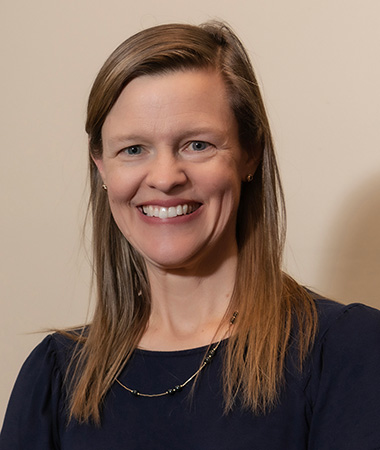
Elizabeth Kensinger
Boston College
Project Title: Webinar Modules for Teaching the Psychological Science of Memory in Senegal
Grant Amount: $5,000
Project Description: This project aims to expand access to psychological science in Senegal and across Francophone West Africa by developing a culturally responsive, open-access series of six teaching modules on the psychological science of memory. Modules will cover research design fundamentals, the episodic memory cycle, emotional influences on memory, collaborative and communal remembering, and cognitive aging across cultural contexts. Each session will include downloadable slides, classroom-ready activities, mini-demonstrations, post-session knowledge assessments, and instructor guides. The first session will launch with a live, cohosted kickoff event with colleagues at Université Cheikh Anta Diop in Dakar, Senegal, including an interactive discussion and Q&A. An online forum will facilitate continued dialogue and exchange.
Psychological science remains heavily concentrated in Western, Educated, Industrialized, Rich, and Democratic (WEIRD) contexts, limiting representation and engagement from African institutions. A critical barrier is the scarcity of contemporary, culturally contextualized materials available in French. This project addresses that gap. Pedagogically, the modules follow a scaffolded design that builds foundational methodological literacy before advancing to applied topics. Content explicitly addresses issues of replication, ethics, and the global critique of WEIRD sampling, encouraging students to consider how local cultural questions can shape research design.
The target audience includes undergraduate students, advanced secondary students, and instructors in Senegal and other Francophone African institutions. Measurable outcomes will include gains in research-method knowledge, increased confidence in engaging with psychological science, and instructor reported classroom integration. By providing sustainable, open-access, culturally grounded materials, this project aims to strengthen research literacy, stimulate scientific curiosity, and lay the groundwork for future international research collaborations, addressing key goals of APS.

Mark Terjesen
St. John’s University
Project Title: Training Undergraduates to Develop Competency in Delivering Evidence-Based Parent Training Interventions
Grant Amount: $4,250
Project Description: Behavioral parent training is a highly effective, evidence-based intervention for reducing children’s disruptive behaviors and strengthening family functioning. Despite its efficacy, widespread implementation is hindered by a critical shortage of trained clinicians. Traditional training methods, such as workshops and manual reading, produce minimal improvements in therapist competence and treatment fidelity. Deliberate practice, which emphasizes targeted skill development through repetition and immediate expert feedback, offers a promising alternative but remains underutilized in parent training contexts.
This project aims to develop and evaluate ParentTrainer, a comprehensive four-week training program that combines didactic instruction with simulated AI parent-clients and expert feedback to enhance undergraduate competencies in delivering evidence-based parent training interventions. The program addresses a critical gap in clinical training by providing accessible, scalable, and standardized practice opportunities that traditional apprenticeship models cannot offer.
Using a three-phase mixed-methods design, this study will: (1) develop ParentTrainer materials through expert consultation and user feedback; (2) evaluate system usability, acceptability, and feasibility with 30 mental health professionals across various training levels; and (3) conduct a randomized controlled pilot study with 60 undergraduate trainees comparing ParentTrainer-enhanced training to standard didactic training. Primary outcomes include trainee self-efficacy, knowledge of parent training principles, and observed competence in standardized role-play assessments.
This research has significant potential to transform clinical training by demonstrating the feasibility and effectiveness of technology-enhanced deliberate practice for developing complex therapeutic competencies. Success could catalyze similar developments across therapeutic modalities, ultimately improving workforce capacity and access to evidence based mental health services, particularly for underserved communities.

Peejay Bengwasan
De La Salle University
Project Title: Through Child-Like Lenses: A Reflective, Experiential Model for Teaching Youth Psychological Interventions
Grant Amount: $5,000
Project Description:
Through Child-Like Lenses is an ongoing educational initiative at De La Salle University in Manila, Philippines, that aims to advance the training of future psychologists through a reflective and experiential model of teaching youth psychological interventions. Grounded in the principles of play therapy and developmental psychology, the project integrates experiential learning, clinical supervision, and reflective practice to help master’s and doctoral students develop the competencies needed to work effectively with children, adolescents, and their families.
A central feature of the initiative is a flexible, mobile play therapy laboratory that transforms existing university spaces into therapeutic environments. Rather than relying on a permanent playroom, therapeutic toys and materials can be transported and adapted to different training settings, allowing students to experience how meaningful therapeutic spaces can be intentionally created based on client needs and available resources. This approach encourages creativity, adaptability, and thoughtful use of the therapeutic environment.
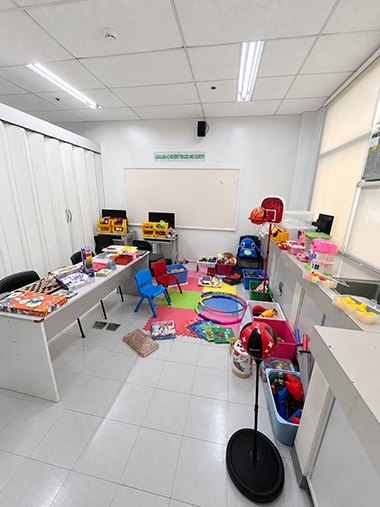
Students engage in structured role-plays, simulated and supervised clinical sessions, reflective discussions, and case conceptualization exercises that strengthen therapeutic alliance building, intervention planning, and ethical decision making. The model also emphasizes collaboration with parents and caregivers, recognizing their critical role in supporting children’s emotional and psychological development beyond the therapy room. Through continuous supervision and guided reflection, trainees learn to integrate evidence-based practices with culturally responsive care.
By encouraging students to view the therapeutic process through child-like lenses, marked by curiosity, empathy, creativity, and playfulness, this project seeks to cultivate reflective practitioners who are equipped to deliver developmentally appropriate, relationship-centered psychological interventions while contributing to the growth of play therapy education and youth mental health services in the Philippines.
Feedback on this article? Email [email protected] or login to comment.

 <
<

APS regularly opens certain online articles for discussion on our website. Effective February 2021, you must be a logged-in APS member to post comments. By posting a comment, you agree to our Community Guidelines and the display of your profile information, including your name and affiliation. Any opinions, findings, conclusions, or recommendations present in article comments are those of the writers and do not necessarily reflect the views of APS or the article’s author. For more information, please see our Community Guidelines.
Please login with your APS account to comment.