
Member Spotlight: 2026 Spence Awardee William Brady on Blazing Your Own Research Path
William Brady, Edited by Lou Willwood
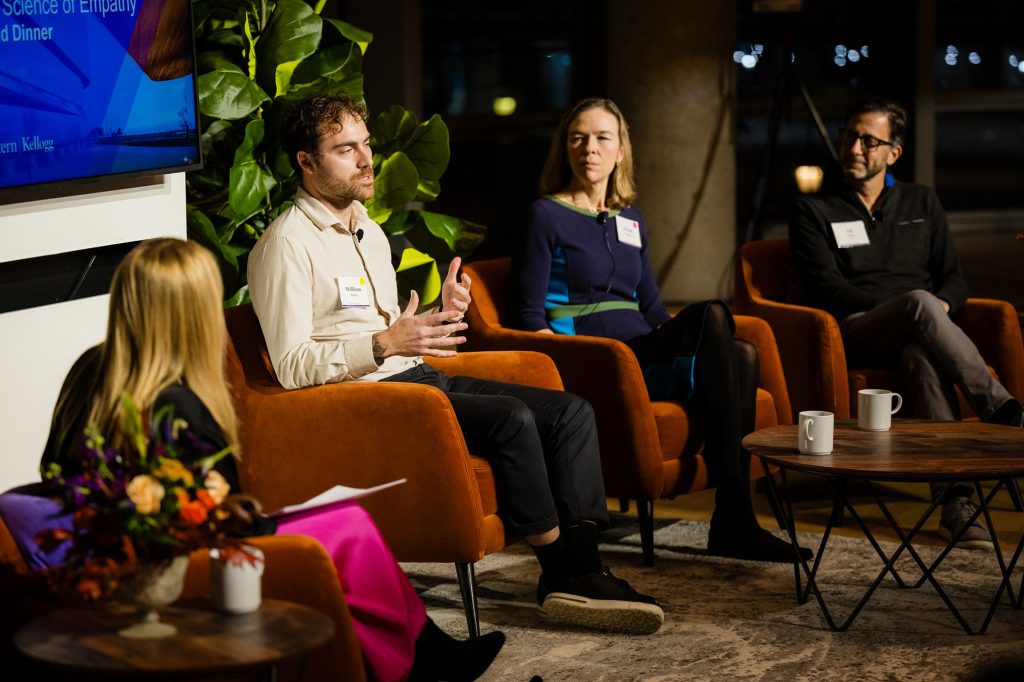
Image above: Brady discussing best practices for using AI with Northwestern Alumni.
William Brady, an assistant professor of management and organizations at Northwestern University, is one of six psychological scientists chosen for APS’s 2026 Janet Taylor Spence Award. The Observer’s Digital Content Manager Lou Willwood asked Brady a few questions about his research on the interactions between human psychology and technology, the highlights of his career, and his practical advice for future researchers.
Learn more about Brady and the five other Spence Award recipients.
Your research focuses on how human psychology interacts with technology-mediated social contexts to shape people’s morality and emotions. What led to your scientific interest in this subject?
I think my scientific interests grew out of a particular time and place in my life. I came of age in North Carolina in the 1990s and early 2000s, in a part of the country where morality was highly visible in everyday life through the rise of evangelical Christianity and its increasing entanglement with politics. Even as a teenager, I found myself trying to make sense of the intensity of people’s moral convictions and the powerful role those convictions played in shaping social and political life.
At the same time, I entered college right as Facebook was first emerging. For me, those early digital platforms were exciting because they expanded our social world. They made it easier to find like-minded people, but they also created new opportunities to engage with people who saw important issues very differently. That combination—strong moral conviction on one hand, and a new technology for large-scale social interaction on the other—left a lasting impression on me.
At the University of North Carolina at Chapel Hill, I was lucky to study both psychology and philosophy in an environment where moral psychology was especially vibrant. People like Jesse Prinz and Joshua Knobe were asking questions that felt deeply philosophical, but they were also approaching them with the tools of behavioral science. That helped me see that morality and politics were not just things to argue about; they were things we could study scientifically.
By the time I got to graduate school, social media platforms were shifting toward algorithmic curation and advertising-based business models. It became increasingly clear to me that these systems were not just reflecting human psychology—they were actively shaping it. That realization pushed me toward the questions that still motivate my work today: how digital environments amplify moral emotions, how they change what people learn from one another, and how those changes affect conflict, cooperation, and collective life.
What are some highlights of your research? What has it shown?
My research has focused on two broad questions. First, how do digital platforms shape moral emotions? Second, how do algorithms and AI shape social learning—our sense of what other people believe, feel, and find acceptable?
In my early work, I showed that moral emotions such as outrage, disgust, and contempt spread especially well through social networks, a phenomenon I called moral contagion. Compared with other kinds of emotional expression, moral-emotional language is more likely to be shared, especially in political networks. But that spread is not neutral. It often happens in highly polarized ways, with people sharing moralized content primarily within their own groups. Over time, this can deepen divisions and make cross-group conversation more difficult.
To explain why this happens, I developed the MAD model—Motivation, Attention, and Design. The idea is that people are motivated to express moral emotions because doing so can signal loyalty to their group; moral-emotional content captures attention in crowded information environments; and platform features such as likes, shares, and identity cues amplify both of those processes. Across experiments and large-scale social media analyses, my work has shown that moral-emotional expression can enhance a person’s standing within their political ingroup, draw disproportionate attention, and become reinforced over time by social feedback systems.
A second major line of my research examines how algorithms shape social learning. I developed a framework called algorithm-mediated social learning, which argues that engagement-based algorithms systematically amplify what I call PRIME information—content that is prestigious, ingroup-relevant, moralized, and emotional. When people are repeatedly exposed to that kind of content, they start to form distorted impressions of what others are like and what is normal in their social world. In experiments, field studies, and large-scale digital trace analyses, I’ve found that these systems can inflate perceptions of outrage, exaggerate social and political extremity, and contribute to polarization and misinformation.
More recently, I’ve been especially excited by intervention work. Rather than only documenting the problems, my lab has started testing ways of designing feeds that are more socially representative and less dominated by extreme users or outrage-heavy content. That work is helping us move from diagnosing how digital systems distort psychology to identifying what healthier digital environments might actually look like.
What new or expanded research are you planning to pursue?
A lot of my earlier work was focused on identifying problems created by algorithms, AI, and digital platforms for political communication and interpersonal conflict. I still think that work is important, but I’m increasingly motivated by a complementary question: how do we build something better?
As mentioned above, one direction I’m especially excited about is designing and testing interventions that make online environments more socially representative. In forthcoming work, we test algorithms that reduce the disproportionate influence of extreme users in political communication online. The broader goal is to create systems that preserve the benefits of large-scale social learning without allowing a small number of highly extreme voices to dominate what everyone else sees.
I’m also interested in how AI might help people navigate disagreement more constructively. One possibility is using AI to support perspective-taking in contexts like content moderation and platform governance. The challenge for democratic platforms is not to eliminate disagreement—disagreement is essential—but to create institutions that allow people to argue across difference while still maintaining shared standards about what kinds of speech are acceptable in public debate. I think AI could play a useful role there, not as a replacement for human judgment, but as a tool that helps structure it more fairly and transparently.
A third direction concerns how reliance on generative AI impacts our psychology. My past research has shown that algorithmic systems can distort norms by overrepresenting certain kinds of people and content. Generative AI may create related but distinct problems. Instead of merely amplifying what is already salient, it can be biased toward reproducing what appears most common or typical, which may distort people’s sense of social reality in new ways. I’m very interested in how these systems affect norm perception, moral learning, and coordination—and in how we might design them to avoid repeating the mistakes social media companies made. This direction follows naturally from my earlier work on moral emotions and social learning, but it opens up a new set of questions about what it means for AI systems to be psychologically and socially aligned.
“To me, that felt like the right way to study the problems I was interested in. But it was not always obvious to others that this counted as psychological science.”
What is the biggest challenge you have encountered in your career so far?
One of the biggest challenges was that the questions I cared about required methods that, at the time, were still somewhat unusual in psychology. When I started doing this work around 2014, computational social science was not established within social psychology compared to today. I was trying to combine large-scale observational data, natural language processing, network analysis, and experiments in order to study moral and political behavior in real-world digital environments. To me, that felt like the right way to study the problems I was interested in. But it was not always obvious to others that this counted as psychological science.
As a graduate student and on the job market, I was often asked some version of the same question: Is this really psychology, or is it just a methodological trend? Those conversations were happening in the broader aftermath of the replication crisis, when many psychologists perhaps were cautious about new methods and observational datasets. So, there was a real challenge in persuading people that computational approaches were not a substitute for psychological theory but actually expanded it.
“… trends come and go, but important questions last.”
In hindsight, I think that challenge ended up being formative. I was very fortunate to have advisors who encouraged me to keep going, and I also found intellectual support outside my home discipline. That pushed me to read more broadly, collaborate more widely, and think more carefully about what psychology can gain from interdisciplinary work. It made me a better scientist. I came away with a strong belief that some of the most important questions in psychology today sit at the boundaries between fields, and that the best work often comes from learning how to bridge those boundaries without losing theoretical rigor.
What practical advice would you offer to student researchers who want to be in your position someday?
Recently a lot of students have been asking me: In a field where methods are changing so quickly, especially with AI and computational tools, what should I focus on developing? My answer is usually that trends come and go, but important questions last.
The most useful thing you can do is identify a problem you genuinely care about and then commit to doing the best version of that work you can. It is easy to feel pulled toward whatever seems hottest in the moment, but in the long run, what tends to matter most is the quality, clarity, and importance of the work itself.
I also tell students not to confuse methodological novelty with scientific contribution. Learning new tools is valuable, and students today absolutely should become conversant with computational methods and AI. But methods are ultimately in service of questions. The strongest researchers I know are the ones who can combine technical flexibility with a clear sense of what they are trying to understand.
Finally, don’t be afraid to learn from people outside your immediate area. A lot of what helped me early on came from conversations with generous scholars in other disciplines. For example, some of my earliest exposure to collecting and analyzing social media data came from political scientists at New York University, because very few psychologists were doing that kind of work at the time. Science is challenging for various reasons, but one of the best parts of it is that people are often willing to help if you reach out with curiosity and seriousness. Build a network of people who expand how you think, and keep returning to the questions that matter most to you.
Feedback on this article? Email [email protected] or login to comment.



APS regularly opens certain online articles for discussion on our website. Effective February 2021, you must be a logged-in APS member to post comments. By posting a comment, you agree to our Community Guidelines and the display of your profile information, including your name and affiliation. Any opinions, findings, conclusions, or recommendations present in article comments are those of the writers and do not necessarily reflect the views of APS or the article’s author. For more information, please see our Community Guidelines.
Please login with your APS account to comment.