
Representation and Relevance: Diverse Scholars in Psychology


Editor’s Note: In this special edition of the Student Notebook, we invited early-career scholars from across the APSSC community to share their experiences navigating psychological science as diverse scholars and to reflect on their hopes for a more inclusive and equitable future for our field.
If you would like to contribute to Student Notebook, please email [email protected].
—Tiffany Shao, Claremont Graduate University
Kierra Peterson

Kierra Peterson is a fourth-year doctoral student studying School Psychology at Illinois State University. Before entering her program, Peterson secured two master’s degrees from Clayton State University—in Clinical/Counseling Psychology and Strategic Leadership Development. Her research interests include microaggressions, culturally relevant interventions, dehumanization of Black women, phone-based coping for Black students, and the #BlackInTheIvory movement. In addition to her academic success, Peterson is currently the President of APA’s Division 16 Student Affiliates in School Psychology representing graduate students across the nation; the Doctoral Student Representative for the Department of Psychology’s chair search; and the Doctoral Student Representative for the School Psychology Coordinating Committee.
Why do you think it is important to address DEI in psychological science?
Historically, psychological science has been a predominantly white-centered field. Much of the psychological research of the past was conducted with white participants—and by white researchers. This has provided a skewed view of the realities that we walk through life asserting. When diversity is embedded into psychological science, people can continuously uncover more nuanced perspectives that allow people holding marginalized identities to have their lived realities amplified. Diversity should encompass people with disabilities, marginalized racial identities, religions, socioeconomic status, gender identity, location, educational status, etc., including them in access to research opportunities, publications, and resources. Without understanding each person or group’s distinct cultural values, it can be difficult to create culturally relevant interventions and draw conclusions about specific groups. Psychological science is data-driven, and knowing the demographic characteristics that make up the participants in the research is beneficial for uncovering nuances in treatments, disorders, and more, based on a person’s unique identification.
In your experience, what challenges are more commonly faced by members of underrepresented groups currently in psychological science?
I can speak from my personal experience and observations by noting the challenges with acquiring funding for research, especially if not attending a research-heavy (e.g., R1) institution. Funding is essential for getting into programs, conducting research, and attending professional development conferences to present the research. In addition to that, I think finding mentors who share similar identities can be difficult in a field that is dominated by WEIRD (Western, educated, industrialized, rich, and democratic) people. When we fail to have many examples of other people who resemble us in the field of psychological science, it can be discouraging, unmotivating, and can open the door for us to be exposed to microaggressions.
Microaggressions are another common challenge that people face when entering the field of psychological science, and these transgressions can lead to increased stress, anxiety, and negative self-concept for people from marginalized groups. Microaggressions are subtle, often unintentional, comments, or behaviors that communicate derogatory, hostile, or negative messages to individuals based on their membership in a marginalized group. These acts have a lasting impact on both the mental and physical health of those exposed. People in the psychological sciences must take heed to ensure that we are not doing harm to others in the field by engaging in these harmful behaviors.
Related content: Representation and Relevance: Diverse Scholars Share Ideas for a More Equitable Field
What strategies and practices do you suggest should be implemented to address these challenges and advance efforts toward a more equitable field?
To ensure that the field becomes more equitable, it is essential for those in power to advocate for those who hold marginalized identities (i.e., professors must advocate for students, white people must advocate for people who hold marginalized racial identities, etc.). This helps to reduce the bystander effect, where people feel that an issue of injustice is “not their business.” More important than those in power advocating is the need for those who are marginalized to amplify their plight so that our voices, needs, and struggles are heard to the highest extent. It is valuable to share lived experiences of inequities so that they do not go unchecked.
In addition to advocacy, more money needs to be put into recruiting students from underrepresented backgrounds and into funding research from people who hold marginalized identities. More money in recruiting includes scholarships, fellowships, and higher-paying graduate assistantship stipends for those from underrepresented backgrounds, as this will help attract them to the field of psychological science. As for research funding, the people from marginalized backgrounds are the ones who are more likely to center research participants holding marginalized identities, so increasing the funding for underrepresented groups will help the studies that are published to be more equitable—which makes the findings published within psychological sciences more generalizable. When more diversity is embedded within the published research, it advances the field to be more representative of all the members of society.
Sahar Wahidi

Sahar Wahidi (she/her) earned her PhD in Education from George Mason University in spring 2025 and is a first-generation college graduate whose parents immigrated from Afghanistan. Wahidi received her BS in Psychology and her MS in Educational Psychology from Mason. During her time pursuing these degrees, Wahidi worked as a preK–12 learning disabilities tutor, a substitute teacher, and a Site Director/Classroom Leader for Therapeutic Recreation Services. Wahidi is currently a research assistant for both the Educational Psychology Department and Kellar Institute for Human disAbilities (KIHd) at Mason. Her research focuses on educators’ self-efficacy as self-regulated learners, promoting the idea that to best support our learners we must first begin by empowering our teachers.
Why do you think it is important to address DEI in psychological science?
Perspective. We all come from different walks of life, and we all bring our own unique knowledge of the world based on our perspectives. By disregarding equity, diversity, and inclusion we intentionally disregard the knowledge that these perspectives bring. Psychological science is meant to dig deep into human behavior and build that understanding using empirical evidence—addressing DEI allows us as a scientific community to explore the nuances of human behavior as it relates to sex, gender, disability status, race, ethnicity, age, and so much more that intersects into our identity as human beings.
In your experience, what challenges are more commonly faced by members of underrepresented groups in psychological science?
Underrepresentation is a social construct that is perpetuated by the political structures that have historically been placed to keep certain groups from equal representation. That being said, the challenges and barriers that exist today are complex and many times go beyond a single study or single paper. From a research perspective, quite often I experience members of underrepresented groups being portrayed from a deficit-based approach with their challenges being displayed on a pedestal by the dominant group as a means to show their inclusivity and tolerance, highlighting a savior complex. As a scientific community we often forget that members of these groups are more than just participants in our studies—they are human beings who should be acknowledged for more than the “category” they are placed in (a category that is prescribed by the dominant groups).
What strategies and practices do you suggest should be implemented to address these challenges and advance efforts toward a more equitable field?
As a community of scholars and institutions, we can and should continue to have transparent discussions on DEI, what that means and looks like in practice, whilst continuously working toward practicing what we preach. As scholars, we can choose to honor diverse perspectives from a strengths-based approach, humanizing those who are willing to share their experiences for the sake of scientific advancement. Finally, as individuals in a position of privilege, we can begin by reflecting on our own biases toward the inequities in our everyday world. To quote Rumi: “Yesterday I was clever, so I wanted to change the world. Today I am wise, so I am changing myself.” By fundamentally changing our mindset in how we perceive the perspective of underrepresented groups, we open the opportunity to celebrate DEI for what it is—a necessary lens that values humanity.
Shiza Shahid
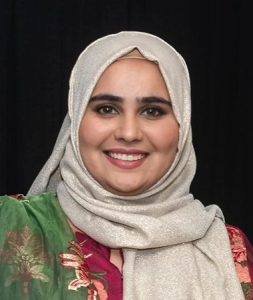
Shiza Shahid recently earned her PhD in Experimental Psychology from the University of Southern Mississippi and will join Texas A&M University–Central Texas as a tenure-track Assistant Professor of Psychology in fall 2025. Her research focuses on the psychological roots of inequality, including social class and gender inequality, with an emphasis on cross-cultural perspectives. She has conducted research in Germany, Japan, Pakistan, India, and the United States. While pursuing her PhD, Shahid secured over $60,000 in internal and external funding to support her research. In her final year, she received several prestigious honors, including induction into her graduate school’s Hall of Fame and the Graduate Student Research Award from the University of Southern Mississippi. She also served as the Communication and Marketing Officer for the APSSC during the 2024–2025 academic year. Shahid is passionate about addressing global inequality through research and collaboration.
Why do you think it is important to address DEI in psychological science?
Equity, diversity, and inclusion are not peripheral concerns in psychological science; they are fundamental to the rigor, relevance, and responsibility of the field. Psychological science aims to understand the human mind and behavior, but to do so authentically, it must reflect the full diversity of human experiences—yet over 90% of psychological research is still conducted in Western cultures, representing only a fraction of the global population.
Addressing DEI means broadening the scope of inquiry, recognizing cultural variation, and questioning assumptions that may go unnoticed in homogenous academic spaces. It also means confronting systemic barriers that have historically excluded scholars from underrepresented backgrounds, not just for the sake of fairness, but because inclusion strengthens science. As a cross-cultural researcher, I have seen firsthand how cultural values shape beliefs about inequality, leadership, gender roles, and social class. If we study these phenomena through only a Western lens, we miss the opportunity to understand how they operate globally and perpetuate the false idea that there is one “universal” psychology. True equity in psychological science requires expanding our methodologies, rethinking whose voices we prioritize, and being intentional about training the next generation of scholars to view DEI not as a side project but as a scientific imperative.
In your experience, what challenges are more commonly faced by members of underrepresented groups currently in psychological science?
In my experience, one common challenge faced by members of underrepresented groups is the pressure to overperform in spaces where their presence is not normalized. Whether due to race, nationality, gender, religion, or socioeconomic background, many scholars navigate environments where implicit bias and microaggressions are frequent but often go unaddressed.
As an Asian woman in psychology, I have experienced the unique challenges of conducting research rooted in non-Western contexts. Such research is often undervalued or misunderstood, creating additional emotional labor as scholars must constantly justify the relevance and validity of their work. I have also witnessed how the lack of systemic support for inclusive research and researcher well-being contributes to higher attrition rates among scholars from underrepresented groups. Many face difficulty navigating the competitive academic environment, particularly in U.S. institutions, where their research may not always be recognized or valued. However, I think these challenges should not be seen as a reflection of the quality of their work. Instead, they highlight the urgent need for a more inclusive academic culture, one that values diverse perspectives, recognizes the importance of cross-cultural research, and provides better support for scholars from underrepresented backgrounds.
What strategies and practices do you suggest should be implemented to address these challenges and advance efforts toward a more equitable field?
I think that to create a more equitable psychological science, we need both structural and cultural changes across training, research, publishing, and professional development. First, institutions and organizations must prioritize funding for research that focuses on underrepresented populations and global perspectives. This could include rethinking review criteria that often disadvantage work done outside traditional frameworks or with non-Western samples.
Mentorship also plays an important role in a person’s life. For scholars from underrepresented backgrounds, having the right kind of mentor can provide vital support. These programs should go beyond just academic advice. They need to create a sense of community, offer cultural validation, and help build resilience. Having mentors who truly understand the unique challenges faced by international students, first-generation scholars, or those working on social justice topics can make a huge difference in how well they thrive and succeed in psychological science.
Student Notebook serves as a forum in which APS Student Caucus members communicate their ideas, suggestions, and experiences. Read other Student Notebook columns here, and learn about the benefits of Student Membership.
Interested in submitting a Student Notebook article of your own? Learn more and indicate your interest by clicking here (logged-in APS members only).
Feedback on this article? Email [email protected] or login to comment.



APS regularly opens certain online articles for discussion on our website. Effective February 2021, you must be a logged-in APS member to post comments. By posting a comment, you agree to our Community Guidelines and the display of your profile information, including your name and affiliation. Any opinions, findings, conclusions, or recommendations present in article comments are those of the writers and do not necessarily reflect the views of APS or the article’s author. For more information, please see our Community Guidelines.
Please login with your APS account to comment.