
Culture is Bound to Shape Motor Development
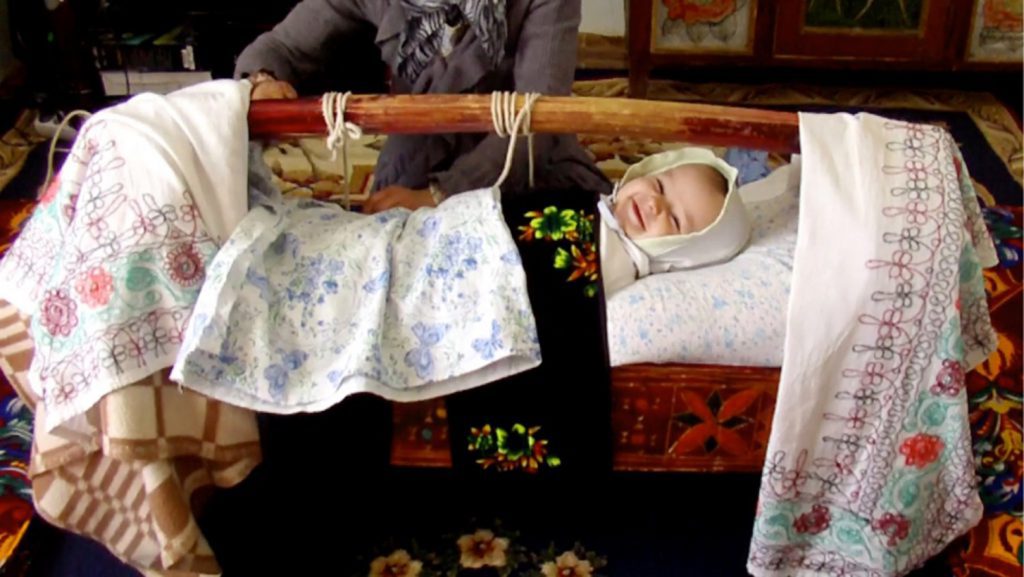
Image above: Figure 1. Tajik baby in gahvora. Photo courtesy of Lara Karasik; photo by Pierre Thiriet, Scott Robinson. Learn more about Karasik’s Lab.
Aimed at integrating cutting-edge psychological science into the classroom, columns about teaching Current Directions in Psychological Science offer advice and how-to guidance about teaching a particular area of research or topic in psychological science that has been the focus of an article in the APS journal Current Directions in Psychological Science.
Imagine you’re expecting a new baby. What items must you have in your home? We might choose diapers, clothes, a bassinet. In a home in Tajikistan (a country that shares borders with Afghanistan, China, Kyrgyzstan, and Uzbekistan), expectant families would select a gahvora (Figure 1). Few Tajik families own high chairs or infant carriers; all own gahvoras.
A gahvora is a wooden cradle. A baby’s arms and legs are straightened and wrapped to the base with wide, soft, fabric panels (Karasik, 2025). Tajik babies don’t wear diapers. Instead, their bottoms are placed over a hole in the mattress. Fussy babies are soothed to sleep with the gahvora’s rockers, and mothers can lean in to breastfeed. Swaddled in their cradles, babies watch the extended family work and play around the family courtyard, spending up to 20 hours per day in their gahvoras, up through age 3 (Karasik et al., 2018).
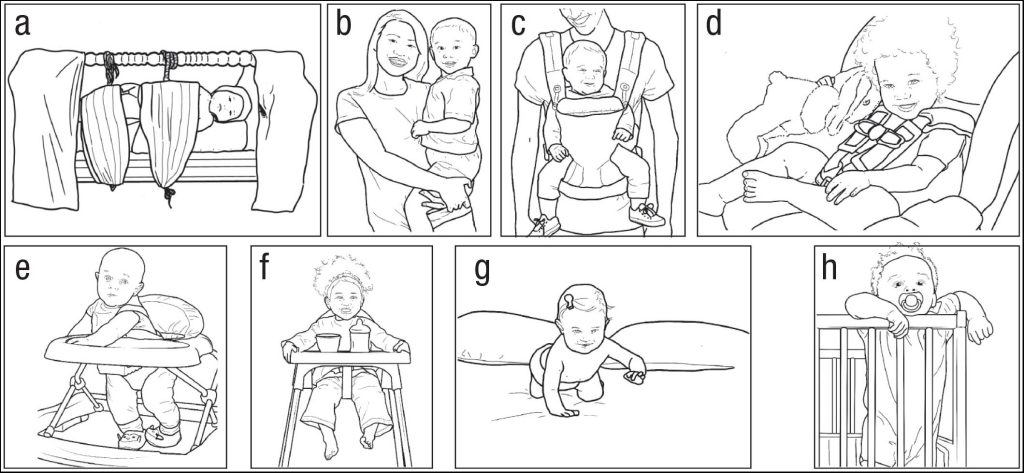
Upon hearing about gahvora cradling, students might respond with astonishment and curiosity. Convert these emotional reactions into teachable moments by building cultural awareness and introducing the concept of developmental cascades.
Before you introduce gahvoras, show the different domains of development (Table 1). As students predict whether culture will influence each domain, they may assume that motor development is the least likely to be influenced by culture. After all, a baby’s body “just grows.” But motor development, unlike simple growth, reflects rich, socially responsive, culturally diverse environments.
| Developmental domain | Example | Rating: How likely is this type of development to be influenced by culture (1 to 10) |
|---|---|---|
| Language | Babbling Turn-taking Saying or signing first word Two-word sentences | |
| Moral | Egocentric rules of morality Black-and-white “rules” for behavior Abstract moral principles | |
| Social | Infant attachment Independent action First friendships | |
| Motor | Sitting alone Standing alone Walking Running | |
| Cognitive | Object permanence Understanding of basic physics (what balls do, what water does) |
Introduce your students to childrearing with gahvoras using photos from Karasik’s lab website. Ask students to reflect:
- What might be the benefits of using a gahvora?
- What do you wonder about the motor development of babies raised in gahvoras?
- How might gahvoras influence domains besides motor development?
After students list their ideas, share specific findings described in Karasik’s Current Directions article.
- Benefits. Just as Western parents may not question using diapers or high chairs, Tajik parents were surprised when asked why their babies used gahvoras. Certain products are simply considered “natural” in one’s own culture.
Nevertheless, Tajik mothers emphasized practical uses, such as better sleep. One study found that babies in gahvoras woke up less often at night than those who were cosleeping (Catalano et al., 2024). Tajik parents claimed that Gahvora-raised babies also stay cleaner and stay safe while they care for other children or do chores.
- Motor milestones. Students may wonder whether babies in Tajik cultures achieve motor milestones at later ages. They intuit that motor development progresses as babies interact with toys, furniture, and other people.
In one study, Tajik 12-month-olds’ daily gahvora time was about the same as the total time U.S. babies were restricted in high chairs, car seats, and carriers. Yet the Tajik babies actually had about 2 hours more unrestricted movement per day on the floor.
Nevertheless, Karasik and her collaborators (2022) found that Tajik babies start to crawl, stand, and walk later than World Health Organization (WHO) milestones. For example, about 50% of 8-month-old Tajik babies could sit on their own, but the WHO standard specifies that 90% of 8-month-olds are able to sit. Within the sample, babies who were cradled more hours tended to be slower at crawling and walking. (Tajik babies had all caught up by age 4.) A complementary study found that most 5-month-olds in Kenya and Cameroon were sitting independently—much earlier than babies from the United States, Italy, Korea, and Argentina (Karasik et al., 2015). One reason? In Kenya and Cameroon, mothers settle babies without any supports, so the babies get more practice.
These studies emphasize that cultural practices shape motor development. They also prompt us to ask—what populations of babies are the WHO standards based on, and to whom can they generalize? Which culture is “normal”? (WHO norms are based on Ghana, India, Norway, Oman, and the United States.)
- Cascades. Through this example, you can introduce developmental cascades: the idea that precocious, delayed, or disordered development in one domain can influence development in other domains (Mastin & Cicchetti, 2010). For example, the onset of sitting, crawling, and walking allows babies to interact more with objects, leading them to learn more about objects’ physical properties (the cognitive domain). Walkers can carry objects to caregivers, starting conversations that facilitate language development. And so on.
Some students might predict that gahvora use postpones when Tajik babies can start exploring and playing with objects. However, in one study, Tajik babies engaged in the same amount of object play as Western babies (Karasik et al., 2025). Thus, one potential developmental cascade appears not to be affected by gahvora use.
We might predict that babies in gahvoras sleep better and stay calmer, cascading as better emotional regulation, which can lead to better social relationships and school success. The research hasn’t explored this question yet. Challenge your students to come up with other potential cascades!
In sum, research on the Tajik use of gahvoras in childrearing reminds us that child development is shaped by cultural context, both short-term and long-term.
Karasik, L. B., Adolph, K. E., Fernandes, S. N., Robinson, S. R., & Tamis-LeMonda, C. S. (2023). Gahvora cradling in Tajikistan: Cultural practices and associations with motor development. Child Development, 94(4), 1049–1067.
Kuchirko, Y. A., Dodojonova, R., & Elison, J. T. (2022). Comparison of U.S. and Tajik infants’ time in containment devices. Infant and Child Development, 31(4), e2340.
Kuchirko, Y. A., & Dodojonova, R. (2025). Object play in Tajikistan: Infants engage with objects despite bounds on play. Infancy, 30(1), e12627.
Developmental cascades [Editorial]. Development and Psychopathology, 22.
WHO Multicentre Growth Reference Study Group (2006). WHO motor development study: Windows of achievement for six gross motor development milestones. Acta Paediatrica, 450, 86–95.



APS regularly opens certain online articles for discussion on our website. Effective February 2021, you must be a logged-in APS member to post comments. By posting a comment, you agree to our Community Guidelines and the display of your profile information, including your name and affiliation. Any opinions, findings, conclusions, or recommendations present in article comments are those of the writers and do not necessarily reflect the views of APS or the article’s author. For more information, please see our Community Guidelines.
Please login with your APS account to comment.