
A Different Image of Problematic Drinking
Aimed at integrating cutting-edge psychological science into the classroom, columns about teaching Current Directions in Psychological Science offer advice and how-to guidance about teaching a particular area of research or topic in psychological science that has been the focus of an article in the APS journal Current Directions in Psychological Science.
Consider, for a moment, a “problem drinker.” What image comes to mind? It may be something along the lines of a distressed individual clutching a bottle of cheap vodka, drinking in solitude to drown their sorrows and mute their feelings of isolation. Prototypes—the mental images we conjure as best representations of a category—help organize our thoughts, sensations, and perceptions (Rosch, 2002). Ask someone to think of a bird and they may quickly come up with the image of a crow (as opposed to a penguin) because the features that make a crow a bird (e.g., feathers, wings) are more evident than they are in a penguin.
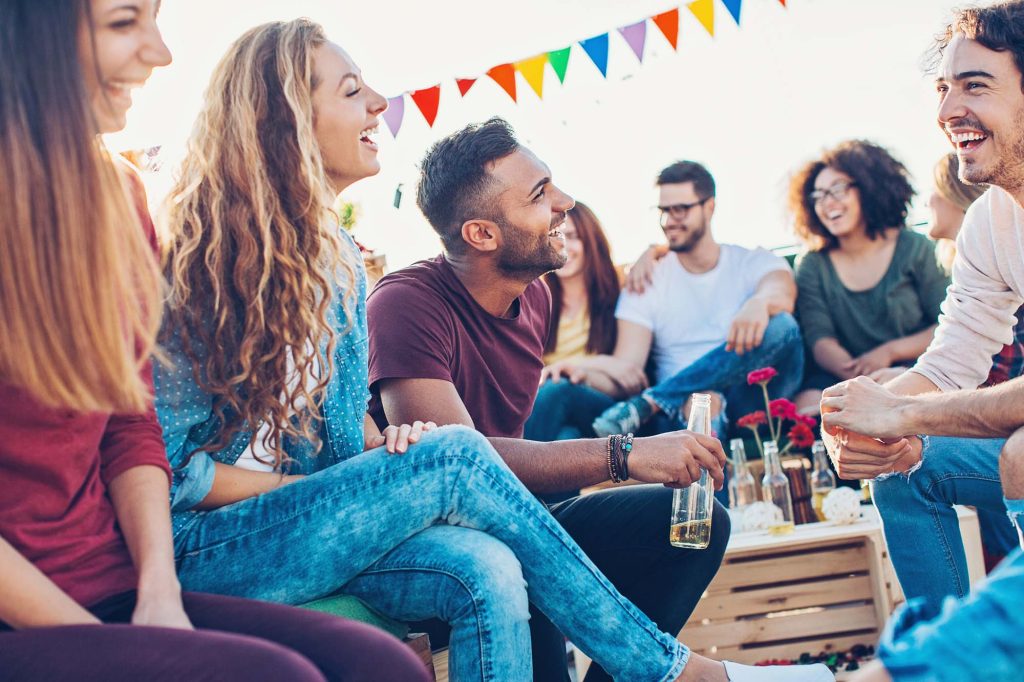
Understanding these categories and recognizing prototypes allows us to make snap judgments as we move through life. We also have prototypes for social categories, such as the problem drinker described above, which influence our judgments. In this example, features such as isolation and loneliness match the category. However, in their Current Directions in Psychological Science article, Fairbairn and Kang present another image of the problem drinker—one surrounded by friends in a festive social setting, seeking to connect and have a good time.
Given that this social image of drinking doesn’t match the prototype of problematic drinking, it is often overlooked in discussions of alcohol use disorder (AUD) risk. Indeed, drinking alone is often used as an indicator of problematic drinking, and the vast majority of scientific studies in this area focus on solitary drinking (Creswell & Fairbairn, 2025). Further, abundant scientific evidence suggests that drinking alone and AUD are associated. The very term “social drinker” is used to refer to nonproblematic drinking (Fairbairn & Sayette, 2014). Although Fairbairn and Kang acknowledge the role of solitary drinking in the development of AUD, they emphasize that focusing on this factor alone paints an incomplete picture, especially because the majority of drinking behavior happens in social settings.
Drinkers drink for a reason, and, most typically, they drink because they like how it makes them feel in the moment. That is, they find drinking rewarding or reinforcing. In their social–cognitive model of alcohol reinforcement, Fairbairn and Kang argue that social settings reliably provide two types of alcohol-related reinforcement. First, drinking impairs cognition and narrows one’s focus to the immediate environment, which is often a pleasurable and fun scene. Second, alcohol enhances mood and social interactions by suppressing high-order cognitions that promote self-focus, distraction, and worry. Taken together, these two factors provide unique social rewards to drinking that can lead to more frequent or more heavy drinking, ultimately increasing one’s risk for AUD. Although there is some evidence to support this link, more research is needed to flesh out the nuances of the relationship.
Drinking in social settings is a common activity for college students. According to a national survey (SAMHSA, 2023), almost 50% of college students reported drinking in the past month and 29% reported binge drinking (five drinks for males and four for females on one occasion) in the past month. In addition, as other recreational drugs are becoming more common (e.g., marijuana, microdosing of psychedelics), research on the influence of social context in substance use is even more relevant in getting a full picture of risk. Having students think about the incomplete picture in the current literature and ways to incorporate the social–cognitive model of alcohol reinforcement can enhance their critical thinking skills around an issue with significant health-related consequences.
This article provides an opportunity for students to think critically about an issue with important health-related consequences. To bring this Current Directions article to life, try one of the following activities.
Activity 1. Discussion prompts
Present students with two contrasting scenarios:
- Scenario A: A person drinking alone at home with visible distress.
- Scenario B: A person drinking with friends at a lively party, laughing and engaging socially.
Ask the students the following questions:
- Why might Scenario A feel more like “problem” drinking than Scenario B? Where does this prototype come from?
- Knowing that alcohol focuses on pleasurable aspects of the environment and reduces self-focus, distraction, and worry, how might these reinforcement or reward mechanisms increase AUD risk in social settings?
- How might we adapt the study of AUD to include social drinking behaviors?
Activity 2. Understanding reinforcement
To understand the social–cognitive model of alcohol reinforcement, students must understand the concept of reinforcement (i.e., a consequence that makes a behavior more likely). In pairs or individually in writing, have them address the following:
- Why might people find drinking reinforcing? Brainstorm as many reasons as you can.
- How many of the reinforcements that you list are social in nature? How many are solitary in nature?
- Does your list support or refute the social–cognitive model of alcohol reinforcement?
Activity 3. Psychological science
Use this article to review research concepts and emphasize the scientific nature of psychology. In their article, Fairbairn and Kang state that “while solitary drinking might serve as a useful early indicator of AUD risk, evidence points to its role being one of correlates and not cause.”
Put students into small groups or pairs and have them address the following:
- What do the authors mean by this statement?
- Explain the directionality problem inherent in the relationship between solitary drinking and AUD.
- Explain the third-variable problem inherent in the relationship between solitary drinking and AUD.
- How do experimental studies avoid the two problems mentioned above? What ethical issues do experimental studies raise?
Feedback on this article? Email [email protected] or login to comment.
Additional References
Creswell, K. G., & Fairbairn, C. E. (2025). The need for multi-participant alcohol administration studies. Addiction, 120(4), 574–577.
Fairbairn, C. E., & Sayette, M. A. (2014). A social-attributional analysis of alcohol response. Psychological Bulletin, 140(5), 1361–1382.
Rosch, E. (2002). Principles of categorization. In D. J. Levitin (Ed.), Foundations of cognitive psychology: Core readings (pp. 251–270). MIT Press.
Substance Abuse and Mental Health Services Administration. (2023). Prevalence.



APS regularly opens certain online articles for discussion on our website. Effective February 2021, you must be a logged-in APS member to post comments. By posting a comment, you agree to our Community Guidelines and the display of your profile information, including your name and affiliation. Any opinions, findings, conclusions, or recommendations present in article comments are those of the writers and do not necessarily reflect the views of APS or the article’s author. For more information, please see our Community Guidelines.
Please login with your APS account to comment.