
Life Is Better Remembered in Chunks

Aimed at integrating cutting-edge psychological science into the classroom, columns about teaching Current Directions in Psychological Science offer advice and how-to guidance about teaching a particular area of research or topic in psychological science that has been the focus of an article in the APS journal Current Directions in Psychological Science.
Imagine a busy Monday morning. From the moment you wake up until you get to work, you move through a series of tasks—showering, dressing, eating, checking social media, coordinating with family, and hunting for your keys and phone. Does your memory store all this as one continuous stream of “my Monday morning routine” or as separate activities? And if they are separate, does it matter how you mark the boundaries between them?
Maverick Smith (Truman State University) and APS Fellow Jeff Zacks (Washington University in St. Louis) propose that people parse a seemingly continuous stream of activities into distinct, meaningful events through a process called event segmentation. Segmentation is flexible. For example, “showering” might be segmented into smaller events like turning on the water, washing one’s hair, and toweling off. Showering might also be part of the larger event of “getting ready for work.” Thus, segmentation can occur simultaneously at multiple levels from just a few seconds to several minutes. Understanding how people segment events—where they perceive the boundaries of the events to be—is important because it appears that the way an individual parses events is associated with how much they remember.
In the lab, researchers study event segmentation by asking participants to watch a video and press a button whenever they perceive an event boundary—the end of one activity and the start of another. These boundaries are subjective and vary from person to person, yet studies show meaningful overlap. As shown in Figure 1, Kurby and Zacks (2011) found that both younger and older adults tended to mark boundaries at many of the same moments in a film.
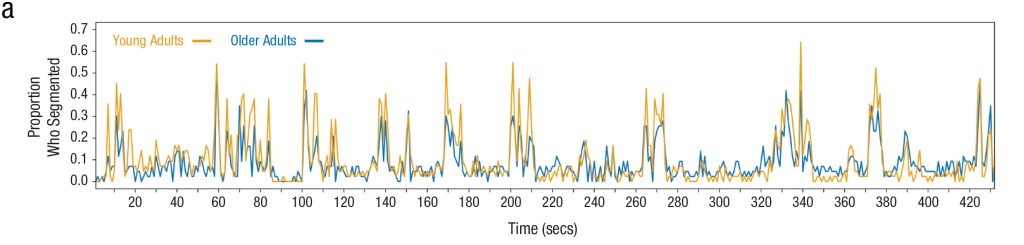
Despite this shared pattern, individuals differ in how they segment events—and these individual differences matter. People who segment events in a pattern that matches the norm (i.e., their event boundaries are similar to others’), tend to recall events better, likely because segmentation acts as a form of chunking that creates distinct episodes less vulnerable to interference. A growing body of research suggests that event segmentation helps form long-term memories:
- Memory is better for event boundaries than for information throughout an event. For example, people might be more likely to remember the moment they put toothpaste on their brush than a specific moment during the time they spent brushing their teeth (Lu et al., 2022).
- Patterns of neural activity are stable during an event but reorganize at event boundaries (Baldassano et al., 2017).
- Hippocampal and cortical activation increases at shifts in events, and memory is better for shifts that result in greater hippocampal activation (Ben-Yakov & Dudai, 2011; Zacks et al., 2001).
- People who show high agreement with a majority of viewers regarding the boundaries of events tend to show better event memory (Sargent et al., 2013).
- Groups that tend to show memory deficits (e.g., older adults) also tend to show low agreement with normative event segmentation (Zacks & Sargent, 2010).
- Interventions that encourage event segmentation during encoding tend to improve recall, at least for younger adults (Flores et al., 2017; Gold et al., 2017).
To help students understand event segmentation and its role in memory, use this slideshow with three simple word-perception tasks. Start by explaining that detecting boundaries between events is similar to detecting boundaries between words.
In the first task, students try to parse a continuous stream of letters with no spaces. Students might struggle to perceive—let alone remember—the words. In the second task, show the students the letters that are already segmented into words, making them easy to read and remember. In the third task, have students listen to a short passage in German and try to identify where one word ends and the next begins. Non-German speakers will find this difficult until they see the written text. Together, these demonstrations show how our ability to perceive boundaries shapes what we are able to remember.
Finally, have students reflect on their morning routines, and ask them to write down how they segment their memories of those routines. Have students share the boundaries for their events with a partner and look for overlap in those boundaries and the memories associated with them.
Feedback on this article? Email [email protected] or login to comment.
Baldassano, C., Chen, J., Zadbood, A., Pillow, J. W., Hasson, U., & Norman, K. A. (2017). Discovering event structure in continuous narrative perception and memory. Neuron, 95(3), 709–721.
Ben-Yakov, A., & Dudai, Y. (2011). Constructing realistic engrams: Poststimulus activity of hippocampus and dorsal striatum predicts subsequent episodic memory. Journal of Neuroscience, 31(24), 9032–9042.
Flores, S., Bailey, H. R., Eisenberg, M. L., & Zacks, J. M. (2017). Event segmentation improves event memory up to one month later. Journal of Experimental Psychology: Learning, Memory, and Cognition, 43(8), 1183–1202.
Gold, D. A., Zacks, J. M., & Flores, S. (2017). Effects of cues to event segmentation on subsequent memory. Cognitive Research: Principles and Implications, 2(1), Article 1.
Kurby, C. A., & Zacks, J. M. (2011). Age differences in the perception of hierarchical structure in events. Memory & Cognition, 39(1), 75–91.
Lu, Q., Hasson, U., & Norman, K. A. (2022). A neural network model of when to retrieve and encode episodic memories. eLife, 11, Article e74445.
Sargent, J. Q., Zacks, J. M., Hambrick, D. Z., Zacks, R. T., Kurby, C. A., Bailey, H. R., Eisenberg, M. L., & Beck, T. M. (2013). Event segmentation ability uniquely predicts event memory. Cognition, 129(2), 241–255.
Zacks, J. M., Braver, T. S., Sheridan, M. A., Donaldson, D. I., Snyder, A. Z., Ollinger, J. M., Buckner, R. L., & Raichle, M. E. (2001). Human brain activity time-locked to perceptual event boundaries. Nature Neuroscience, 4(6), 651–655.
Zacks, J. M., & Sargent, J. Q. (2010). Event perception: A theory and its application to clinical neuroscience. Psychology of Learning and Motivation, 53, 253–299.



APS regularly opens certain online articles for discussion on our website. Effective February 2021, you must be a logged-in APS member to post comments. By posting a comment, you agree to our Community Guidelines and the display of your profile information, including your name and affiliation. Any opinions, findings, conclusions, or recommendations present in article comments are those of the writers and do not necessarily reflect the views of APS or the article’s author. For more information, please see our Community Guidelines.
Please login with your APS account to comment.