
Member Spotlight: 2026 Spence Awardee Dorsa Amir on How Culture Shapes the Mind
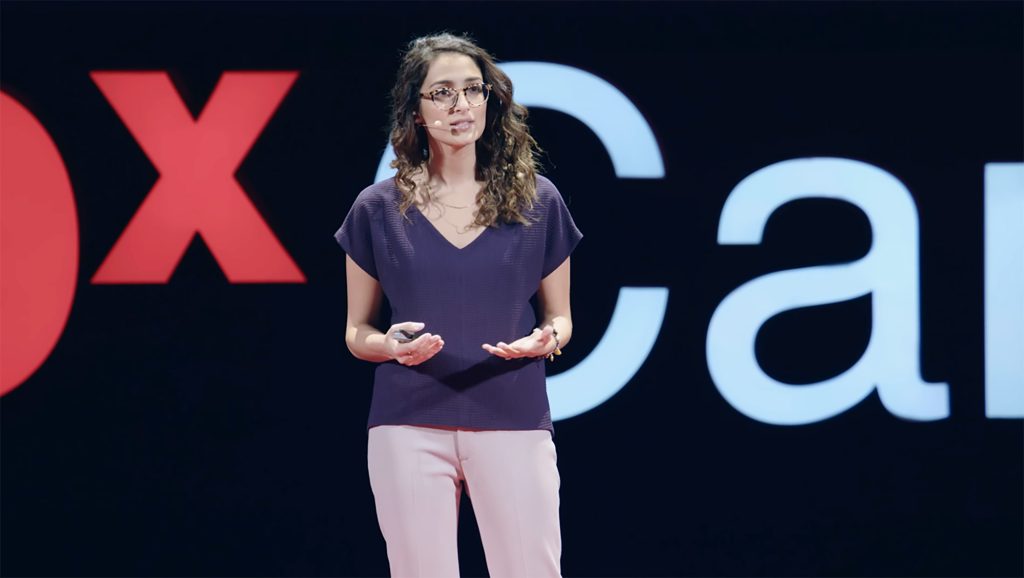
Image above: Dorsa Amir presenting at TEDxCambridge, 2019.
Assistant Professor and 2026 Janet Taylor Spence Award recipient Dorsa Amir is the director of the Mind & Culture Lab at Duke University, where she and her colleagues research how culture shapes the developing mind. The Observer’s Digital Content Manager Lou Willwood asked Amir a few questions about her research, her career, and her advice for the upcoming generation of psychological scientists.
Learn more about Amir and the five other Spence Award recipients.
Your research focuses on the relationship between culture and cognition, specifically on how cultural environments shape cognition. What led to your scientific interest in this subject?
Growing up bicultural, the importance of culture was always salient to me. The world would change as I stepped in and out of my house—different norms, languages, customs, foods. So I grew up with this longstanding appreciation for cultural differences and how they manifested and the growing sense that there was no single default way of being human.
These interests eventually led me to pursue my PhD in biological anthropology, and to the question of how different ecologies shape human behavior. What I really appreciate about the field of anthropology is that it lends structure and meaning to the sometimes-invisible current of culture that we are all swimming in. It concretizes this amorphous idea of “culture” into a tractable concept, with theories for how and why culture evolved and a deep time perspective to appreciate how it has changed over millennia.
Throughout the course of my graduate studies, I also had the chance to take classes and attend lab meetings in the psychology department, and those experiences were quite formative in shaping my research interests. In psychology, I found frameworks and methods to help explain what I think is one of the most interesting questions in the world: How does the mind work? I was also integrated into the broader field of cognitive science, which I consider my intellectual home—here was a field that, like me, refused to see the mind through any single lens.
What are some highlights of your research? What has it shown?
My research sits at the intersection of culture, development, and cognition, and a common thread running through it all is assessing which aspects of our mind occur with regularity across contexts and which aspects are more penetrable by culture.
One domain I’ve spent a lot of time thinking about is cooperation—we live in such different habitats all over the planet, each of which pose unique challenges to cooperation, yet we manage to pull it off at scales unmatched in the animal kingdom. How do we do this? One way to get at this is to study how cooperative behaviors actually develop across different cultures.
“I’ve come to believe that the most innovative work often happens in the space between disciplines.”
In a recent study spanning five diverse societies (Amir et al., 2026), my collaborators and I tracked how children’s cooperative behaviors developed across middle childhood and found that while the timing and process of norm acquisition appears consistent across societies, the content of those norms—and therefore the cooperative behaviors children ultimately develop—varies substantially depending on where you grow up. These patterns mirror other work I’ve conducted on the development of decision-theoretic preferences (e.g., Amir et al., 2019), which similarly highlights the role of the local environment in shaping behavior.
Alongside this empirical work, I’ve also been interested in a more foundational question: not just whether culture shapes cognition, but how—and perhaps more interestingly, where its influence ends. I explored this question in a recent theoretical paper (Amir & Pitt, in press), proposing a taxonomy of four distinct pathways through which culture can influence cognition: It can leave certain abilities unaffected, it can privilege some cognitive outputs over others, it can prune abilities that go unused, or it can produce entirely new ones. And another theoretical contribution came from asking where exactly culture’s influence ends—in a recent paper (Amir & Firestone, 2025), my collaborator and I took on one of the most famous claims in cross-cultural psychology: that culture can influence core processes such as visual perception.
We argued that this account is unlikely to be true, drawing on the diverse fields of cognitive science to make the case that visual perception is unlikely to be affected by cultural inputs. Taken together, this body of work has convinced me that the relationship between culture and cognition is neither uniform nor unbounded: Culture is a powerful force, but its reach is selective, and mapping those boundaries is one of the most exciting projects in cognitive science today.
What is the biggest challenge you have encountered in your career so far?
The biggest challenge has been learning to make my research legible across different disciplines that, despite shared interests, operate quite differently. Early in my career, I felt the pull to choose one tradition and speak only to that audience. But the questions I care about most and the scholars I most admire have never respected those boundaries. In fact, I’ve come to believe that the most innovative work often happens in the space between disciplines. Of course, this comes with its own hurdles: Learning to write and think in a way that can be understood and evaluated by researchers coming from very different starting points is tough, but I actually think it’s extremely useful because it forces clarity. You can’t hide behind the jargon and theories of your home field when your audience doesn’t always share them, and that, I think, makes the work better.
What new or expanded research are you planning to pursue?
The work I’ve described so far treats culture largely as an input, something that acts on the mind. But I’ve become increasingly interested in the other direction: how the mind creates culture. One place I think this is especially visible is in children, whose cognitive profile, long characterized as immature or incomplete, I’ve come to see as functionally optimized for exactly the kind of variance generation that cultural evolution requires. Children are noisier, more exploratory, and more willing to abandon existing solutions than adults, traits that look like deficits from a performance standpoint, but may be features from an evolutionary one. Some of our ongoing work suggests that children will pay surprisingly high costs to explore rather than exploit, and that they use distinctive heuristics that may produce higher-variance outputs than adults. But individual children are unlikely to drive cultural change on their own. What makes this story more compelling is an often-unmarked social structure that children are embedded in: the peer group.
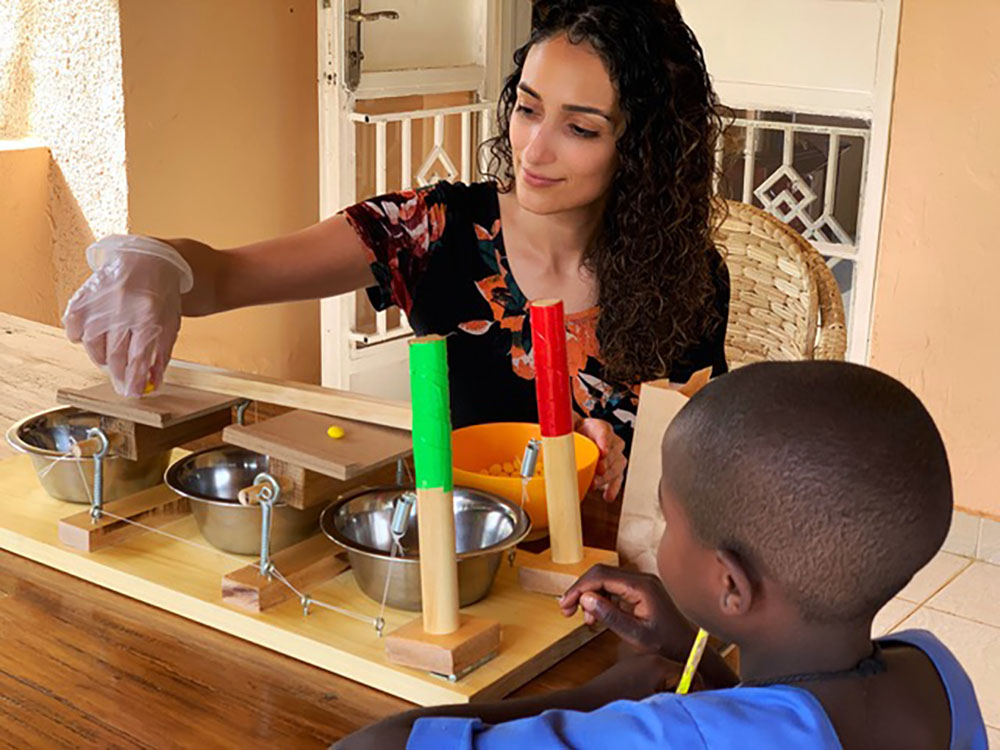
Across virtually all small-scale societies (and almost certainly across evolutionary time), children spent the majority of their time in mixed-age peer groups from around age four onward. Importantly, within these groups, children create and transmit peer cultures: autonomous bodies of knowledge, practice, and artifacts that are governed by children, transmitted child-to-child, and distinct from adult culture. In a recent article (Lew-Levy & Amir, 2024), my collaborator and I argued that these peer cultures may function as engines of cultural evolution—repositories of variation that, especially in times of rapid ecological or social change, can drive innovation in ways that adult culture cannot. This is, I think, a profound reframing of what childhood is: not a waiting room for adult competence, but an active and irreplaceable force in how human culture grows and changes.
What practical advice would you offer to student researchers who want to be in your position someday?
The most important thing, I think, is to find a question you genuinely can’t stop thinking about; not a question that seems tractable or publishable or fashionable, but one that authentically interests you. The longevity of a research program depends less on any particular finding than on the depth of your curiosity, and that curiosity has to be real. To do that, you also need to invest in yourself. Figure out who you are, what you like, how you like to work. Push your boundaries and take risks. The most rewarding career is one that offers a genuine fit between you and the work.
Relatedly, don’t let the history of your field dictate what questions are worth asking. Every discipline has its grooves—the methods it favors and the phenomena it has traditionally studied—and it’s easy to mistake those grooves for the boundaries of what’s possible. I’d also encourage students to spend time actually observing human beings and their lives, in all their messiness and cultural nuance. It’s easy, especially in psychology, to forget that the phenomena we study exist in the actual world, and not just in the lab.
And finally, read broadly and voraciously! Especially outside your own field. The ideas that have most shaped my thinking rarely came from within psychology.
Feedback on this article? Email [email protected] or login to comment.
References
Amir, D., Jordan, M. R., McAuliffe, K., Valeggia, C. R., Sugiyama, L. S., Bribiescas, R. G., … & Dunham, Y. (2020). The developmental origins of risk and time preferences across diverse societies. Journal of Experimental Psychology: General, 149(4), 650.
Amir, D., Ahl, R. E., Jordan, M. R., Bolotin, H., Bogese, M., González, G. T., … & McAuliffe, K. (2026). The emergence of cooperative behaviors, norms, and strategies across five diverse societies. Science Advances, 12(6), eadw9995.
Amir, D. Pitt, B. (In Press) What does it mean for culture to ‘shape’ cognition? Trends in Cognitive Sciences.
Lew-Levy, S., & Amir, D. (2024). Children as agents of cultural adaptation. Behavioral and Brain Sciences, 1-68.



APS regularly opens certain online articles for discussion on our website. Effective February 2021, you must be a logged-in APS member to post comments. By posting a comment, you agree to our Community Guidelines and the display of your profile information, including your name and affiliation. Any opinions, findings, conclusions, or recommendations present in article comments are those of the writers and do not necessarily reflect the views of APS or the article’s author. For more information, please see our Community Guidelines.
Please login with your APS account to comment.