
New Anti-Autocracy Handbook Aims to Give Power Back to Scholars
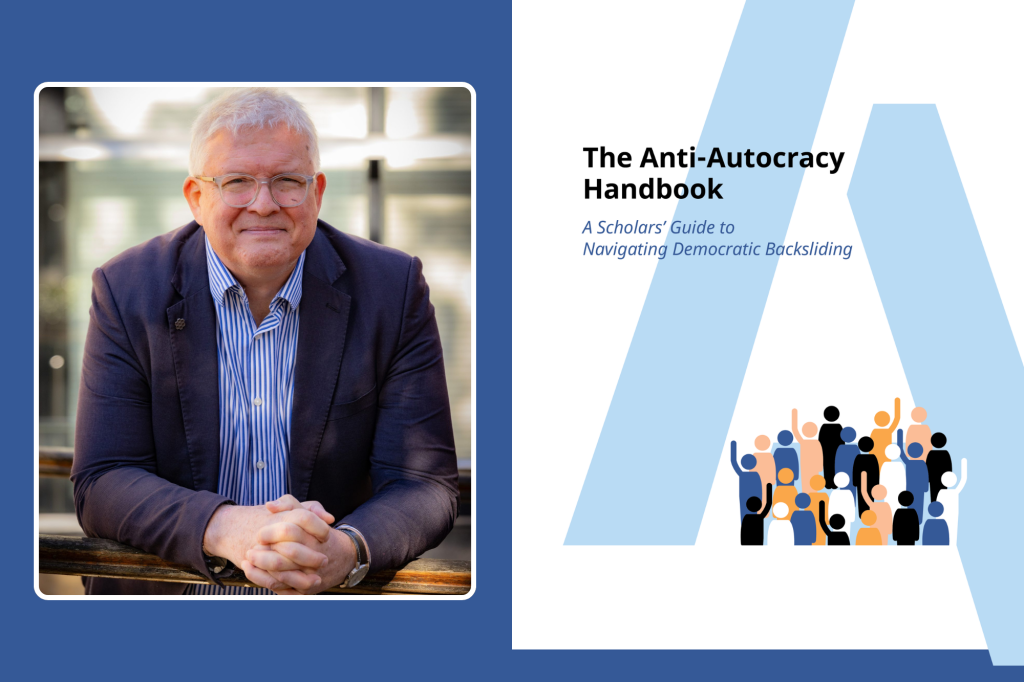
APS Fellow Stephan Lewandowsky (University of Bristol) and colleagues have recently developed the Anti-Autocracy Handbook, which they describe as “a call to action, resilience, and collective defense of democracy, truth, and academic freedom in the face of mounting authoritarianism.”
The handbook is designed to provide guidance to scholars navigating the growing global trend of democratic backsliding and autocratization, with special emphasis on the United States.
You can read the handbook here.
The Observer asked Lewandowsky a few questions about the project. His responses are below.
What first motivated your team to create an anti-autocracy handbook specifically for scholars, and why now?
It didn’t take long after the inauguration for us to realize that the United States was heading down a very dangerous pathway, and the events since then have only served to amplify our concerns. As scientists, we were particularly concerned with the assault on American academia by the U.S. government, which has expressed itself in so many ways—from grant cancelations based on lists of keywords that the administration deemed unacceptable to the extortionist demands for universities to surrender their independence in exchange for restoration of federal funds (which were likely illegally withheld to begin with). Because our team’s expertise was in academia and research and scholarship, we addressed the handbook mainly to fellow scholars, although some of the material is likely of broader interest.
Were there particular moments in your own academic career that made you aware of the risks of creeping autocracy in scholarly life?
I have been fortunate thus far to live in environments that have not become autocratic, although I do fear that British universities may soon face similar challenges as American institutions. Nonetheless, I have observed the creeping normalization during the last 10 years of previously unthinkable ideas, from misogyny to overt racism to—incredibly—even attempts to whitewash slavery (see President Donald Trump’s recent post about the Smithsonian Institution!), all under the banner of “free speech.”
What do you see as the most urgent threats to academic freedom and democracy today?
This depends very much on the context in which you operate. In many European countries—with some concerning exceptions such as Hungary—academics can still feel safe to conduct their research without much interference by governments or other political actors. Unfortunately, that is not the case in the United States, where academics are not only now subject to government intimidation and control (at least in some states; e.g., Indiana, to pick just the latest example), but are also at risk of well-organized, nongovernmental actors who observe academics in the classroom and launch campaigns against them if an academic expresses an opinion that is not to their liking. This is nearly unheard of in most European countries, again with the exception of the United Kingdom, where classrooms have occasionally become stages for politically motivated campaigns against academics.
How can individual scholars—who may feel powerless—use the handbook in their everyday work?
I think that each one of us has some degree of power, although that varies with where we live and what our status is. And one of the core premises of the handbook is that the degree of risk we are exposed to—and hence the amount of power we have—differs between individuals. We would never ask an immigrant female person of color to take the same risks as a tenured white male professor. But nonetheless, there is always something you can do, even if your personal risk is high. For example, you can tell your story, anonymously if required. We have a link in the handbook to a secure facility that allows us to verify submissions and then publish them anonymously, with us vouching for the authenticity of the author. Nothing in history has lasted forever, and so even this dark period will end sooner or later, and, at some point, all those stories will be heard and appreciated. And people will ask once again, as they did in 1945, how could this have happened?
What role does collective action (departments, associations, universities) play, beyond individual responsibility?
I think collective action is crucial. Any authoritarian government will seek to divide and conquer and split people apart so they can be more readily controlled. I therefore think that professional organizations have a large role to play, as do collectives of universities. I was initially disappointed by how professional medical organizations were prepared to “work with” Robert F. Kennedy, Jr. as secretary of health because there were sufficient indications to believe that his tenure would be disastrous. But now some professional organizations have started suing because of the devastating consequences of RFK Jr.’s actions on public health. This should have happened much sooner. Although, I also understand that Americans have not experienced anything other than democracy for 250 years, so they were caught completely unprepared by this onslaught.
Did your team encounter resistance or risks in developing or sharing this handbook, and how have they navigated that?
“There is strength in collective action, and that is what we need all around the world if we want to turn around the fascist juggernaut.“
APS FELLOW Stephan Lewandowsky
No, we have not, unless you consider the comment from White House spokesperson Taylor Rogers that “all of the authors of this ‘handbook’ that graduated from an American university donate to ActBlue and Democrat presidential candidates … Democrat donors should keep their journal entries about their disdain for President Trump to their diaries.” In fact, many of the authors (myself included) are not U.S. citizens and none of us contribute to American election campaigns. But oh well ….
What impact do you hope the handbook will have in shaping the role of scholars in defending democracy over the next decade?
I really don’t know, but the feedback we have received to date has been very positive. We will certainly continue to work on this. For example, we have nearly completed our first translation (into German), and we have further volunteers who want to translate the handbook into other languages. I think the most important thing right now is for everyone who is fighting for democracy to know that they are not alone, and to realize that there is power in collective action—even if the Trump administration doesn’t like the word collective, judging by their cancelation of an National Science Foundation network grant on “collective cognition” that I was part of. So let me say it again, precisely because they don’t like it: There is strength in collective action, and that is what we need all around the world if we want to turn around the fascist juggernaut.
“The pace at which democracy is unraveling in the United States has surprised even me, and I have been studying democratic backsliding, authoritarianism, and so on for 20 years.“
APS FELLOW Stephan Lewandowsky
Is there anything you wish scholars understood—or acted on—about resisting autocracy that isn’t in the handbook?
We were very careful not to self-censor while also trying to avoid hyperbole and exaggeration. In retrospect, as has happened many times in the recent past, we were perhaps too careful. The pace at which democracy is unraveling in the United States has surprised even me, and I have been studying democratic backsliding, authoritarianism, and so on for 20 years.
I think it is essential to recognize that, however discomforting it is, because without a clear vision of reality, it cannot be changed. And change will not arrive on its own, and it will not be easy to achieve. I think the United States is now living under occupation by a hostile fascist power. Sadly, that hostile power is the U.S. government. And I am not the only one to say that.
Feedback on this article? Email [email protected] or login to comment.



APS regularly opens certain online articles for discussion on our website. Effective February 2021, you must be a logged-in APS member to post comments. By posting a comment, you agree to our Community Guidelines and the display of your profile information, including your name and affiliation. Any opinions, findings, conclusions, or recommendations present in article comments are those of the writers and do not necessarily reflect the views of APS or the article’s author. For more information, please see our Community Guidelines.
Please login with your APS account to comment.