
This American Moment Calls for Psychologists to Think Differently
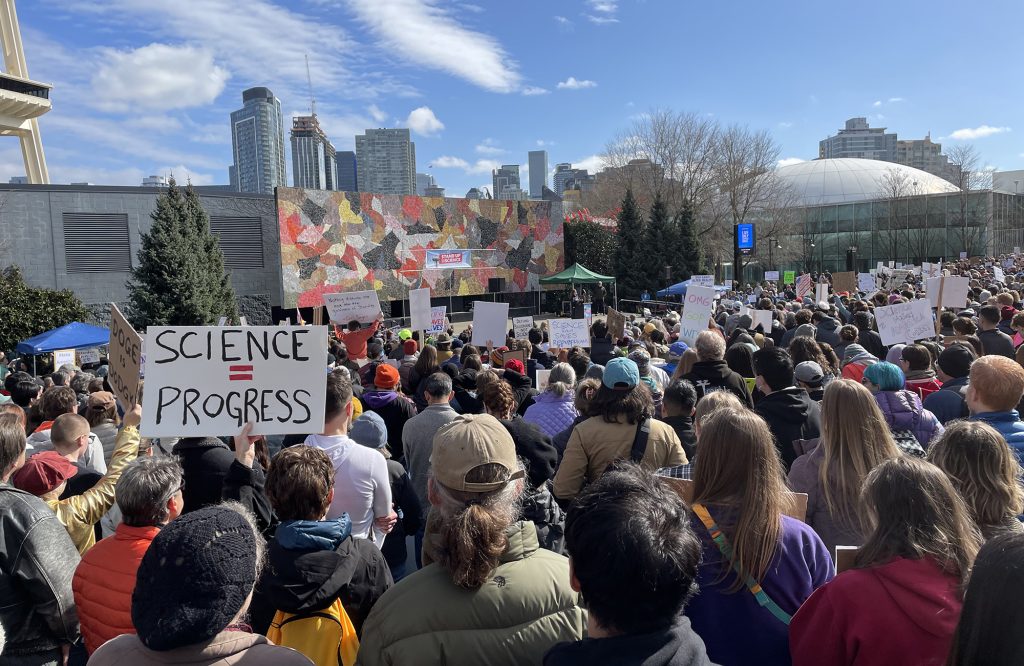
Image above: Protesters gather for the Stand Up for Science protest in Seattle, Washington on March 7, 2025. LivingBetterThroughChemistry, CC BY-SA 4.0, via Wikimedia Commons.
APS’s Advocacy Task Force is committed to bringing psychological science into the forefront of both public policy and public understanding. This regular column features insights from psychological scientists who have become vocal advocates for science-driven policy.
Explore the APS Advocacy & Policyhub, your gateway to up-to-date policy statements, expert analysis, action tools, and resources to engage meaningfully with legislation, funding decisions, and public discourse.
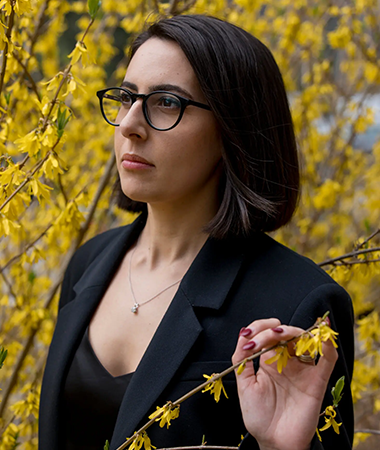
For our latest column, managing editor of the Observer, Hannah O. Brown, spoke with Colette Delawalla. Delawalla is the founder and CEO of Stand Up for Science, an organization that is mobilizing the fight for science and democracy. Stand Up for Science has mobilized thousands of scientists across the globe, supported whistleblowers from federal agencies, fought cuts to federally funded research, launched a campaign to impeach Robert F. Kennedy Jr., and is working to ensure a pro-science Congressional majority in 2026. Delawalla is also a clinical psychology doctoral candidate at Emory University.
Stand Up for Science is gearing up for a National Day of Action on March 7. To find a protest in your area, visit their website.
Brown and Delawalla spoke on February 12, 2026. Edited excerpts of their conversation follow.
How did the idea for Stand Up for Science emerge?
I am in the Behavior Genetics of Addiction Lab at Emory University, which is run by Rohan Palmer. I’m particularly interested in establishing a phenotype of compulsive alcohol use that marries the preclinical literature as well as human literature and then developing an assessment to better understand compulsive alcohol use without asking people how much and how frequently they’re drinking. The idea is to be able to use this as a screening measure for folks in private practice on the clinical side, but also to be able to use it in basic research.
Last year, I was about to submit my dissertation grant. Several days before
I was supposed to submit this to my grants office at my university, the banned words list came out, and it had “woman,” and “Black,” and “community,” and “at risk,” and “vulnerable,” and “definition,” and “opioid,” and “marijuana.” I use all of these words, and my grants office was like, well, take them out. And I was like, I will have to rewrite my grant. My grant is defining compulsive alcohol use in a community sample to understand who is at risk for developing addiction. I was so frustrated, and it was so un-American that we would be told that we can’t use certain words in government, in grant funding.
I started looking for ways to get involved, ways to take action. I thought “surely people are organizing protests, I’ll just join a protest.” And nobody was. I took to Bluesky to feel things out, to see if it was something that people would be interested in, and posted on Bluesky, “We’re doing this. We’re going to do a protest in Washington, DC.”
I thought that me and 50 of my closest psychology friends would go yell on the National Mall for an hour and have dinner and then go home. I did not realize that it’d be thousands of people on the National Mall with over 170 events worldwide on this day. And I think it just speaks to the fact that there really was an appetite for action that was more than just calling Congress.
Since then, we have developed into a real organization. We’re a 501(c)3. We have a foundation arm. We’re a 501(c)4. We have a political action arm. We have 21 staff all across the country. We are headquartered in Atlanta with an office in DC. We have Reduction-in-Force employees from the Centers for Disease Control, the National Science Foundation, the U.S. Department of Agriculture, the U.S. Agency for International Development, Retired Army. We have folks who have been in the progressive nonprofit sector for 40–45 years that help set up places like the Natural Resources Defense Council and the Planetary Society. We have strategic communication and press folks. We have a social media team. We have a group of people who just do politics. And I think that speaks to the diversity and breadth of knowledge that we have on our team, that we’re bringing to this more edgy, more intense fight to save science and democracy.
Did you end up submitting the grant?
Yeah, it was an R36 through the National Institute on Drug Abuse, and I ended up filing it in June. We pushed it back because it just was untenable that I would be able to take all these words out. There was a weird thing with a change in the Notice of Funding Opportunity that disqualified the grant. I wrote it, and it got disqualified after I submitted it.
Because of my timeline changing, because of what I’m doing with Stand Up for Science changing the trajectory of my career, it didn’t make sense for me to resubmit it. We sought some internal funding and got it, and I pared down my dissertation.
So, when you say you’re the trajectory of your career has changed now, you’re thinking of yourself more in this advocacy role instead of pursuing a more traditional academic track.
Yeah, I really was on the trajectory of an R1, tenure-track, research-focused clinical psychology position. I had planned to do an internship but not get licensed and be focused on my research and to have an addiction science research lab—really run with this idea of compulsive substance use that I have spent the last few years building up. It’s not to say that I won’t ever come back to science, because I do think that totally could be the case, but I have managed to build something with Stand Up for Science.
I did not realize the gap in the political machinery that the entirety of the scientific ecosystem had. What I learned is that there are a lot of slivers of the ecosystem that have protection. I like to think about the scientific ecosystem as the Amazon, and the ants have a group that’s saying save the ants, and the tree frogs have a save the tree frogs campaign, but there isn’t a save the Amazon level of political machinery. Meanwhile, chiropractors, firearms, you name it, used car sales. Dentists have an unbelievably sophisticated, modern set of political machinery that they employ to elbow their way into making sure that they’re protected as a sector. Despite the fact that STEM is 34% of the workforce in the United States, or it was before Trump, we don’t have that. There really isn’t true, modern, nimble political machinery in the way that you see in other sectors.
Can you talk a little bit how your psychology background has contributed to this work? Do you bring something unique to this as a leader with that experience?
I think I do. Mobilizing scientists is a uniquely difficult task. It is not the same as mobilizing other members of the public because scientists are trained to exist in the gray zone. Be skeptical of everything. Wait for details before you make a call. Don’t take action until you get everything together.
I have had to lean on so many of my clinical skills that I use with my clients like behavioral activation and dialectical behavior therapy skills. Doing dialectics where you talk about not getting sucked down into the minutiae of something, but sort of rising above to stay above the fray, and how to take opposite action. There’s a clinical piece of it where we’re all experiencing this really challenging thing together, and so it means that these clinical tools are widely applicable. I have a platform that I can use to share them.
There’s also this broader piece of just being tapped into the psyche. I may be a scientist, but I’m a social scientist. It’s not outside of my realm of training to think through like, what about that style of communication isn’t working? Why isn’t the public understanding what scientists bring to the table? What about our forms of communicating what science does for the public isn’t landing?
And then also having clinical tools to help people deal with their hopelessness, frankly. I think people feel bad. I also think that there’s a degree of soft skills that you have to learn and know in clinical training, and I use those soft skills every day with our team.
Yeah, that makes a lot of sense. You talked about working with scientists and how that’s kind of like a unique charge. Can you elaborate on that a little bit? Have those scientists expressed hesitancy to take up an advocacy perspective?
I get a lot of push back about this, and the way that I have been framing it is this: 2025 and 2026 is decidedly a different political moment in the United States than anything any of us have ever lived through. It is not business as usual. I think we can all feel that it is not business as usual, and we actually started off pretty nonpartisan. I say that to make the point that we started off meeting with both. Me and my team in Washington, DC, had over 100 meetings with members of Congress between July and December of last year. We were getting meetings with both sides.
And what we found was the Republicans might give us an inch, but they would take a mile somewhere else. They might say that science is really important and mental health care is really important, but they also signed the bill to kick 16,000,000 Americans off their health insurance, the most vulnerable Americans. You don’t actually care about what science says or people’s health if you’re willing to do that.
We got to this point where we’d have these meetings, and they’d nod and say, yes, I agree with you, my heart agrees with you, my head agrees with you, but I can’t vote in that direction. And that was a waste of time for us.
“We view this as a red alert, all-hands-on-deck moment. I understand that makes people uncomfortable, but I don’t think it always is going to be this way. I don’t think these times are normal.”
We started realizing that there is one party right now in the United States who votes to support science, and there’s one party who doesn’t. Unfortunately, moral lines are, in a way that hasn’t happened in our lifetime, aligning with political parties. It’s a different time in American history where there is a very neat overlap between moral lines and political lines. We are seeing some Republicans will crossover and will stand up for what is right, stand up for the Constitution. But we’re not seeing a lot of that.
Our concern is that science is going to be used by Trump and the Trump administration as a weapon against people. We’ve seen that happen in the United States. We’ve seen science used against the public, and we certainly have also seen a situation with U.S. Immigration and Customs Enforcement (ICE). These two things happening together historically are the biggest red flag you could possibly have right now—a masked paramilitary paired with ideological extremism, paired with government censorship and purging of science. When those three things happen, actual human atrocities happen.
We view this as a red alert, all-hands-on-deck moment. I understand that makes people uncomfortable, but I don’t think it always is going to be this way. I don’t think these times are normal. Let’s just get through this moment and then we can figure out how we’re going to deal with things on the other side.
Can you talk about some of the initiatives or campaigns that you’ve launched that you’ve thought were particularly successful or exciting?
Sure. Over the summer and into the fall, we worked with federal scientists at the National Institutes of Health, National Science Foundation, the Environmental Protection Agency, the National Aeronautics and Space Administration, and the Federal Emergency Management Agency to do whistleblower declarations of dissent. We worked with thousands of employees, and I’m really proud of that work. I know my team is, too, because we were able to provide a voice for folks who have dedicated their lives to science at a federal level, who work day in and day out to do things like make sure our water is clean, make sure that we have cutting-edge cancer treatments, make sure that we have disaster relief, getting us to the moon. It was an honor and a privilege to work with them.
We also worked with Representative Haley Stevens to see Articles of Impeachment against Robert F. Kennedy Jr. filed on the House floor. We went back and forth with her office for about six weeks writing those articles. We pulled in public health experts, Nobel laureates, and deans of colleges to help us make sure the charges laid out were exactly right, and they’re focused on harm to the public.
I’m proud of that because it gets on public record the harms that he’s bringing to the United States and to people. I don’t think that people understand that RFK Jr. is going to be the person in Trump’s cabinet who has the highest body count at the end of all of this if he is left to his own devices for the next three years. He is extraordinarily dangerous in a way that people just are not grasping. It is a five-alarm fire, and we’re working to get members of Congress on board. We actually think it’s possible because there are Republicans who don’t like him for objectively different reasons than us. There are people on both sides who really want him gone.
As a student, are there tips or insights you would share for early career psychologists who are interested in doing advocacy work?
Yeah, I would say that there’s something to be said for people in the social sciences being particularly effective in advocacy, and it’s our soft skills. It’s that we study people for a living and not the DNA of people. We study the people-ness of people, and I think that there are ways to leverage that to get our point across. Social scientists and psychology students, we have a finger on a part of society most people don’t. We have the means to take the temperature and then to communicate that temperature to our elected officials. We have also the unique opportunity to tie our research area into whatever we’re advocating.
I always talk about addiction when I meet with elected officials because everybody knows somebody with addiction. It’s a really easy way in, and it allows me to show my expertise. Just don’t be afraid to think outside of the box about what your place in society is because we as scientists do have this very unique skill set that I think we can and should use in these ways, especially in this particular moment.
What about psychological scientists more generally? What’s the best way for people to get involved?
The best way for people to get involved with Stand Up for Science is to volunteer, which we have information about on our website. We are working to set up Congressional matchmaking. We get people set up for meetings with their members of Congress. It’s quite an undertaking, but it is something that we like to do and that has been successful.
Attend a rally. Get involved with your local Stand Up for Science group. Most universities have one, or there’s one within the state at least. Don’t be afraid to do something different. So many people I talk to that attended the March 7th rallies have never protested before, or if they did protest, the last time was March for Science in 2017. It’s OK to try something different. I think it’s good to sort of embrace this, break out of the normal thing, and see what happens. Experiment a little bit.
Ready to take action? Visit APS’s Act Now page to learn more about how to speak with your U.S. Representatives and Senators.
Feedback on this article? Email [email protected] or login to comment.




APS regularly opens certain online articles for discussion on our website. Effective February 2021, you must be a logged-in APS member to post comments. By posting a comment, you agree to our Community Guidelines and the display of your profile information, including your name and affiliation. Any opinions, findings, conclusions, or recommendations present in article comments are those of the writers and do not necessarily reflect the views of APS or the article’s author. For more information, please see our Community Guidelines.
Please login with your APS account to comment.