
Seeking Evidence of Altruism in Turbulent Times
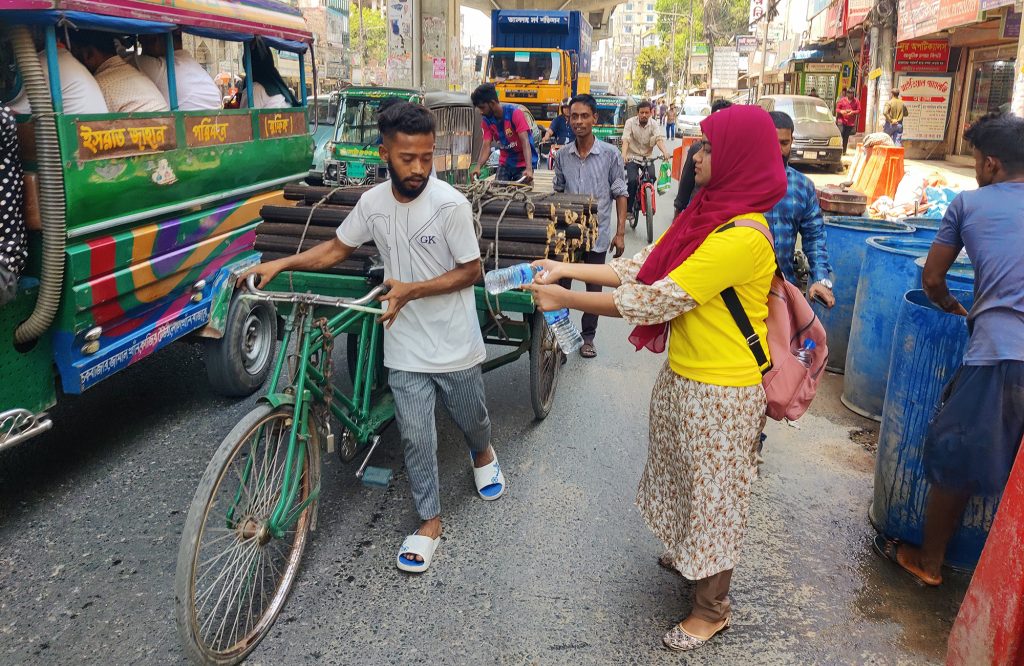
Image above: Water distribution by Volunteer for Bangladesh. IqbalHossain, CC BY-SA 4.0, via Wikimedia Commons
- For much of the 20th century, psychologists primarily studied altruism through a lens of self-interest.
- In recent years, psychological science has discovered that altruism is encouraged within our neural pathways, comes in diverse forms around the world, and emerges in communities during times of crisis.
- Scientists believe that by understanding the factors that create altruistic motivation, societies can learn to better cooperate during turbulent times.
During her graduate studies, psychologist Stephanie Brown, now an associate professor at Stony Brook University, was immersed in the topic of altruism. One of her advisors, APS Charter Member and Fellow Robert Cialdini, was a key player in the Batson–Cialdini debates on the motivations behind helping behavior—and was firmly on the side that altruism didn’t exist.
For much of the 20th century, psychologists primarily studied altruism through a lens of self-interest. Forms of prosocial behavior like helping, sharing, and caregiving were perceived with an ulterior motive, as a way for people to gain favor with others or intentionally propagate their genes. Much of Brown’s work under Cialdini focused on proving that altruistic motivation does not exist or was at least “an unparsimonious explanation for helping behavior,” she said.
Related content: Robert B. Cialdini and Jennifer L. Eberhardt on The 7 Principles of Influence
But as Brown searched through the literature and analyzed her data, she stumbled across “evidence that altruistic motivation must exist, both from a theoretical perspective, and from the empirical data.” And she’s not the only one to draw this conclusion. In recent decades, an increasing amount of research is finding evidence that supports altruism’s existence. Studies show that altruism is encouraged within our neural pathways, comes in diverse forms around the world, and emerges in communities during times of crisis.
As a result, scientists like Brown are gaining a better understanding of altruism, how it shapes human behavior and society, and how it’s more common than we think. Understanding the factors that create altruistic motivation helps us understand how we can leverage it to better cooperate amidst turbulent times.

“The reason that social psychology exists is to solve social problems. We do this by revealing some of the basic human tendencies that lead to horrendous situations, and the goal is to prevent their occurrence in the future,” Brown explained. Accepting altruism’s existence, she argued, can help reshape research and policy for a world where people care for one another.
A new point of view
To show how research on altruism could have far-reaching effects, Brown and colleagues discussed the implications of evolutionary biology for our most pernicious problems in a 2025 study. Published in Current Directions in Psychological Science, the paper synthesized decades of research and outlined ways altruism can be used to tackle problems such as war, overpopulation, immigration, the criminal justice system, and environmental issues.
For their paper, Brown first focused on evidence that supports altruism’s existence. She relied on selective investment theory (Brown, 1998/1999; Brown & Brown, 2006), her evolutionary theory of altruism developed with her father that proposes strong social bonds evolved to promote altruistic behaviors, even though those behaviors may put us in harm’s way. “Selective investment theory is basically saying that our motivational bonds get us to suppress our self-interest when necessary, so we can help others,” she said.
In past research, scientists have found evidence that supports this theory, specifically neurobiological mechanisms that are at work when people complete altruistic deeds. Our brains suppress reward motivation when we help people we are bonded to, and this interferes with threat responses and interrupts the stress response. This is most commonly seen with parental care, such as when a parent puts themselves in danger to protect their child. Research has shown that the same circuitry is activated in a variety of helping behaviors, across many different types of relationships.
Understanding that altruism is something innate and tied to our social bonds may help us see new ways of solving problems. For instance, by looking at the world through selective investment theory, Brown suggested that we can better approach peace negotiations.
“War doesn’t usually happen because countries want to invade one another,” Brown said. Instead, research by Glowaki (2024) suggests that war is usually led by a few disenfranchised individuals within a nation who seek revenge or status while forcing underlings to follow suit.
The solution, as proposed by Glowaki (2024), is similar to selective investment theory. “Interdependence within the country is what’s going to keep your country at peace,” Brown said, meaning that making everyone feel important and part of a cohesive population may ultimately shield a country against war.
Further, if prioritizing bonds becomes the status quo, the legal system could potentially be reshaped to be more effective. As Brown explained, crimes could be evaluated according to their altruistic intentions. The exoneration of victims of circumstance could free up time and resources within the criminal justice system. Possession or use of illegal drugs may also be seen as less criminal, as drugs recruit the same biological pathways as falling in love. Further, to overcome financial or informational barriers, Brown described that nondisclosure agreements could be declared unconstitutional, and monies secured from illegal businesses could be redirected toward transitioning those businesses into ethical ones.
“When you accept that we can also be other-focused, then it means that that you can actually count on people’s genuine interest in helping to solve problems,” Brown said. Through this lens, Brown and her colleagues argued for the inevitability of a more empathetic world that functions more effectively and restores our collective well-being.

Well-being around the world
For APS Fellow Abigail Marsh, her interest in altruism began when she was a teenager. She was driving down the freeway when a dog ran in front of her car, causing her to swerve and spin out of control, putting her directly in the way of incoming traffic. With a dead engine, she was stuck, until a stranger suddenly pulled over and ran toward her car. He was able to restart the engine and drive the vehicle back to safety.
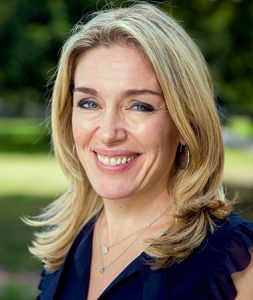
“It’s when something like that happens to you, it makes it feel a lot more real and also a lot more mysterious that somebody would take such a huge risk,” she said. The experience stuck with her, eventually guiding her research interests as a psychologist.
Today, as a professor at Georgetown University, much of Marsh’s work focuses on nondirected, or altruistic, kidney donors, one of the most “extraordinarily altruistic” acts. Her research has indicated that the distribution of kidney donors in the United States had a strong correlation to individuals with a sense of subjective well-being.
“That goes along with something that I think a lot of different research has been pointing to for a while, which is that well-being promotes prosocial behavior, and vice versa, which is really cool,” Marsh said. “And then our thoughts naturally turned to, well, I wonder what this looks like around the world? And what about other kinds of altruism?”
This led Marsh to study altruism on a global scale. In a 2021 study published in Psychological Science, she and her colleagues examined whether various altruistic acts are linked with subjective well-being across 152 countries. The study found that not only was altruism consistently and strongly associated with subjective well-being, but this was true for diverse forms of altruism across different countries and cultures.
For the study, Marsh and her coauthors pulled data on seven altruistic behaviors. These included marrow donations, blood donations, live kidney transplants, and survey data on volunteering and helping strangers. (Altruistic kidney donation to benefit strangers is still outlawed in some countries and so wasn’t included in the global study.) Across the countries, these altruistic acts were consistently correlated, meaning that if one type of altruistic act in a country was common, the others occurred at a high rate as well.
The study authors then looked at a wide range of variables and their associations with altruism. “We looked at everything we could think of that might be relevant,” Marsh said, which included wealth, health metrics, education, age structure, religion, languages, and more.
Notably, they found that subjective well-being (i.e., reported life satisfaction), as well as all the variables that contribute to objective well-being (e.g., wealth, longevity, etc.), were strong predictors of altruistic acts. This can help inform policy goals, Marsh noted, as it suggests that higher standards of living—e.g., having better health, more wealth, and better longevity—can make people more altruistic, rather than selfish.
The study also found that altruism was higher in more individualist cultures, when compared with more collectivist cultures. Although this may seem surprising, Marsh explained individualist cultures are often misinterpreted as selfish. In reality, individualism is characterized by people being motivated by personal meaning rather than group identity and is associated with more dynamic interpersonal relationships—and may be why people in these countries are more likely to help strangers. However, that doesn’t mean altruism doesn’t exist in collectivist cultures. In collectivism, helping is focused more on people’s innermost circles, whereas helping someone outside of your family or group can carry more risk or cost.
“There’s no society in the world where people don’t care about other people. It’s mostly an issue of how it gets expressed,” Marsh said.
The diversity of altruistic expression also means that you don’t need to donate a kidney to be considered selfless. “Most of the [kidney donors] that I’ve worked with are quick to emphasize that there’s all different ways to be a good person,” Marsh said. “Altruism and moral goodness can manifest in lots of different ways.”
Helping, sharing, and comforting in times of crisis
When COVID-19 restrictions started easing in France and kids went back to school, life within classrooms wasn’t quite what it was like before. Kids and teachers wore masks and enforced social distancing. For researchers like Lucie Rose, this provided an opportunity to study how altruism shifts in times of emergency.
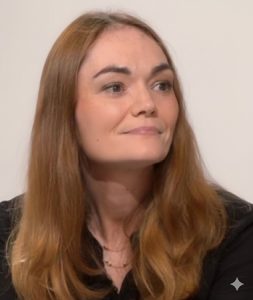
“We were observing around us that people couldn’t implement altruistic behaviors in the ways they used to,” said Rose, a clinical neuropsychologist and a part-time researcher at the University of Lyon. And as time went on, Rose and her team started noticing a pattern. People’s behaviors shifted quickly, and the actions that emerged seemed to be similar to categories of prosocial behaviors that developmental psychologists observe in children, such as helping and sharing.
So, in a 2022 study published in Current Directions in Psychological Science, Rose and her colleagues bridged the two worlds of developmental psychology and altruism to propose a new framework. The researchers argued that by connecting the two fields, it’s possible to better categorize altruism and understand the cognitive mechanisms of how prosociality arises and shifts in a crisis.
In particular, the paper focused on the usefulness of the helping, comforting, and sharing model. “We know that a tendency toward acting prosocially emerges really, really early on,” Rose said, so this model is a way for researchers to categorize and make sense of altruistic behaviors early in life.
For instance, helping is the first behavior that emerges in a child’s first or second year, where they can perceive, pick up, and return dropped items. Sharing, on the other hand, involves controlling the desire to keep things for oneself as well as numerical understanding. Finally, comforting requires understanding complex emotional cues, so it appears later in life.
“These three different types of prosocial behavior, they develop distinctly,” Rose said. “They really rely on different cognitive skills.” She added that these behaviors also wax and wane throughout adolescence and adulthood, meaning that the development of the three types of prosocial behaviors can be very flexible and adaptable throughout one’s life.
This dynamic nature of helping, sharing, and comforting was what Rose and her colleagues noticed during France’s COVID-19 restrictions. “These three main categories of prosocial behavior—the way they were expressed shifted, but it happened really fast.” For example, at the height of the pandemic, sharing material goods quickly morphed into sharing information. Social distancing, because of its benefits, was a form of helping. And comforting shifted from physical solace to clapping and cheering by your window at 8 p.m.
The study’s authors also examined the factors that allowed people to adapt to new prosocial behaviors, as well as factors that inhibited altruism in an emergency. For example, by looking at the literature, Rose and her colleagues found that adults and adolescents of lower socioeconomic backgrounds, or those who had a family member who contracted the virus, were less likely to be prosocial. The study also concluded that prosociality after disaster can be fleeting. After a crisis, people often quickly go back to their normal lives.
But Rose noted that there are ways to encourage altruism outside of emergencies, which can build societal resilience against disasters. “Generally, what we find in research is that you need to not have a sense of immediate danger,” she said.
Another crucial aspect is community support. “Community support really is one of the foundational aspects that can then help you use your cognitive flexibility, your attention skills, pretty much everything that’s going to help you enact prosocial behaviors,” she explained.
These findings also emphasize empathy for those who aren’t able to help, share, or comfort. Kids who come from more vulnerable, underserved backgrounds may not be able to express their altruism, so understanding the context behind inaction could also lead to better interventions.
“Be more tolerant,” Rose said. “Ask: What are the factors that are not in place for this person to be able to help? We would all benefit from doing that a bit more.”
Feedback on this article? Email [email protected] or login to comment.
Brown, S. L. (1998/1999). Fitness interdependence theory. In S. Brown, Evolutionary origins of investment: Testing a theory of close relations (UMI No. 9950232) [Doctoral dissertation, Arizona State University]. Dissertation Abstracts International, 60(11-B), 5830.
Brown, S. L., & Brown, R. M. (2006). Selective investment theory: Recasting the functional significance of close relationships. Psychological Inquiry, 17, 1–29.
Brown, S. L., Brown, R. M., & Cavallino, D. (2025). Does altruism exist? Implications of selective investment theory for solving social problems. Current Directions in Psychological Science.
Glowacki, L. (2024). The evolution of peace. Behavioral and Brain Sciences, 47, Article e1.
Rhoads, S. A., Gunter, D., Ryan, R. M., & Marsh, A. A. (2021). Global variation in subjective well-being predicts seven forms of altruism. Psychological Science, 32(8), 1247–1261.
Rose, L., Dezecache, G., Powell, T., Chokron, S., & Kovarski, K. (2022). The emergency of prosociality: A developmental perspective on altruism and other prosocial behavior in the face of disaster. Current Directions in Psychological Science, 31(6), 486–492.





APS regularly opens certain online articles for discussion on our website. Effective February 2021, you must be a logged-in APS member to post comments. By posting a comment, you agree to our Community Guidelines and the display of your profile information, including your name and affiliation. Any opinions, findings, conclusions, or recommendations present in article comments are those of the writers and do not necessarily reflect the views of APS or the article’s author. For more information, please see our Community Guidelines.
Please login with your APS account to comment.