
A Life Devoted to the Science of Goodness
Psychology Is Everywhere
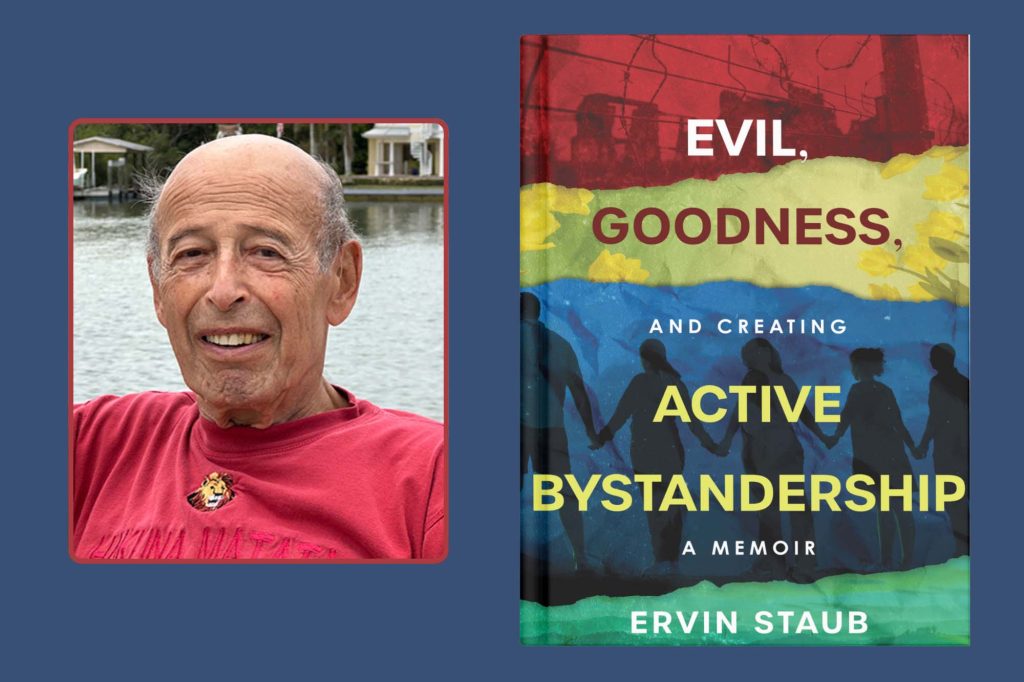
APS Fellow Ervin Staub’s early life in Budapest was shaped by danger and heroism. His parents, his aunt, his nanny, and other adults in his life endured, resisted, and protected each other from the pro-Nazi Arrow Cross regime that terrorized Jewish families like his during World War II.
“Everybody close to me was unbelievably courageous,” Staub, a professor emeritus of psychology at the University of Massachusetts Amherst, said in an interview with the Observer. “That’s where my strength later came from—to persist with challenging work in other countries.”
Those acts of everyday bravery formed the core of Staub’s life and career. Decades later, as a social psychologist, he would dedicate himself to understanding what motivates some people to help others in need—and what makes others turn away.
In his forthcoming memoir, Evil, Goodness, and Creating Active Bystandership, Staub describes escaping Hungary’s communist government, pursuing an education in the United States, and building a storied career as a social psychologist. His study of the causes of intergroup violence, and the factors that prompt people to help others, are particularly salient today amid wars, political polarization, and rising authoritarianism around the globe.
Inspirations from childhood and beyond
Staub drew some of his most significant inspiration for his research from his childhood. He points to Raoul Wallenberg, the Swedish humanitarian who saved thousands of Hungarian Jews—including Staub’s immediate family—from the Nazis.
He also credits his survival to his caregiver, Maria Gogan (or Macs, as the family called her). Macs, a Christian, stayed loyal to the Staub family, hiding with them in protected housing. Once, while returning from a bakery where she had fetched food to feed Staub’s family and others in hiding, she was arrested and nearly executed by Hungarian fascists for helping Jews. (A Nazi who knew her advised the group to let her go.) Macs also smuggled documents to Staub’s father that facilitated his escape from a labor camp.
“[She] could have kept her distance from us, but instead regularly endangered her life to help us during the Holocaust,” he writes in his book.
After the war, Staub transitioned from living under fascism to living under communism. At age 18, after the Soviet Union crushed the Hungarian Revolution of 1956, he fled to Vienna and later to the United States. He earned an undergraduate degree at the University of Minnesota and his doctorate at Stanford University. He later taught at Harvard University, Stanford University, the University of Hawaii, and the London School of Economics.
Staub’s friendships and professional influences included APS Past President and William James Fellow Walter Mischel and the eminent psychologist Perry London, who studied the traits of Christians who risked their lives to save Jews and other Nazi targets during World War II. Mischel instilled in him the value of scientific rigor. London’s work inspired Staub’s own research on ordinary individuals who defy brutality and injustice.
“I began to do research that was far removed from the Holocaust as such, but instead was focused on helping behavior,” he said.
Active bystandership and reconciliation
In his early research conducted in the 1960s at Harvard, Staub found something surprising. The famous “bystander effect”—the psychological phenomenon in which individuals are less likely to help a victim when others are present—didn’t emerge until later childhood. Younger children instinctively helped a peer in distress; older ones hesitated to do so, bound by social rules about obedience and order.
“They’d say, ‘I didn’t think I was supposed to stop working on my task,’” Staub recalled. “So these children learned conventional rules, but had not learned that under certain circumstances, caring about and helping others supersedes the conventional rules.”
This led Staub to coin the term “active bystandership”—the decision to intervene when others are being harmed. He decided to explore the phenomenon in the field. In the late 1990s, he joined colleagues and local organizations in genocide-shattered Rwanda to design community workshops promoting reconciliation and mutual understanding between the clashing Hutus and Tutsis. The training aimed to help participants understand how ordinary people could be drawn into the type of extraordinary violence that ravaged Rwanda. More importantly, the program aimed to also show participants how they could work against the brutal fighting.
Part of that effort, he explained, was targeting the extreme hierarchy that characterized Rwandan society. Villagers showed a strong obedience to authority, which translated into a reluctance to oppose genocidal leaders, he said.
The training included role-playing activities and discussions about participants’ experiences during the genocide. Post-training evaluations showed that months after training, participants were more willing to cooperate and converse across ethnic lines and more skeptical of authority compared to a control group.
“Rwandans had a deep need to understand how what happened to them could have happened,” Staub writes in his book. “We believed that understanding this could change survivors’ perceptions of perpetrators as simply evil and that, coming to see their actions rather than the perpetrators as evil would make reconciliation and prevention of future violence more likely.”
To reach a wider number of Rwandans, Staub and his collaborators created an educational radio drama, Musekeweya (New Dawn), which premiered in 2004 and ran for more than two decades. The program’s fictional settings reflected real Rwandan villages that were struggling between vengeance and reconciliation. The team had some groups of Rwandans listen to Musekeweya and control groups listen to another radio program. Independent evaluations showed that Musekewaya listeners showed more empathy and more opposition to authoritarianism compared with the control groups. The drama became a national hit and inspired similar efforts in the Congo and Burundi.
Beyond Africa
Staub eventually applied his work to other settings. After the 1991 police beating of Rodney King and other incidents of violence in law enforcement, he helped design one of the first training programs to teach officers to intervene when colleagues were about to use excessive force. That initiative evolved into the ABLE (Active Bystandership for Law Enforcement) program, now adopted by hundreds of departments across the United States.
He also helped schools develop curricula that encourage students to step in when peers are bullied.
And he helped the city of Amsterdam alleviate conflicts between ethnic-Dutch and Muslim residents. The municipal government proposed 11 practices and concepts based on Staub’s research, such as encouraging Muslims to invite non-Muslims to dinner at the end of Ramadan and establishing centers for people to gather and learn about each other’s faiths and practices.
In every context, the principle of Staub’s work remained constant: Preventing harm begins with recognizing one’s own agency.
Legacy
“We used to accept each other much more,” he said. “How do we accept each other now, when people don’t even dare talk to each other and ask them about their views and their values? We are dealing with circumstances and ideas that can make people destructive. So, it’s quite important to think about how to promote what I call a constructive ideology.”
Staub’s research offers plenty of lessons for current world events, including in Gaza and Sudan as well as the Ukraine–Russia conflict. His work into the impact of genocide and war has identified several precursors. As he described in a 2019 article in Perspectives on Psychological Science, those roots include:
- difficult social conditions such as economic decline and festering intergroup conflicts;
- past group trauma that makes the world look dangerous; and
- hierarchical and authoritarian culture.
He encourages psychological scientists to look beyond how things are to how things can change—an objective that provides ample experimental opportunities in today’s culture of racial, political, and international divisions.
“We used to accept each other much more,” he said. “How do we accept each other now, when people don’t even dare talk to each other and ask them about their views and their values? We are dealing with circumstances and ideas that can make people destructive. So, it’s quite important to think about how to promote what I call a constructive ideology.”
Now in his 80s, Staub has a great deal of wisdom to share with younger psychological scientists. He urges them to merge research with action, mirroring his own path from researcher to humanitarian.
His advice to aspiring psychologists pursuing field research is both pragmatic and moral:
- Ground interventions in evidence.
- Work within the specifics of group culture.
- Recognize every individual’s capacity for harm—and our equal capacity for benevolence.
“To bring about real change one has to identify what is to be accomplished, how it is to be done, and who are the agents with competence and the power or influence to do it,” he concludes in his book. “In my work, I have come to be guided by these questions.”
Feedback on this article? Email [email protected] or login to comment.
References
Staub, E. (2019). Promoting healing and reconciliation in Rwanda, and generating active bystandership by police to stop unnecessary harm by fellow officers. Perspectives on Psychological Science, 14(1), 60–64.
Staub, E. (in press). Evil, goodness, and creating active bystandership. Köehler Books.



APS regularly opens certain online articles for discussion on our website. Effective February 2021, you must be a logged-in APS member to post comments. By posting a comment, you agree to our Community Guidelines and the display of your profile information, including your name and affiliation. Any opinions, findings, conclusions, or recommendations present in article comments are those of the writers and do not necessarily reflect the views of APS or the article’s author. For more information, please see our Community Guidelines.
Please login with your APS account to comment.