
Member Spotlight: Thora Bjornsdottir on How We See the World—And Each Other
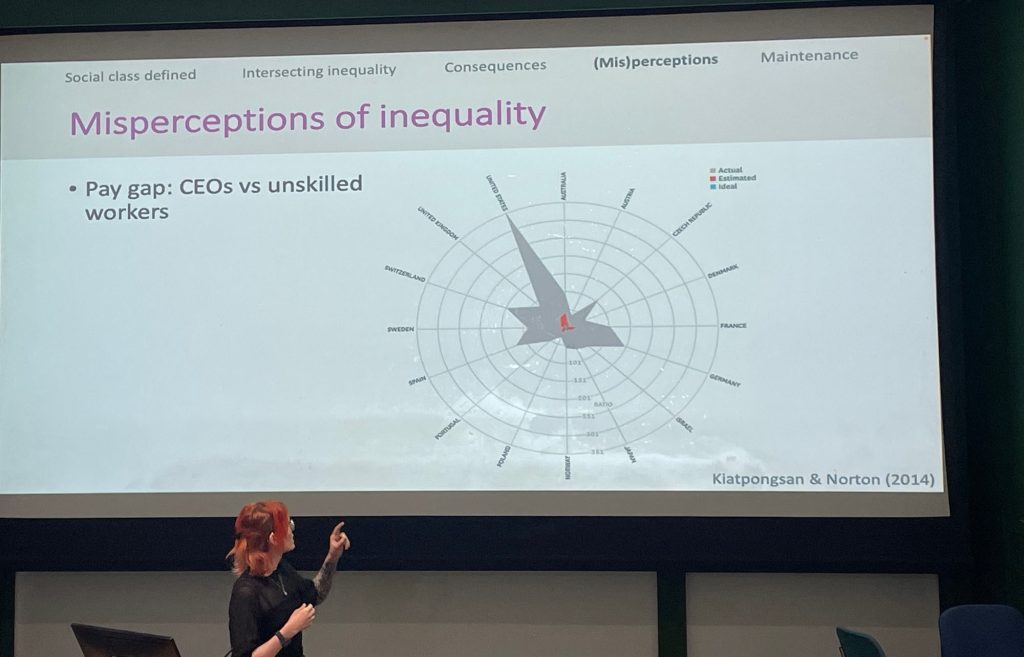
Image above: Bjornsdottir teaching on the psychology of social class. Photo taken by Dr. Carol Jasper.
Thora Bjornsdottir, named an APS Rising Star in 2024, is a lecturer of psychology at the University of Stirling, where she researches and teaches person perception, prejudice, and inequality. The Observer’s Lou Willwood interviewed Bjornsdottir about her research and work, funding challenges, and the importance and benefits of collaboration.
Your research focuses on social perception, cognition, and biases. What led to your scientific interest in these subjects?

Ultimately, social perception unifies the two areas that appealed to me most as an undergraduate: perception and social psychology (thanks to James Cutting and Tom Gilovich for their excellent teaching of these respective subjects). I’m interested in how people see the world and, particularly, how they see other people. To me, this feels quite central to understanding everyday human interactions. I came to study first impressions after taking a class on face perception during a semester studying abroad (thanks here goes to Dave Perrett). I was lucky enough to have incredible mentors who fostered this interest and gave me the freedom to explore my ideas (Melissa Ferguson as an undergraduate, Nick Rule as a PhD student). My initial focus was on the accuracy of people’s first impressions, which developed into exploring biases in these impressions—and the perhaps counterintuitive overlap between accuracy and bias.
What are some highlights of your research? What has it shown?
A lot of my research has explored people’s first impressions of others’ social class standing. Social class is a highly consequential social category, which affects people’s life outcomes, opportunities, cognitions, and everyday interactions. My research, among others’, shows that individuals’ social class is inferred from minimal nonverbal information (which I reviewed recently here). For example, my research finds that people rapidly form impressions of others’ social class standing from photographs of their faces and/or bodies. They do so with some degree of accuracy—above chance, but certainly not perfect accuracy—and infer higher class standing from healthier, more attractive appearance and more positive-looking facial expressions. This indicates that social class leaves its mark on individuals’ appearance, much as it leaves its mark on many aspects of life.
Importantly, there is also substantial bias at play in people’s first impressions of social class. For example, although people of higher class standing may tend to have a slightly healthier and more positive-looking facial appearance, perceivers disproportionately rely on these cues to inform their impressions of social class. This may be because of strong cultural stereotypes tying higher social class to health and happiness, which do bear some kernel of truth. However, other, more damaging stereotypes (e.g., associating low social class with incompetence) also affect social class judgments. For example, facial features that elicit perceptions of competence and trustworthiness also underlie perceptions of social class. This matters, because individuals perceived as higher social class are also perceived as more employable, demonstrating how social class perceptions and stereotypes can play a part in reinforcing inequalities.
I’ve also explored a variety of other social perceptions. For example, in recent work with collaborators Iris Holzleitner and Keiko Ishii, we tested how individuals’ sexual orientation (bisexual, gay/lesbian, heterosexual) and culture (British, Japanese) predicted their preferences for femininity/masculinity in women’s and men’s faces. We found that sexual orientation and culture consistently interacted to predict preferences, highlighting the importance of considering intersecting identities in social perception research. Importantly, our research also showed that how we measured preferences—asking participants to choose between two faces vs. allowing them to manipulate faces’ femininity/masculinity—affected results, demonstrating the consequences of methods of measurement.
Another collaborative project, with Paul Connor and Nick Rule, tested the relative importance of faces vs. bodies for impressions of whole-person images. We found that this varied depending on the type of impression. Faces contributed more than bodies to impressions of intention (such as warmth) and age, whereas bodies were more important than faces for impressions of ability (such as competence) and status (such as social class). This indicates that faces and bodies are each more informative for different kinds of social judgments—and that more person perception research should consider bodies.
What new or expanded research are you planning to pursue?
I have a broad interest in the malleability of social perceptions. I’m particularly interested in examining the extent to which individuals actively shape how others perceive them. First impressions research (particularly appearance-based first impressions research) tends to treat the individuals being perceived as passive stimuli, rather than as agents playing an active role in how they are perceived. People do, however, play a role in others’ perceptions of them. For example, individuals shape their appearance daily through their choice of attire (clothing and styling). Existing research shows that attire can importantly shape first impressions (e.g., see this excellent review by Hester & Hehman, 2023).
There are some important remaining questions, though. For example, it’s unclear how effective individuals’ choices vs. researchers’ manipulations of attire are in eliciting particular impressions. For example, do individuals choose attire for a professional context that helps make them look competent? We also lack a systematic understanding of the degree to which attire tends to shift impressions of the same individual (i.e., attire’s contribution to intra-individual impression variability). My collaborators and I plan to investigate these questions cross-culturally, using both quantitative and qualitative approaches, to gain a broader understanding of attire’s role in impression formation.
“I’ve never had an idea that didn’t turn into something better after talking it over with someone else, and collaboration also just makes research more fun.”
What is the biggest challenge you have encountered in your career?
Frankly, the increasing precarity of academia is a continuing challenge. Nearly every year of my academic career in the United Kingdom has involved taking part in strike action to save our pensions and attempt to increase equality and improve pay and conditions. On top of this, research funding opportunities have decreased, teaching and admin workloads have increased, and universities across the U.K. are now cutting jobs. The current university system (both in the U.K. and elsewhere) is in crisis, and the future of what this career path looks like is unclear.
What practical advice would you offer to an early career researcher who wants to be in your position some day?
Working with other people is one of the most valuable parts of doing research. I’ve never had an idea that didn’t turn into something better after talking it over with someone else, and collaboration also just makes research more fun. Different people have different skillsets. Finding collaborators or mentors whose expertise complements yours means that you’ll learn from each other—and also that you can spend more time on the parts of research that you’re best at or enjoy most, while they do the same. That said, not every collaboration is smooth, and not everyone works well together! Learning from that is important and can help you find more rewarding future collaborations.
Feedback on this article? Email [email protected] or login to comment.



APS regularly opens certain online articles for discussion on our website. Effective February 2021, you must be a logged-in APS member to post comments. By posting a comment, you agree to our Community Guidelines and the display of your profile information, including your name and affiliation. Any opinions, findings, conclusions, or recommendations present in article comments are those of the writers and do not necessarily reflect the views of APS or the article’s author. For more information, please see our Community Guidelines.
Please login with your APS account to comment.