
Facing the Storm, Reimagining Our Future

These are turbulent times. Whether you’re a faculty member or student, in academia or the private sector, in the United States or other country, many APS members—including me—feel as though we’re under siege. Funding for research and graduate education is shrinking. Scientific voices are increasingly questioned or ignored. In many corners of society, expertise itself is being devalued.
I grew up believing that science was the clearest path to truth. As a college student, I saw science as something noble—objective, rational, and fair. Yes, our perception of the truth could be affected by beliefs or expectations, but the scientific method helped separate fact from fiction. The idea that society would one day turn away from science is something I couldn’t have imagined.
And yet, here we are. Scientific expertise is now challenged not just by rhetoric, but by cultural shifts that span the globe. We’re in the middle of a massive psychological experiment—one where misinformation spreads faster than facts, identity often overshadows evidence, and the tools of persuasion we once studied in labs are being used on a global scale. As psychological scientists, we’re uniquely equipped to understand how we got here—and, perhaps, how to find a way forward.
Growing disconnection
It’s tempting to blame our current state on our leaders, social media, COVID-19, or artificial intelligence (AI). But the roots go deeper. Even in the 1950s and 60s, “science” was often more rhetorical flourish than methodological rigor. I still remember TV ads featuring men in lab coats praising the health benefits of smoking—or, in the 1990s, commercials touting fen-phen as a miracle weight-loss drug, before it was pulled from the market for causing heart damage.
Related content: James Pennebaker and the Power of Physical Markers in Social Research
By the 1980s, scientific, medical, and engineering issues had become increasingly weaponized. Some groups viewed nuclear power as the potential solution to the world’s energy needs; Others warned of the permanent environmental destruction of relying on nuclear technology. Two decades later, scientists pointed to the catastrophic risks of global warming and the need for societies to change the ways energy was used. In response, multiple sectors focused on the economic impact of these arguments and questioned the very science of climate change. Once an issue is linked to a political, religious, or even philosophical belief system, rational discussion becomes harder. Today, we see this again in debates over COVID, vaccinations, and even food additives.
Most scientists—including psychological scientists—have avoided getting drawn into these belief battles. I think we’re naturally inclined to keep our heads down and let universities or professional organizations speak for us. Many of us simply want to focus on our research without the messiness of public engagement.
And that might be part of the problem.
Over the past decade, something has shifted in our professional communities. We don’t talk with one another much. Many of us now work more from home than in our department offices. We attend fewer conferences. Informal social gatherings—those serendipitous hallway conversations, celebratory parties, or faculty lunches—have dwindled. In many ways, we’re more disconnected than ever.
Similar patterns exist across other fields, universities, and institutions around the world. These trends mirror a broad cultural shift that’s been underway for at least 2 decades.
And yet, the irony is hard to miss. We are experts in human behavior. We’ve developed extraordinary tools to study cognitive, social, biological, and emotional processes. But the very forces that have enabled our research—remote work, digital tools, hyper-specialization—are also pulling us further from one another, and from the public we aim to serve.
Mobilizing APS to strengthen psychological science
A little over a year ago, I was asked to consider running for the APS presidency. I had just retired and was enjoying post-academic life—writing, analyzing data archives, giving talks. I’d been an APS member since 1990, but never deeply involved. My first response was a polite no.
Then came the nudge that moved me to say yes: “It’s just a couple of hours a week.” [?!]
What I found after stepping into the president-elect role was both heartening and sobering. APS has an outstanding legacy. Our journals are among the most respected in the field. Our staff is committed. Our members are bright, creative, and passionate.
But our structure—brilliantly designed in 1988 for a different era—has become a limiting force.
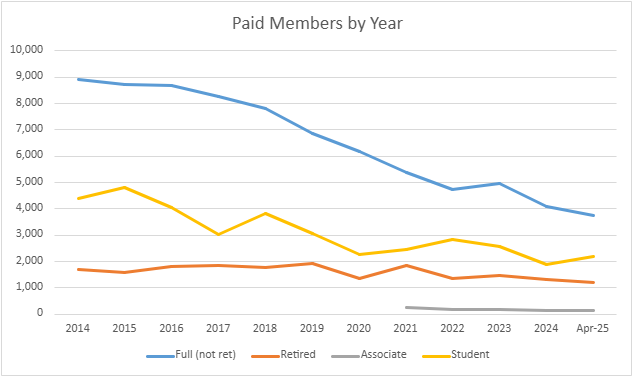
The number of APS full, dues-paying members has dropped steadily from around 9,000 in 2014 to about 3,800 today. Student membership and convention attendance have followed similar trajectories. Even more concerning is the outdated governance model. APS was built for a world with a strong and visionary executive director. The original bylaws gave that role considerable power, with presidents and the board serving mostly advisory functions.
That model worked well for its time. But today’s challenges demand more flexible, collaborative leadership. We need a structure that can respond to shifting funding landscapes, evolving career paths for graduate students, global connectedness and opportunities, and new threats to science and society alike.
Over the past year, I’ve worked with a remarkable team to lay the groundwork for change. Our Board of Directors—including Immediate Past President Randi Martin, President-Elect Pamela Davis-Kean— along with Past President Wendy Wood and Tamera Schneider serving as advisors—has engaged deeply in discussions about rethinking and modernizing APS.
Among the shifts already underway:
- Rethinking governance. To change the way APS works, we have spent several months crafting a new set of bylaws. APS members will soon receive a proposed update to our bylaws—changes designed to strengthen the board structure and function, clarify leadership responsibilities, and enable more sustained strategic planning. Turbulent times require leadership that is both nimble and trustworthy.
- Strengthening advocacy. APS has joined the Federation of Associations in Behavioral and Brain Sciences (FABBS) and become a formal sponsor of the National Academies of Sciences, Engineering, and Medicine (NASEM). These partnerships will help us advocate more effectively for psychological science, and support members in engaging with policymakers and funding agencies. Randi Martin has created a task force that will coordinate advocacy efforts.
- Supporting the next generation. We’re expanding our efforts to serve students, early-career researchers, and psychological scientists in non-academic careers—a group that now represents more than half of PhD recipients in psychology. APS has so much to gain from embracing the valuable expertise of our scientists who are doing important research in government, medicine, business, and other careers.
- Building international and interdisciplinary bridges. We’re actively exploring new collaborations with other psychological societies and with fields such as neuroscience, informatics, education, public health, and policy. The headwinds we are facing are not just blowing in the United States. Working with psychological societies around the world and with our international APS members is a top priority.
And this is just the beginning.
I didn’t take on this role because I had a master plan. I did it because I believe in the power of psychological science—and the public good we have to offer. The work we do matters.
But our organization must evolve to match the strength of our science. That change shouldn’t come from the top down. We particularly need the guidance of those who are early- or mid-career. If that describes you, it will be your generation that can read and react to the cultural and scientific winds we are facing.
Related content: Exploring Tech Jobs as Psychological Scientists
The world is changing fast. If APS doesn’t change with it, we risk irrelevance—not because our science is weak, but because our structures haven’t kept up. Let’s fix that. Let’s make APS the professional home that today’s scientists—and tomorrow’s—deserve.
Feedback on this article? Email [email protected] or login to comment.



APS regularly opens certain online articles for discussion on our website. Effective February 2021, you must be a logged-in APS member to post comments. By posting a comment, you agree to our Community Guidelines and the display of your profile information, including your name and affiliation. Any opinions, findings, conclusions, or recommendations present in article comments are those of the writers and do not necessarily reflect the views of APS or the article’s author. For more information, please see our Community Guidelines.
Please login with your APS account to comment.