
The Nuclear Risk Research Gap
Nuclear war is one of the world’s greatest existential threats, so why isn’t there more psychological research on it?
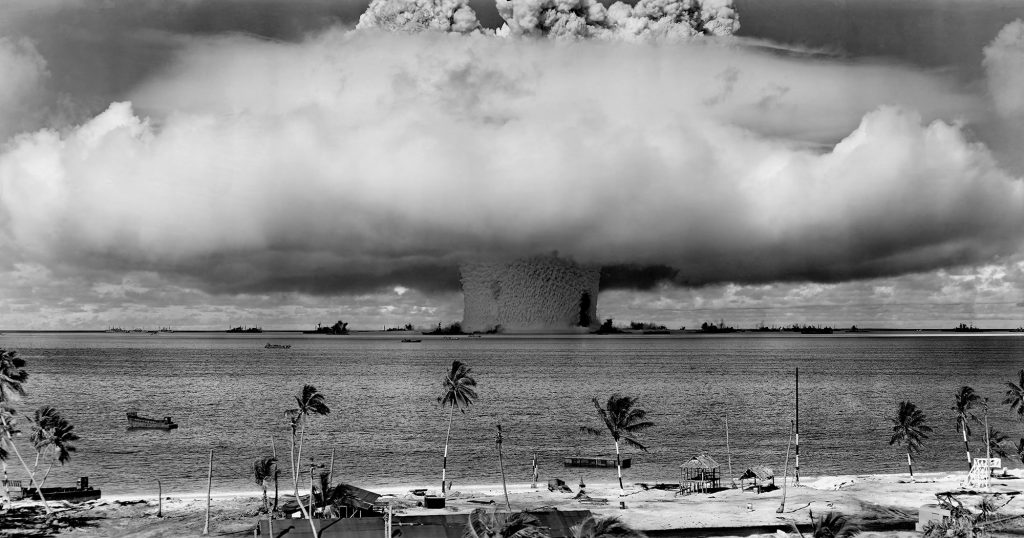
Image above: The “Baker” Explosion, part of Operation Crossroads, a US Army nuclear test at Bikini Atoll, Micronesia, on July 25, 1946. Original: United States Department of Defense (either the U.S. Army or the U.S. Navy) Derivative work: Victorrocha, Public domain, via Wikimedia Commons.
A U-shaped curve • Making sense of nuclear anxiety • Media and collective trauma
Quick Take
- Psychological science on nuclear risk slowed in the early 1990s, after the Cold War ended. Between the late 1990s and the mid 2010s, there was almost no research on the topic.
- Some recent studies, such as ones conducted after the Russia–Ukraine war started, examine the anxiety that people may feel from consuming news related to conflict, including risk of nuclear-weapon use.
- Clues on how psychologists can research anxieties over nuclear conflict can be found in literature from other fields, including studies on media consumption or collective trauma.
When Russia invaded Ukraine in early 2022, public health researcher Abanoub Riad noticed that a spike of anxieties over nuclear war spread across much of eastern Europe. News in this part of the world, namely former Soviet countries, zeroed in on the prospect of nuclear escalation from the conflict. For months, readers were bombarded with headlines from the war, such as political threats of nuclear weapons use, explosions near nuclear power plants, and the refugee crisis.
“Everyone was talking about it, and not only in my community, but in the news and the media,” said Riad, who is based at Masaryk University in Czechia. “All these sources contributed to what we anticipated as an emergence of nuclear anxiety.”

But researching the mental health impacts of nuclear-war threats proved challenging. When Riad and his colleagues began their literature review for their own research, they stumbled upon a significant gap in psychological research on nuclear war and mental health. The literature was extremely active in the 1980s, during the throes of the Cold War, but had calmed by the 1990s. Almost no research has been done in the past decade. “This was a challenge for us because we don’t have reliable or tested instruments about this topic,” Riad said.
This research gap was also noted by Astrid Kause, a psychologist at Leuphana University of Lüneburg in Germany and lead author of a new paper published in Perspectives in Psychological Science. “I’ve studied risk [for] 10 years, and I have never come across the nuclear topic in my own field,” she said. She originally set out to disprove her own impressions, but her recent review affirms this dearth of nuclear-risk research in psychology, highlighting the overall lack of recent research on how nuclear weapons affect people’s behavior, motivations, and mental well-being.
“We as psychologists have a duty in finding out whether and how people understand what they are actually confronted with, in regard to nuclear-weapon impacts,” Kause said. Only then can researchers know how to support people in times of escalated risk, and how to take action and move forward collectively.
A U-shaped curve
Typically, literature in a specific field accumulates along a linear path. “You usually see in systematic reviews … a linear increase in papers over time, because the overall number of publications increases, and specific literature fields reflect this trend,” Kause explained. This is the case in her field of expertise—how people respond to climate change risks—as the field has grown tremendously in the past decade.
The pattern in psychological research of nuclear weapons, however, follows a different pattern. Instead of an upward trend, the literature published over time follows a U-shaped curve. “This U-shaped curve was something that really struck us when we saw it,” Kause said. “It was surprising, given that [nuclear weapons] never disappeared.”

In their recent publication, Kause and colleagues documented this pattern. They conducted a vast literature review in psychology and adjacent fields, collecting papers related to nuclear-weapon risk from the 1980s to recent years. By asking experts in the field, and by scouring scientific databases, the team collected tens of thousands of papers. The large collection was then screened and whittled down to include only empirical papers focused on nuclear-weapons risk, resulting in a body of literature of 256 papers.
From this, the researchers identified not only a U-shaped curve, but also how the focus of nuclear-weapons risk research has shifted in the past few decades. “The literature toward the end of the ’80s and early ’90s was much more psychological,” Kause noted. Papers post-Cold War tended to highlight nuclear anxiety, perception, and activism. By contrast, the recent resurgence of research lies within the political sciences, rather than psychology. These studies focus much more on evaluating security issues, including national and international policies around nuclear weapons, and which policies countries should support.
Kause added that past papers on nuclear-weapons psychology also tended to have a more Westernized perspective, focusing on European countries. More recent research examines more diverse locales such as South Korea, Japan, Morocco, and Brazil, reflecting how nuclear technology and nuclear weapons have expanded globally. In addition, “geopolitical escalation always causes a bit more of a push,” Kause said, inspiring studies in Hawaii after a false missile alert and in eastern Europe as areas faced conflict.
Highlighting this research gap is a call to action. Unlike climate disasters, where the effects are often local, the threat of nuclear war affects a large number of people all at once, as well as over a long period of time, such as through nuclear fallout. “It is even more extreme than extreme weather,” Kause said. “[Nuclear threat is] a thing to be concerned about.”
And yet, there are many things that researchers do not understand about nuclear threats, including how prepared people are for a nuclear disaster, how war threatens mental health, or awareness about the effects of nuclear exposure. One question Kause is particularly interested in is what motivates people to engage in nuclear-war activism.
“There was a huge movement in the 1980s [for] nuclear freeze, actually. And activism is a very important thing to understand,” she said. She added that two recent Nobel prizes were awarded to nuclear activists, yet there is little psychological research on drivers of nuclear activism. “This, again, contrasts the climate domain,” she said.
The complex factors related to nuclear technologies, from weapons to energy production, also have real consequences and affect livelihoods, something psychological researchers have recognized for decades (Morawski et al., 1985). Understanding these nuances is imperative, especially as current geopolitical tensions escalate. “This is a health and mental health issue, and I think psychologists can and should address that,” Kause said.
Making sense of nuclear anxiety
One week after the Russia–Ukraine war broke out, Russian President Vladamir Putin hinted that he would use nuclear weapons. In that same week, Russian forces attempted to seize the Zaporizhzhia nuclear power plant, setting off explosions and fires in the surrounding areas. Tensions were high for people who lived in the area, especially those who had historically experienced nuclear conflict. Young adults feared for the future.
But the extent of this mental distress was unknown, inspiring Riad of Masaryk University and his colleagues to undertake an investigation of some of Czechia’s university students. Their findings, published in 2023 in the International Journal of Environmental Health and Public Health, showed widespread fears, symptoms of generalized anxiety, and depression within this population. “[University students] were the easiest for us to access and [in a] timely manner, because we understood this is a timely threat,” Riad said.
For the 2023 study, Riad and his team focused on how the effects of news about the Russia–Ukraine war on overall mental health was related to nuclear anxiety. “Our definition of nuclear anxiety is that it is an anxiety disorder arising from fears of nuclear war, nuclear escalation, or nuclear accidents, particularly when these fears are amplified by intensive news exposure and geopolitical uncertainty,” he explained.
To measure these factors, the researchers administered a questionnaire to almost 600 Czech university students, assessing demographic characteristics, levels of concern over the news, frequency of news use, generalized anxiety and depressive symptoms, attitudes toward nuclear power, and nuclear-war anxiety. To measure the latter, Riad noted that they had to adapt questions from Cold War era studies. “We extracted the items that we saw as relevant for our context today,” he said.
Overall, the team found that around 40% of participants felt depressed at the possibility of nuclear war and thought that it was very possible that nuclear war could happen in their lifetimes. The analysis also revealed a few factors that were associated with higher nuclear anxiety. Namely, more frequent news consumption was associated with higher general anxiety, and higher background anxiety and depression were strongly correlated with nuclear anxiety. In addition, women had slightly higher levels of nuclear anxiety than men. Certain students from countries with a history of nuclear conflict or disasters also seemed to be more sensitive, such as Japanese or Czech students who grew up near power plants.
“When we’re seeing this stuff [in the news], what is it doing to us?”
– E. Alison Holman
However, these relationships, Riad noted, cannot be considered to be causal. “It’s not easy for us to make these interpretations at this stage because this was cross-sectional analysis,” Riad said. But the study provides some beginnings for future research, showing that nuclear anxiety levels can be elevated, and highlights groups who may be more susceptible to worsening mental health. “People from different backgrounds could have different reactions to the nuclear threat,” he said.
Despite these effects, Riad noted that in the past four years of the Russia–Ukraine war, his research team is one of the few focusing on nuclear anxiety and the trauma that arises from it. His team recently published another study on the topic in Czechia, and he urged more researchers to look at the link between nuclear anxiety and news consumption in their own countries. “In general, as a scientific community, we should have invested more into understanding and exploring nuclear anxiety,” he said.
Media and collective trauma
Although research on the mental health impacts of nuclear threats is lacking, it’s possible that psychologists can look to other forms of trauma to understand how to further its study and support.
E. Alison Holman has been studying the topic of collective trauma and media consumption for decades. She’s especially interested in people’s responses in the first few weeks after a traumatic event occurs and in what happens when people are exposed to repeated graphic videos and harrowing headlines—from 9/11, to visuals of war in the Middle East, to the Boston Marathon bombing. “When we’re seeing this stuff [in the news], what is it doing to us?” Holman wondered.

Over the years, Holman’s research has shown how being constantly bombarded with news of traumatic events is not only linked to acute stress and symptoms akin to post-traumatic stress disorder (PTSD), but this exposure also expands the effects of a traumatic event beyond the place where it occurred. This means that every local catastrophe covered by the media has the potential of becoming a global trauma.
For instance, in a 2013 study in Psychological Science, Holman and her colleagues showed how people across the United States, notably those who watched over 4 daily hours of television footage on the September 11 World Trade Center plane crashes and on the Iraq War during the first weeks of the conflict, had PTSD symptoms that lasted for 2 to 3 years. Similarly, in a 2019 paper in Clinical Psychological Science, she and her team found that repeated watching of the footage of the Boston Marathon bombings, especially graphic and bloody images, was associated with fear of future terrorism, post-traumatic stress, and functional impairment.
Related: Trauma and Resilience in Disaster’s Wake: A Scientific Perspective
The stress is likely compounding. Now, more than ever, people have access to media and news at their fingertips, meaning that researchers now have a mountain of unanswered questions. Holman noted that she’s interested in how different types of media, like text, audio, or video, have differing impacts on mental health. Social media, too, has rapidly changed the media landscape and what types of information people are exposed to. Content on social media feeds can be graphic and comes without context. “It pops right up in front of your face. And I don’t think people realize how easily they can be exposed to graphic imagery without choosing to see it,” Holman said.
The gap and puzzle of nuclear risk, therefore, is a part of this larger context where people are bombarded by many stressors, from increased cost of living to the climate crisis. Understanding how people are reacting to these stressors—and which are most important—can help researchers protect them from harm. “There is so much instability and so much uncertainty about what’s coming next that I think it’s easier for people to imagine the worst,” Holman said. But she recommended staying connected with the people around us, consuming media mindfully, and helping others within our communities.
“Human beings are social animals,” Holman said. “And as social animals, we absolutely need each other.”
Feedback on this article? Email [email protected] or login to comment.
References
Kause A., Fischer, H., Mian, Z., & Fiske, S. T. (2026). People’s responses to nuclear weapons: Mapping post-Cold War research. Perspectives on Psychological Science, 21(3), 309–332.
Morawski, J. G., & Goldstein, S. E. (1985). Psychology and nuclear war. A chapter in our legacy of social responsibility. American Psychologist, 40(3), 276–284.
Riad, A., Drobov, A., Alkasaby, M. A., Peřina, A., & Koščík, M. (2023). Nuclear anxiety amid the Russian-Ukrainian War 2022 (RUW-22): Descriptive cross-sectional study. International Journal of Environmental Research and Public Health, 20(4), 3551.




APS regularly opens certain online articles for discussion on our website. Effective February 2021, you must be a logged-in APS member to post comments. By posting a comment, you agree to our Community Guidelines and the display of your profile information, including your name and affiliation. Any opinions, findings, conclusions, or recommendations present in article comments are those of the writers and do not necessarily reflect the views of APS or the article’s author. For more information, please see our Community Guidelines.
Please login with your APS account to comment.