
Ten Years Applying Psychological Science Inside the U.K. Government
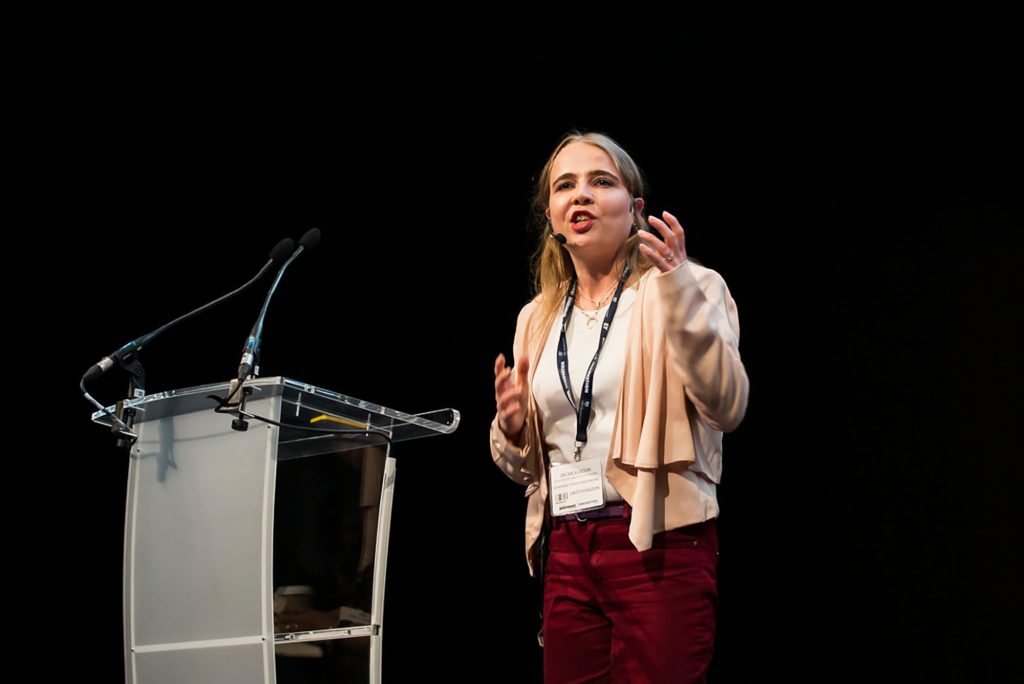
Image above: Carla Groom, former head of human-centered design science at the UK’s Department for Work and Pensions. Photo by Robert Greig at Innovation 2024.
A note from APS President James Pennebaker:
For this Presidential Column, I have asked Carla Groom, a former postdoctoral scholar of mine, to write about her experiences using her training in psychological science to bring about real changes in the British government. Her story points to some of the remarkable effects that psychological training can have in influencing and testing policy changes that affect millions of lives.
APS is increasingly focused on supporting our members who are interested in conducting research in business, government, and other sectors outside traditional academic institutions. Carla’s experience is a powerful lesson in alternative paths available to psychological scientists. Carla worked for almost 20 years in the Department for Work and Pensions, during the last 10 of which she led the Department’s Behavioral Science team, later renamed the Human-Centered Design Science team. She is now an independent consultant offering services to the government and other institutions.
When I was a psychology undergraduate, I became smitten with the question of how to improve the way people make decisions. The question took me on a journey through a PhD at Northwestern University to a postdoctoral position at the University of Texas at Austin, to a stint in consultancy. Then, I joined the United Kingdom government to work on groundbreaking workplace pensions reforms based on psychological “nudge” principles. We switched the default from not saving (into a pension) to saving, but individuals could still choose. Most stayed in, meaning an extra £49.1 billion (about US$62.3 billion) went into U.K. pension schemes annually (Department for Work and Pensions, 2025).
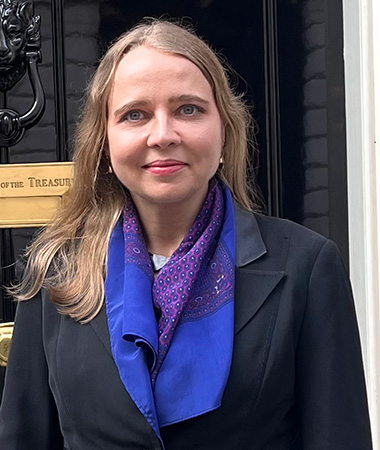
In 2015, our director general for policy, Jeremy Moore, wondered what made this program so successful. Had we simply “harnessed inertia?” Or was there more to the intervention itself and the way the reforms were developed and implemented? Were there other ways in which psychology and related disciplines could improve outcomes? He craved new ways of thinking. Because I had a psychology PhD, he tasked me with building that new capability.
I convened a band of psychologists, sociologists, anthropologists, and philosophers. I oriented us around a particular metaproblem everyone could agree needed fixing: Government decisions were sometimes made on the basis of inaccurate assumptions about people. We focused our efforts on real problems. This is technically “practice research.” I call it “learning by meddling.”
Our favorite case study is about helping people combine work and unpaid caring (“caregiving” for American audiences) if they choose to do so—many people feel forced to leave work when their loved ones become sick or disabled. As a psychologist I intuited that becoming “a carer” would involve multiple transition points and complex identity shifts, and that the process of determining who took on caring responsibility was likely to be laden with social norms, family expectations, and emotionally charged decisions. However, the U.K. government categorized people as “carers” or “not carers.” We spotted that there could be another major group that the system didn’t currently serve: “potential carers.”
My team thought about the gap between what people “should” and “would” do after a loved one developed care needs. Would they be making detailed plans about sharing caregiving between family members? Considering impacts on their work? Future options? We discovered that the information available to potential carers was fragmented, laden with assumptions, and didn’t speak their language.
The next stage was to design collaborative research in partnership with organizations that might be able to reach these people, such as the National Health Service, charities such as the Alzheimer’s Society, and local councils. Sure enough, the research showed people muddled along in those early stages, firefighting problems as they emerged. Only when they reached a crisis point, which often involved leaving their jobs, did they think of themselves as carers and find the support they needed.
Expert content designers helped us develop material that partner organizations could use for websites and leaflets, test it with carers, and come up with ideas for pointing people toward this content early, such as adding messages to pharmacy bags. The lesson was that once we collectively saw this unmet need, we could coordinate action to fix it. A detailed report of the research and collaborative design work has just been published (Department for Work and Pensions, 2026).
A further paper mentions other projects the team got involved in, as well as cognitive science analysis of why these innovative approaches work—or sometimes don’t (Groom, 2025).
Creating a home for this type of psychological science at the APS
The endeavors I’ve described here are not a natural fit for the APS. There were no randomized controlled trials (RCTs), and the final work was published on a government website, not in a journal. Should we be creating pathways for more people to wander across disciplinary boundaries, to zoom into applied contexts and out again? What might it look like for APS to curate a space for psychologists to do this?
Enhancing graduate training
Many of those I hired had a similar background to mine. They were rigorous thinkers, with a conceptual map of human cognition and decision making. They could spot ambiguous thinking and offer clarification. But they needed training in qualitative methods, complexity science, and system dynamics. There was also some unlearning to do about what types of activities are admissible in science. Practice research teaches you things, and adds real value, in ways no amount of reading or laboratory study can.
Sourcing hypotheses from practical contexts
The range of phenomena thrown up by institutional research is as worthy of study as that which emerges from discussions on university campuses. The carers example is a great demonstration that the social context of individuals’ decision making matters, and we can study it rigorously.
Innovation in methods and epistemology
Practitioner-scientists like me wrestle with the tension between setting up a project to discover something generally true and setting it up to be most likely to solve the problem at hand. The carer project succeeded because we mixed methods and built a coalition over time that prioritized solutions. If we had been wedded to RCTs, we would never have gotten the outcomes we did. Nor was it possible to do an RCT for pensions reform.
Focusing on theory
Kurt Lewin claimed, “There is nothing so practical as a good theory.” Twenty-five years after first reading that, I concur. Laboratory results are bounded. Field research is dependent on context. But theory helps tremendously with making sense of complex problems. For example, I’ve found 4-E cognitive science especially helpful, as it offers a framework for thinking about cognition as embedded in the body, embedded in context, enacted from interaction, and extended using tools/environments.
Collective decision making as a unit of analysis
Psychologists have learned a great deal about individual decisions. Automatic enrollment into workplace pensions was one amazing outcome of that work. But people frequently make important decisions together, as in families facing carer situations. Now we’re adding artificial intelligence collaborators to the thinking mix.
A space for envisioning the future
Economists come under fire for simplification, but at least they are trying to offer both explanations of the present situation and ideas on how to proceed. My work has shown it is possible to do something similar using psychological tools and understanding in conjunction with neighboring and complementary disciplines. My challenge for APS is to test the hypothesis that such work can scale.
Acknowledgements
I couldn’t have done this without countless academics willing to traverse the pure–applied boundary with me. I am particularly indebted to Lee de Wit and David Good at Cambridge University, Lucy Kimbell at the University of the Arts London, Weston Baxter at Imperial College London, John Vervaeke at the University of Toronto, and Gregg Henriques at James Madison University. And to James Pennebaker, who has encouraged and supported my adventures since 2001.
Feedback on this article? Email [email protected] or login to comment.
References
Groom, C. (2025, July 17). Public Design Evidence Review: Reflections from the Human-Centred Design Science team, Department for Work and Pensions. Cabinet Office; Policy Profession.
Department for Work and Pensions. (2025, July 31). Workplace pension participation and savings trends of eligible employees: 2009 to 2024.
Department for Work and Pensions. (2026, January 29). Carers’ Employment Digital Discovery and Care Choices reports.



APS regularly opens certain online articles for discussion on our website. Effective February 2021, you must be a logged-in APS member to post comments. By posting a comment, you agree to our Community Guidelines and the display of your profile information, including your name and affiliation. Any opinions, findings, conclusions, or recommendations present in article comments are those of the writers and do not necessarily reflect the views of APS or the article’s author. For more information, please see our Community Guidelines.
Please login with your APS account to comment.