
Member Spotlight: 2025 Spence Award Recipient Justin Minue Kim On the Science of Emotion
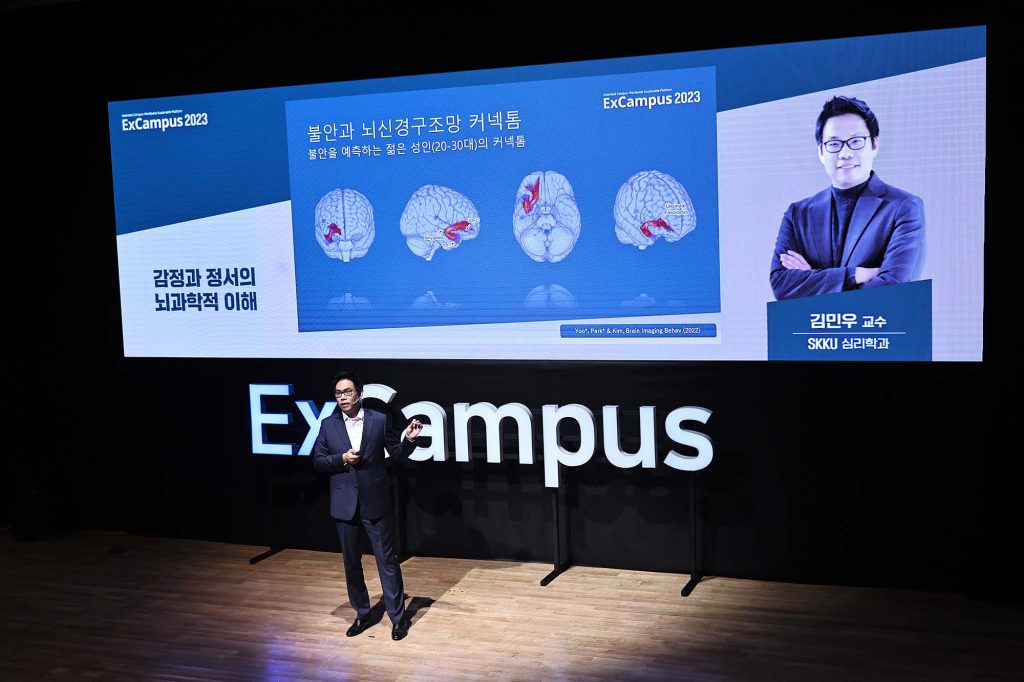
Image above: Justin Minue Kim gives a lecture on the neuroscience of emotion and anxiety.
Justin Minue Kim is an associate professor in the Department of Psychology at Sungkyunkwan University and the director of the Human Affective Neuroscience Lab. The 2025 APS Janet Taylor Spence Award recipient was also named an APS Rising Star in 2021.
Learn more about Kim and the six other Spence Award recipients.
The power of emotion

Emotion is a powerful psychological state that can determine how we engage in human interactions, and how we manage our affect is a crucial piece to being successful in the social world. We all have the ability to experience and understand emotions, but the extent to which we do varies depending on who we are. Focusing on this characteristic of emotion, my research program examines the neurocognitive mechanisms responsible for affective information processing by looking at the universal (i.e., common across individuals) and idiosyncratic (i.e., different across individuals) features of emotion. Naturally, understanding these mechanisms has important implications for mental health, such as anxiety.
Prior to settling on this subject, I had a unique opportunity to study the brains of individuals diagnosed with post-traumatic stress disorder (PTSD) following a tragic subway fire. This was my first attempt at conducting a functional neuroimaging (fMRI) experiment. Though the study produced some useful findings and successfully met its research objectives, I couldn’t help but wonder what was truly happening within the neural circuits that exhibited different responses to emotional stimuli in individuals with and without PTSD. Where do emotions come from? And what role does the brain play in shaping them? These questions sparked my desire to explore the brain–behavior relationship of emotions at a basic science level. This shift in focus inspired me to transition from clinical psychology to cognitive neuroscience, ultimately leading me to pursue a PhD at Dartmouth College. My passion for affective neuroscience has only grown since.
Establishing a foothold
In early 2020, shortly after relocating to Sungkyunkwan University and beginning my new role as an assistant professor, pandemic-related disruptions significantly impacted the launch of my lab. Restrictions on in-person data collection brought our research to a standstill, creating immense pressure as a junior primary investigator striving to publish and establish a foothold in academia. Now, I am grateful to be experiencing what I consider to be the most productive years of my career so far, providing me with valuable opportunities to contribute to our field.
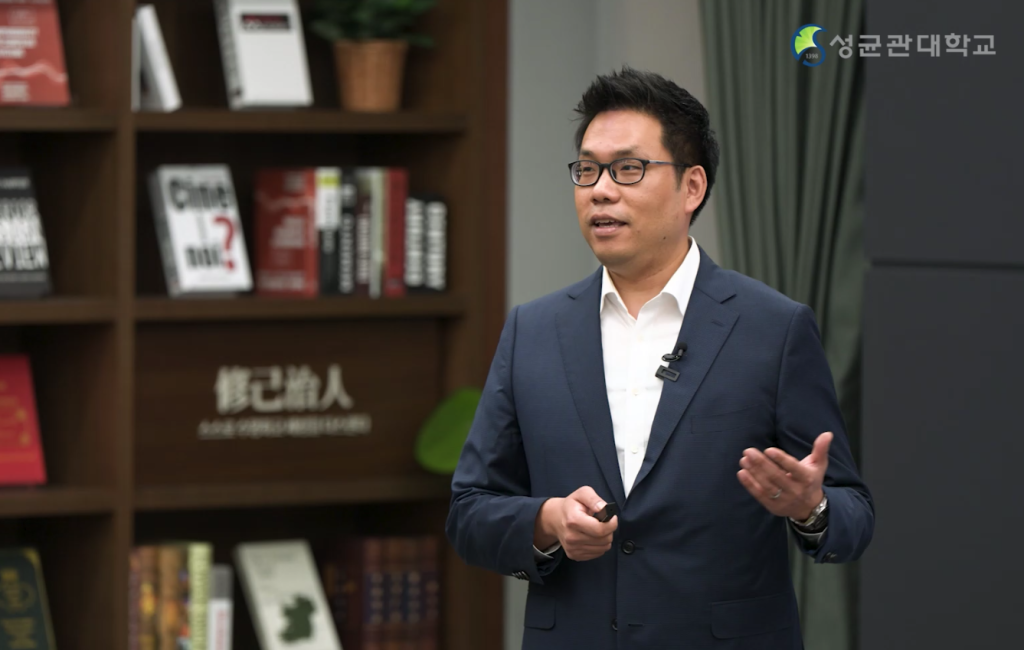
That said, I’d like to think that the biggest challenge lies within the subject matter itself.
Emotions are intuitive and universally intriguing—everyone has their own perspective on what they are. Yet, defining emotion remains one of the greatest challenges in psychology. Moreover, emotional experiences are inherently subjective, making it difficult to establish a clear, objective framework for study. This raises a fundamental question, not unlike the “hard problem of consciousness”: Can we scientifically investigate something that lacks a precise definition and cannot be directly measured in an objective way? This is a question that all affective scientists are striving to answer, and I remain hopeful that our collective research efforts will bring us closer to a meaningful solution.
Performing groundbreaking research
My research has highlighted the multifaceted functional role of the human amygdala–prefrontal circuitry, which includes, but is not limited to, emotion regulation, valence computation, social cognition, and mental health. Using multimodal neuroimaging tools such as fMRI and diffusion tensor imaging (DTI), my work focuses on the interconnectivity of brain networks to understand the neural systems that support emotion regulation by linking ambiguity processing with anxious traits.
Specifically, my first publication as a PhD student was one of the first to combine fMRI and DTI to provide a link between amygdala–prefrontal circuitry and trait anxiety (Kim & Whalen, 2009). Embracing the issues concerning reproducibility in psychological science, I took it upon myself to replicate the earlier findings (Yoo, Park, & Kim, 2022). This line of work is still ongoing in my lab—just a couple years ago, we published a paper analyzing the morphological similarities of DTI-based white matter tracts, which enabled the investigation of the more fine-grained features of the amygdala–prefrontal circuitry while also confirming its functional significance in trait anxiety (Kim & Kim, 2022). This was made possible by adopting novel methods that explicate features of white matter tracts that have typically been disregarded. I’ve also launched a series of experiments to probe this neural system using emotionally ambiguous stimuli (i.e., surprised facial expressions), linking ambiguity processing with anxious traits. My research leads me to believe bringing these two lines of research together is crucial for demonstrating that the capacity for efficient crosstalk between the amygdala and the prefrontal cortex may be key in predicting treatment outcomes in mood and anxiety disorders.
Our lab is also exploring several exciting new directions to expand our research. Recently, we have started incorporating naturalistic experimental designs—such as analyzing brain responses and facial expressions while watching movies or listening to stories—under the premise that these methods more effectively evoke genuine emotional responses in a laboratory setting. Furthermore, my goal is to bridge our basic research findings with practical applications by exploring their predictive, diagnostic, or prognostic value through machine-learning principles. For instance, could a brief movie-watching fMRI session serve as a useful tool to assist in the formal diagnosis of anxiety disorders? These are key research questions we aim to explore in our future work.
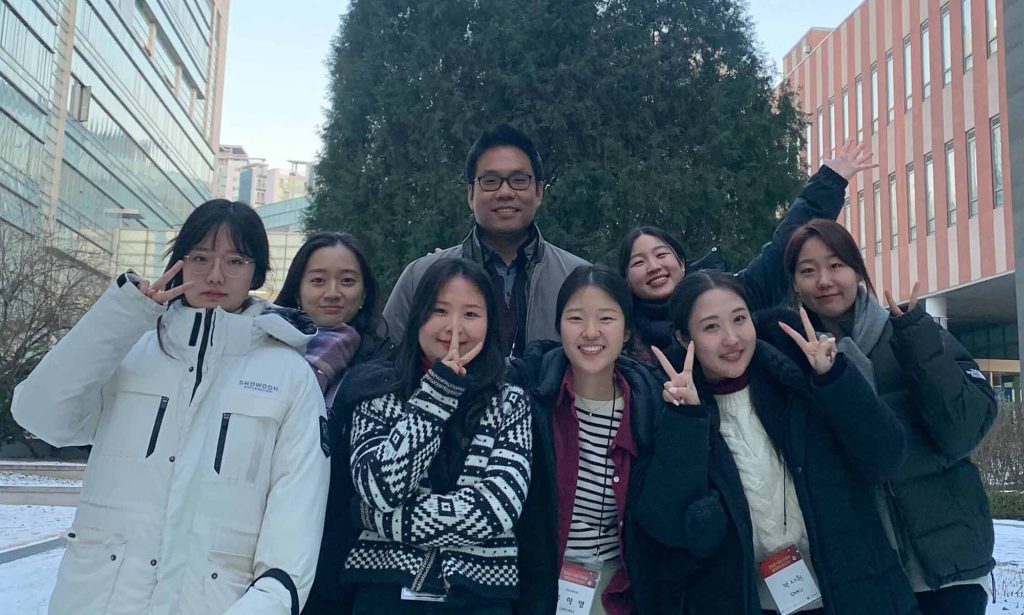
Talking to your colleagues matters
Communication with other researchers is key. Engaging in scientific discussions with colleagues fosters creativity and sparks inspiration. In an era of generative artificial intelligence, where seeking solutions through direct conversation may seem less necessary, the value of human dialogue remains irreplaceable. Although this certainly applies to your mentors and supervisors, I would advise anyone early in their academic careers to also seek out a peer they can fully trust. Additionally, stepping beyond your comfort zone and engaging with researchers from adjacent fields can lead to eye-opening insights and a deeper mutual appreciation for other disciplines. Talk to your colleagues!
Feedback on this article? Email [email protected] or login to comment.
References
Kim, M. J., & Whalen, P. J. (2009). The structural integrity of an amygdala-prefrontal pathway predicts trait anxiety. Journal of Neuroscience, 29(37), 11614-11618.
Yoo, C., Park, S., & Kim, M. J. (2022). Structural connectome-based prediction of trait anxiety. Brain Imaging and Behavior, 16(6). 2467-2476.
Kim, W., & Kim, M. J. (2022). Morphological similarity of amygdala-ventral prefrontal pathways represents trait anxiety in younger and older adults. Proceedings of the National Academy of Sciences of the United States of America, 119(42), e2205162119.



Comments
To J. M. Kim,
Please read the book on emotion by Berkeley professor R. S. Lazerus (1991)
Emotion and adaptation. NY Oxford University Press.
Theories of emotion predict
different relationships between emotion, and other variables. My own book, E.D.Ferguson. Motivation:A Biosocial and cognitive integration of motivation and emotion, 2000 , NY Oxford University Press, also shows different relationships between emotion, cognition, individual differences, and motivation.
Good wishes as you proceed in your interesting research.
APS regularly opens certain online articles for discussion on our website. Effective February 2021, you must be a logged-in APS member to post comments. By posting a comment, you agree to our Community Guidelines and the display of your profile information, including your name and affiliation. Any opinions, findings, conclusions, or recommendations present in article comments are those of the writers and do not necessarily reflect the views of APS or the article’s author. For more information, please see our Community Guidelines.
Please login with your APS account to comment.