
How the Behavioral and Social Science Directorate at NSF Really Came to Be
Commissioned as part of commemorating the 75th anniversary of NSF
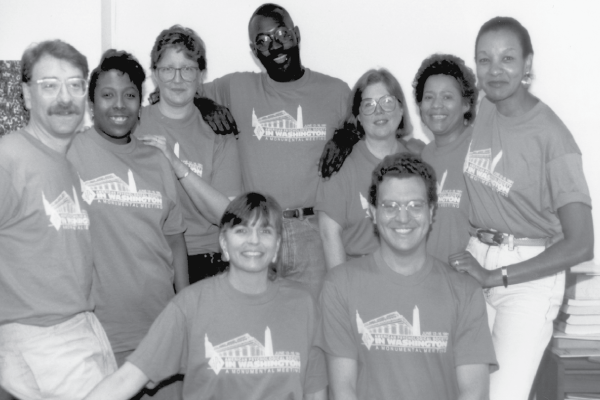
Image above: The APS staff in 1991, including Alan Kraut (top left), the founding executive director, and Sarah Brookhart (top, third from left), executive director from 2015 through August 2020.
APS is the origin of the movement toward a separate directorate.
—Rep. Doug Walgren, APS Observer, November 1991
Creating a directorate for Social, Behavioral and Economic Sciences (SBE) at the National Science Foundation (NSF) was the first big item on the advocacy agenda of APS in 1989. Directorates are the core organizational components of NSF, and their directors comprise the leadership of the agency. Before APS, psychology research at NSF was housed in its biology directorate and was always led by biologist directors. Too often, our science got the short end of the stick there, both in terms of money and respect.
But, curiously up to then there also seemed to be a consensus among establishment psychology organizations that having a separate directorate would make us too easy a target for those who wanted to see less funding for basic research in our science. In fact, in meetings with the NSF director, some establishment behavioral and social science groups argued against creating a behavioral and social science directorate, asserting that we somehow needed the “protection” of being embedded within other sciences.
Enter APS—definitely not an “establishment” behavioral and social science organization! What followed was an approach to advocacy and education that became our playbook for APS’s numerous major achievements for psychological science in the public policy and research funding arenas.
The inside story
APS launched its Washington, DC office in August of 1989, with one of us (Kraut) as its first employee. The other (Brookhart) soon followed, and together, with support from the APS Board of Directors, we set about systematically putting a new NSF plan in place, one that aimed to make psychology and all social and behavioral science as visible as possible.
Running Up That Hill
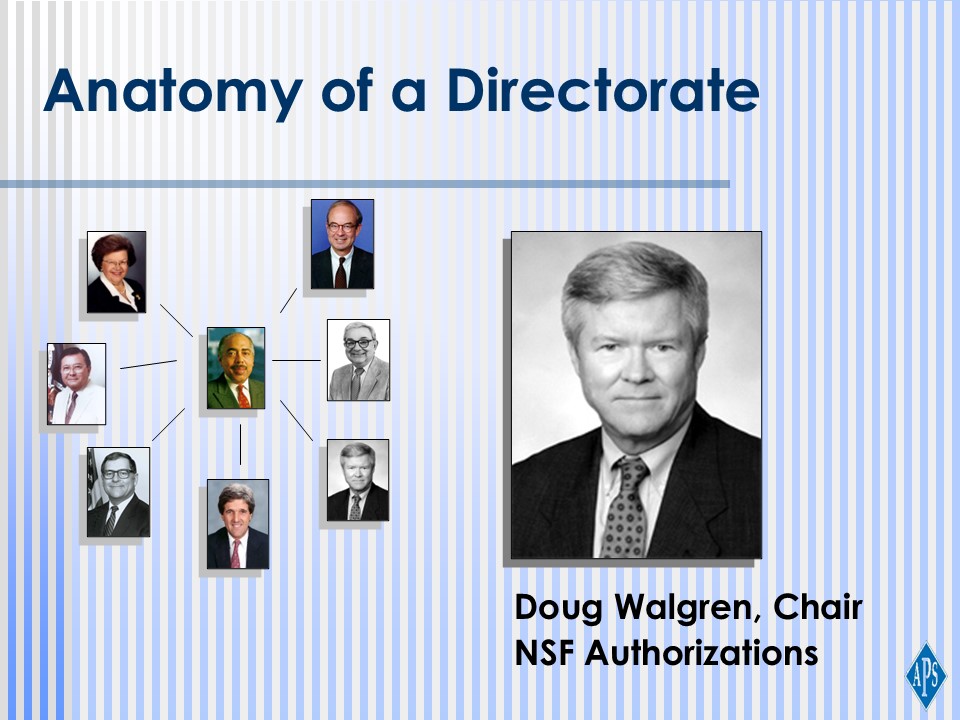
In addition to Rep. Walgren, we worked with several other key representatives and senators to gain their support for the separate directorate, including:
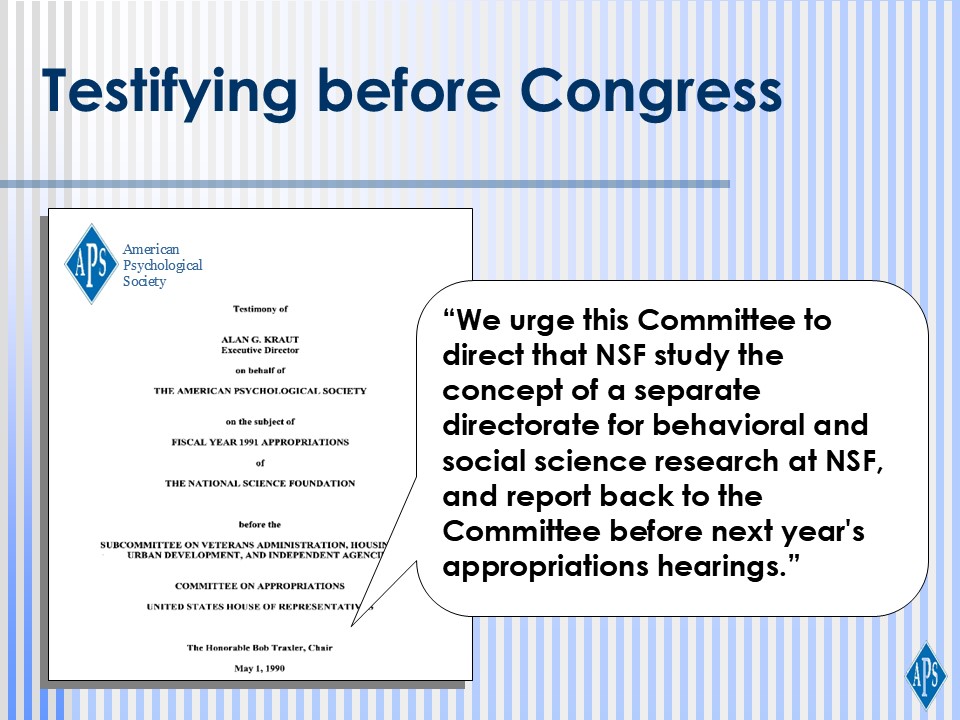
- Michigan Rep. Bob Traxler, chair of the House Appropriations subcommittee that funds NSF (federal agencies typically report to two committees in both the House and Senate; the authorizing committee that guides the agency’s general policies and the appropriations committee that sets the annual funding given to that agency to carry out those policies.);
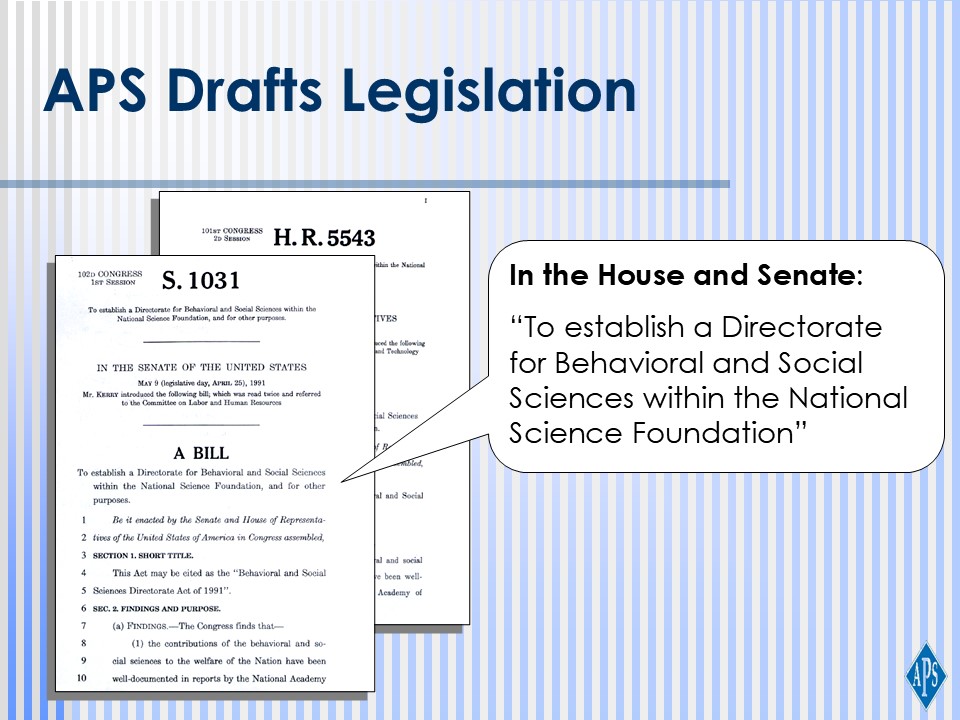
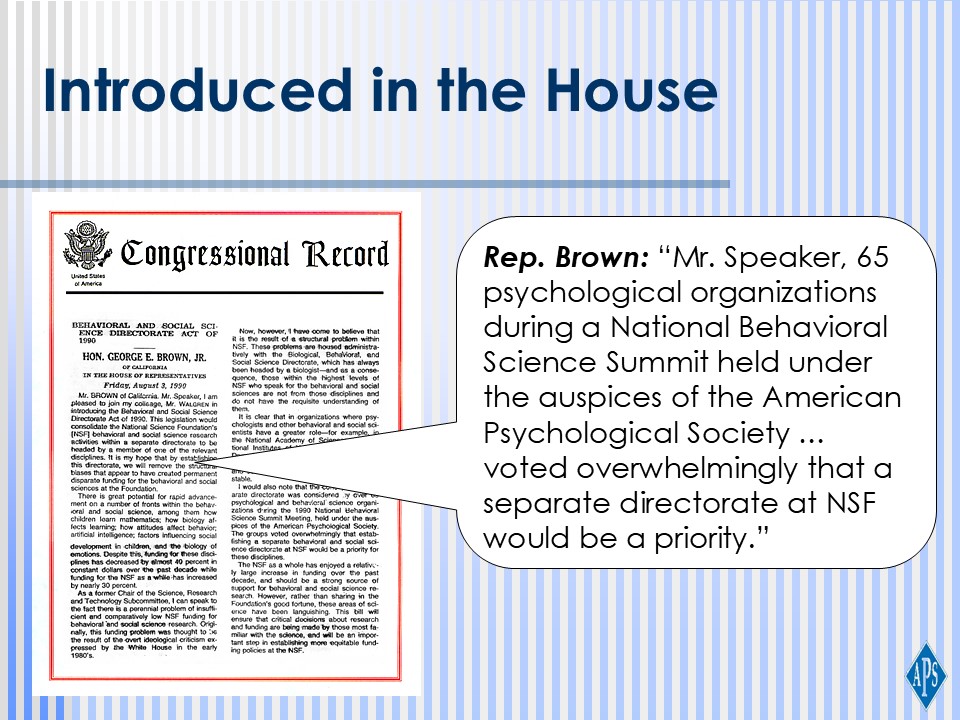
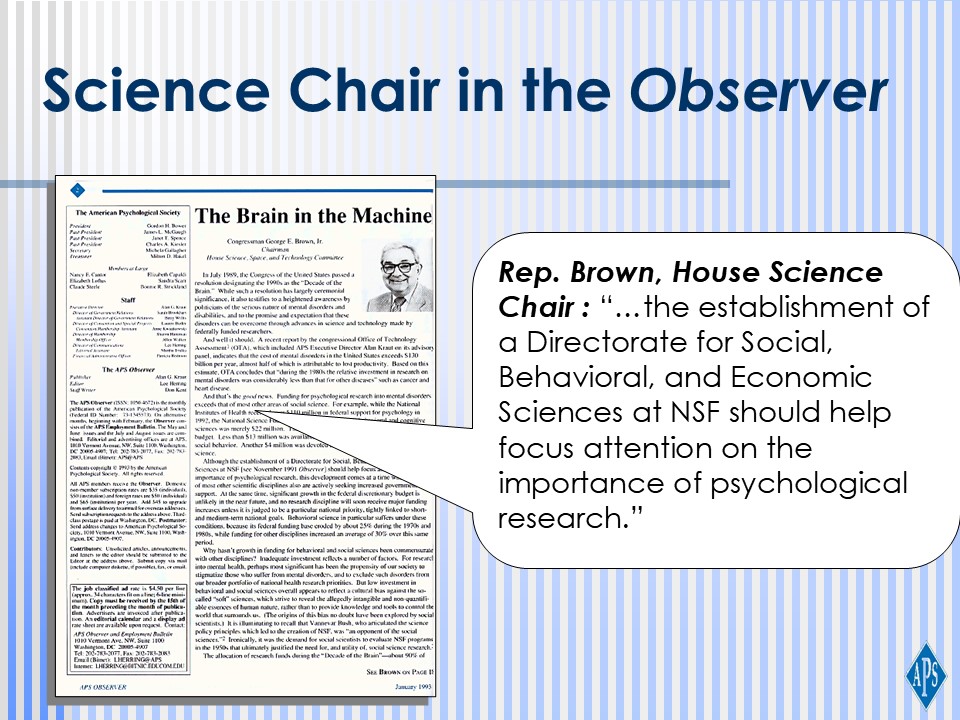
- California Rep. George Brown, known on Capitol Hill as “Mr. Science,” who, with Walgren, introduced the necessary legislation to establish a separate directorate;
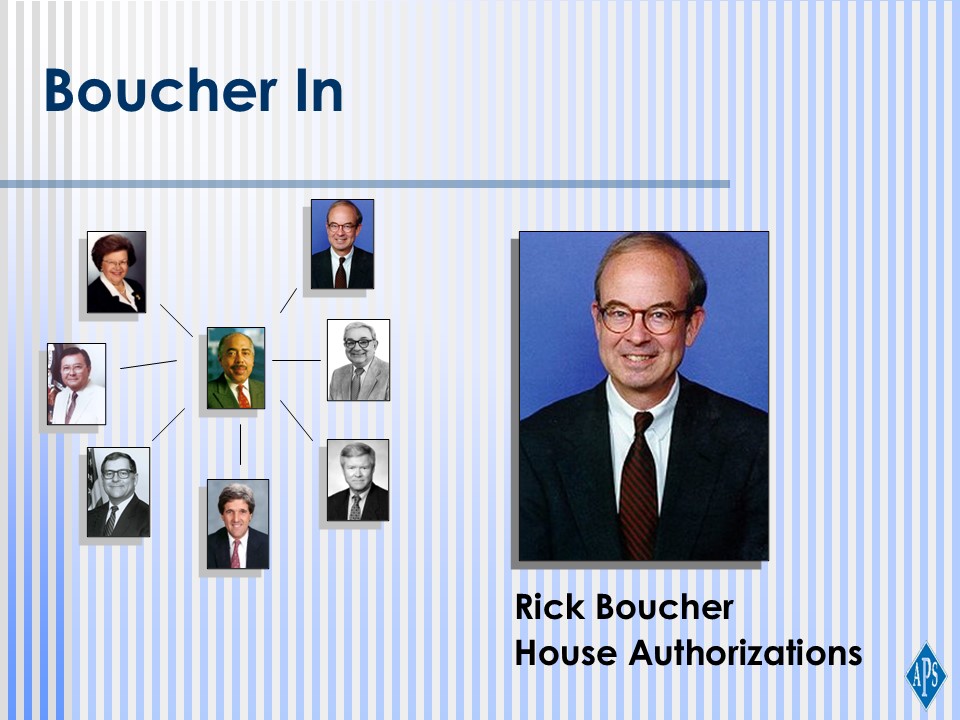
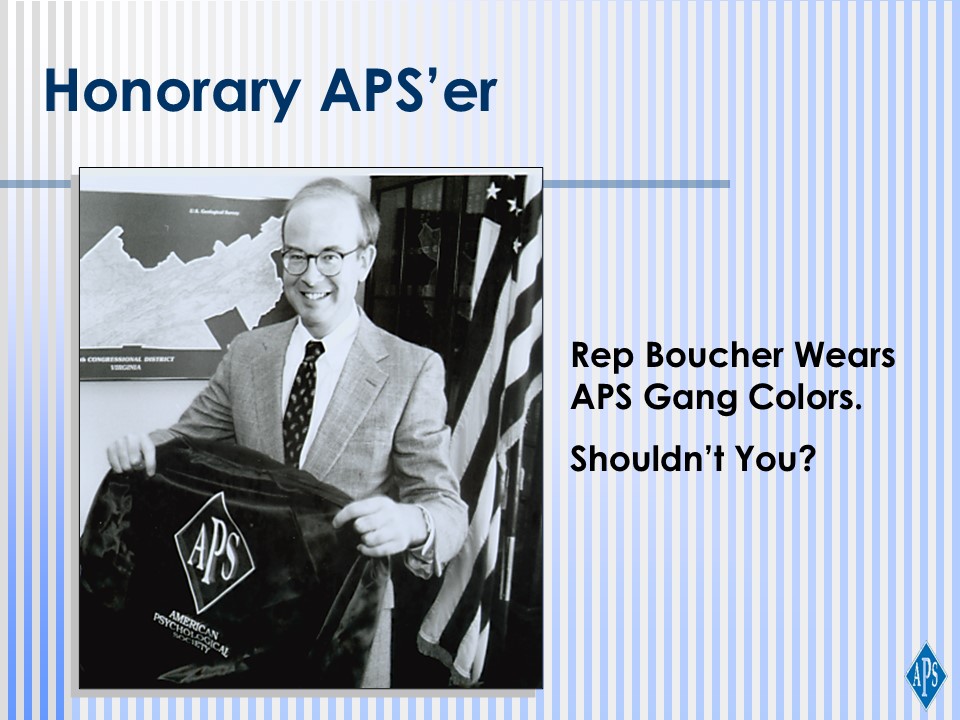
- Virginia Rep. Rick Boucher, a future NSF authorization chair in the House;
- Maryland Sen. Barbara Mikulski, chair of the Senate NSF appropriations committee;
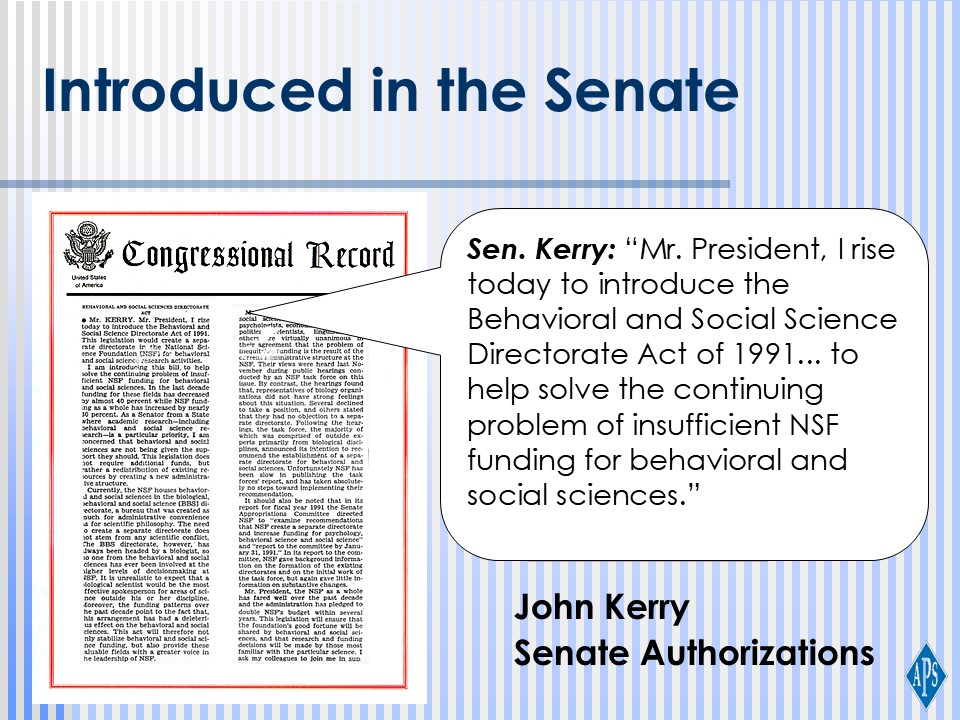
- Massachusetts Sen. John Kerry, who introduced the legislation in the Senate to create a separate directorate at NSF;
- Hawaii Sen. Daniel Inouye, longtime supporter of psychology, and especially his chief of staff, psychologist Pat DeLeon.
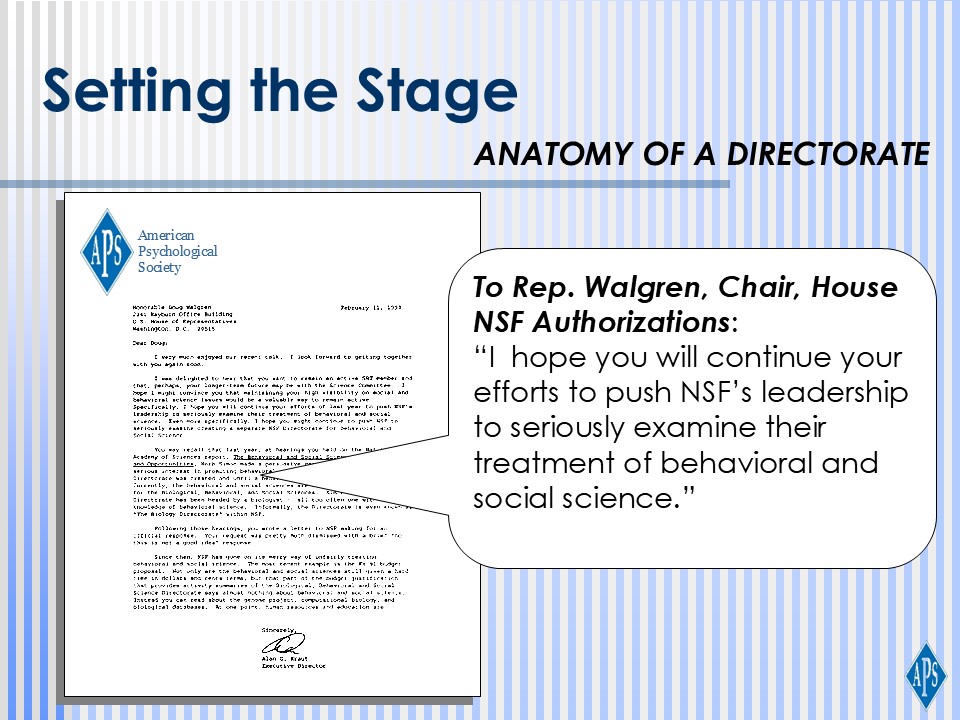
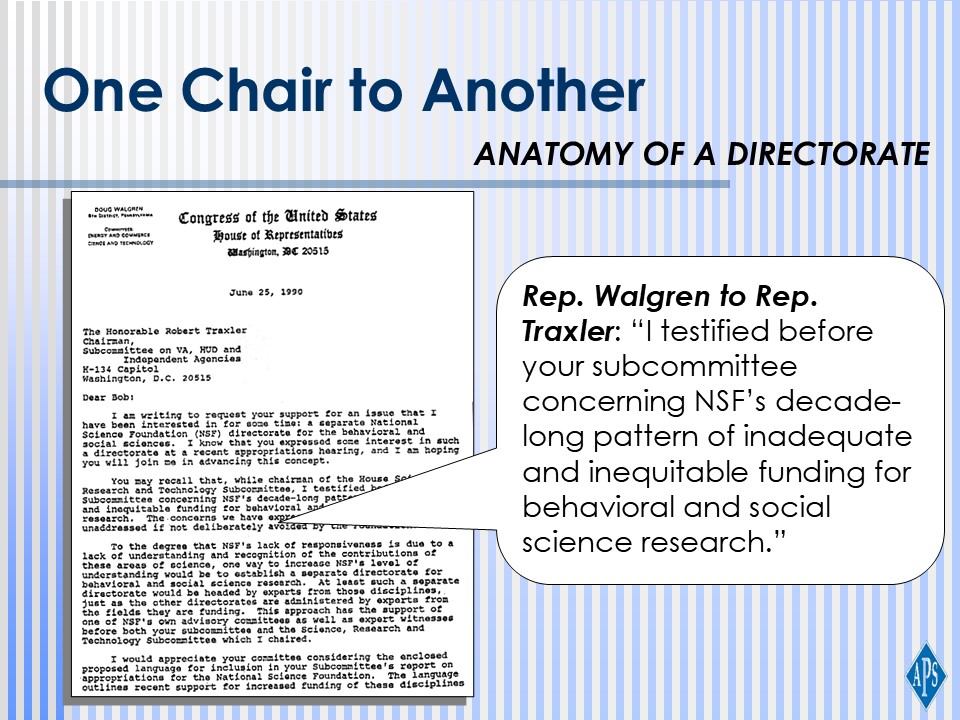
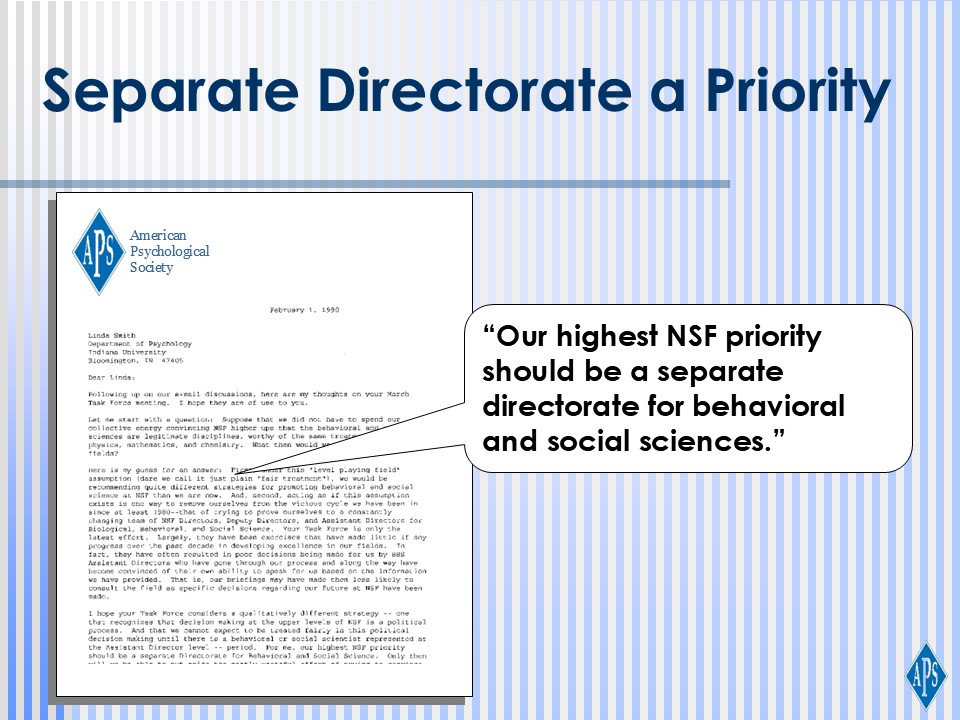
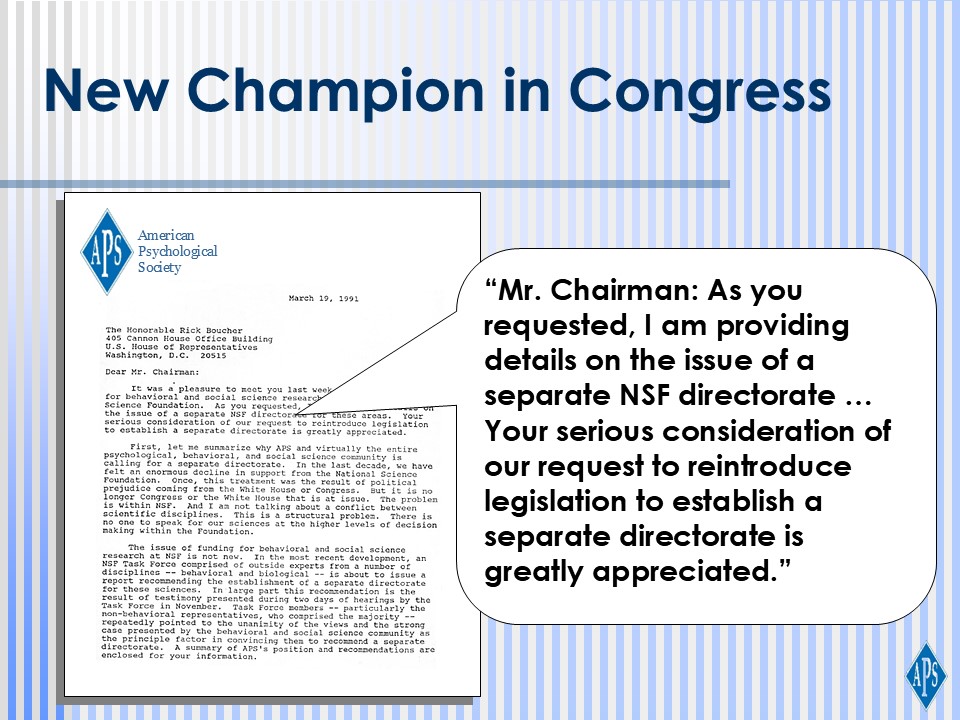
The plan began with fostering relationships with relevant congressional offices on behalf of the new APS. Perhaps the most critical was with Pennsylvania’s Rep. Doug Walgren, then Chair of the House subcommittee that authorized NSF’s programs. Kraut met with Walgren in January 1990 to introduce APS and its new take on psychological science, and to ask for his support for APS’s proposal for a separate NSF directorate. In a follow-up letter, Kraut expressed the hope that Walgren would “push NSF to seriously examine creating a separate NSF Directorate for Behavioral and Social Science.” In fact, when the separate directorate was created in October of 1991, Walgren wrote in the Observer that “APS is the origin of the movement toward a separate directorate.”
[Note: APS was able to engage the influence of a number of key policymakers and psychology researchers in the effort toward a separate directorate at NSF — see related sidebars.]
There are lots of “inside stories” to tell (and some not to tell) about how the separate directorate finally came to pass. Here is one that happened toward the very end and the one we think finally pushed the directorate across the finish line. It came after legislation was introduced in both the House and the Senate to create a separate directorate, after Congressional language encouraging NSF to consider a separate directorate was contained in both House and Senate NSF funding bills, after an NSF task force of outside experts recommended a separate directorate within NSF (Actually, this was the second of two NSF groups to recommend a separate directorate. The first was an internal NSF group that was basically ignored but that did lead to the second external group.), and after many meetings between behavioral and social science groups and NSF—including two days of hearings with multiple organizations presenting testimony to the NSF task force supporting the separate directorate (with other behavioral and social science organizations finally warming up to the issue). But even after all that (and more!), the powers that be at NSF still seemed unmoved.
Related content: Decades at the Helm: APS 2023 Convention Honors APS Founding Executive Director Alan G. Kraut
Sadly, one of the heroes of our story, House NSF authorizations chair and seven-term Congressman Doug Walgren, was unexpectedly defeated in the November 1990 election. He left Congress in January 1991. We offered him APS office space to give him a chance to think about his next career move. He moved in and, in turn, offered to keep advising us on our NSF strategy. APS also gave Walgren our very first Award of Appreciation at our 1991 convention.
Walgren’s replacement as House Chair for Congressional NSF authorizations was Virginia Rep. Rick Boucher. Walgren passed the torch to him, introducing us as good-faith advocates in face-to-face meetings, and helping to convince Boucher of the importance attached to a separate directorate. There were follow-up letters between APS and Boucher and between Walgren and Boucher. We also had multiple meetings with staff of the House NSF subcommittee, most of whom had previously worked for Walgren. Then, as reported in the Chronicle of Higher Education, came an influential in-person meeting between Boucher and then-NSF Director Walter Massey where Boucher “lent his support to the idea of a separate directorate.”
It Took a Village
Prominent academic psychologists were involved in the effort to establish a separate directorate for behavioral and social science at NSF, including:
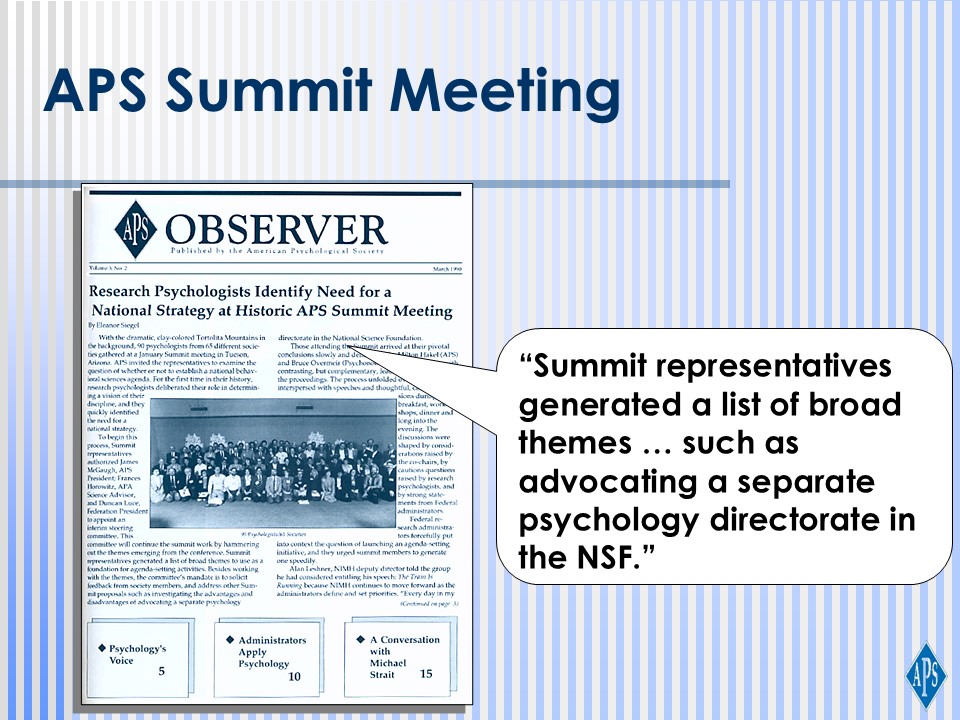
- APS Board Member Duncan Luce (University of California, Irvine) led a discussion at the 1990 APS Summit—a meeting of 65 scientific psychology organizations held in Tucson, Arizona—that resulted in the 90 summit participants voting overwhelmingly in favor of creating a separate NSF directorate for our science.
- APS William James Fellow Linda Smith (Indiana University, Bloomington), representing psychology on the Advisory Committee for the NSF biology directorate, led an effort that ultimately caused NSF to create an external task force to examine a separate directorate for social and behavioral science.
- APS Board Member Nancy Cantor (then at University of Michigan) was appointed to that task force as the only psychologist among the task force’s 12 biologists and eight behavioral and social scientists, and forcefully argued for the separate directorate that was ultimately recommended by the task force.
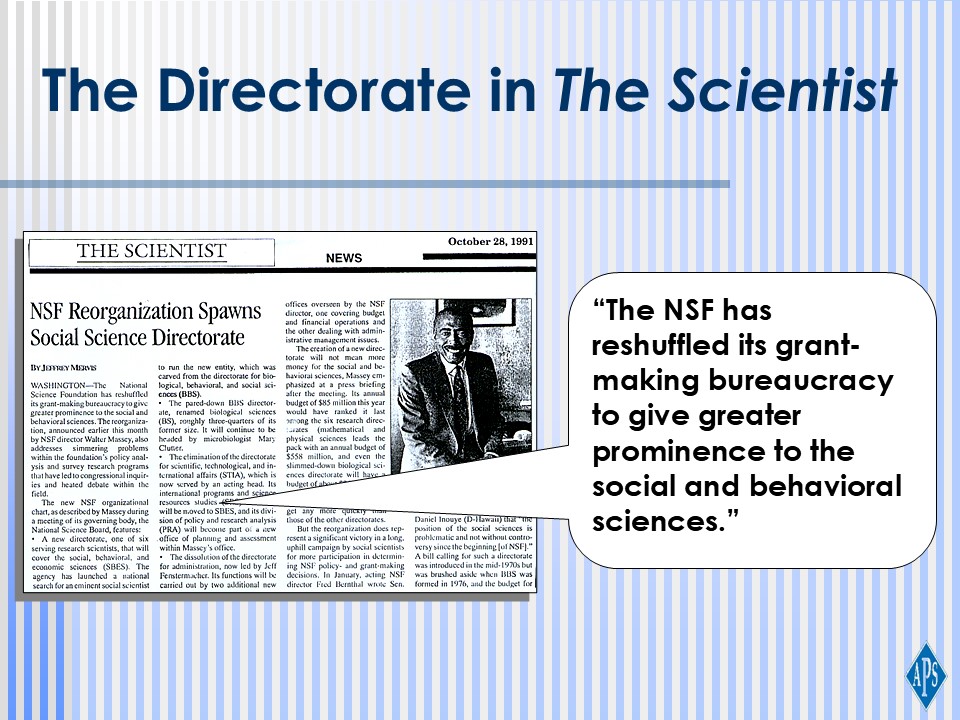
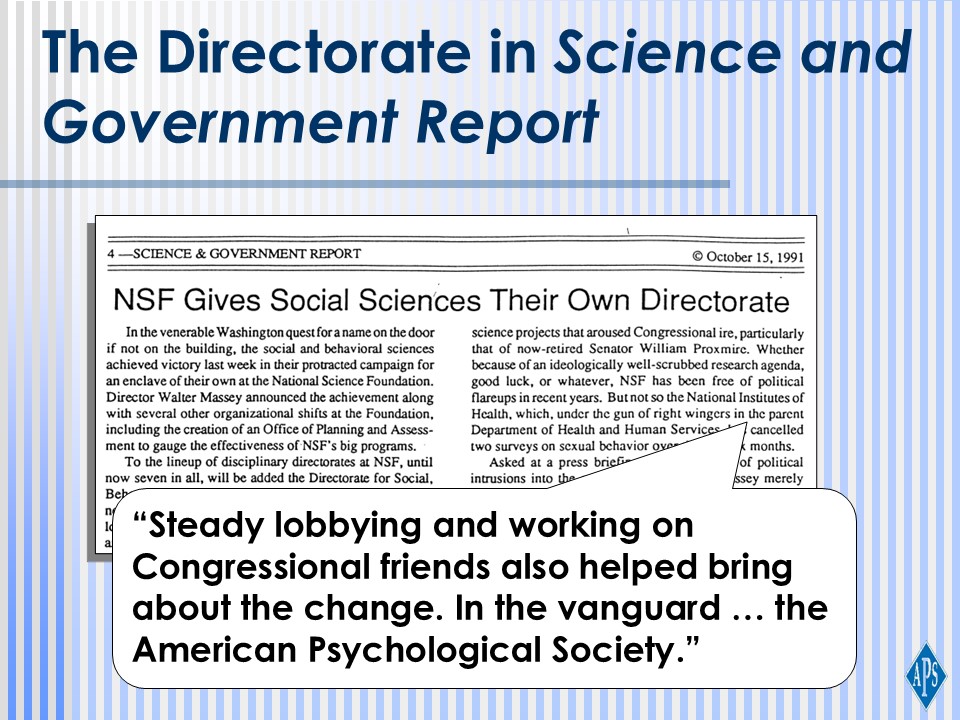
What wasn’t reported in the Chronicle—but was told to us by the congressional staff in that meeting—was that Boucher spoke to Massey like a “Dutch uncle,” saying directly and without hesitation that if Massey didn’t create a separate directorate that he, Boucher, would do it legislatively, and that Massey wouldn’t want Boucher’s version. In October 1991, Massey announced the creation of a separate NSF Directorate “to promote Social, Behavioral, and Economic Sciences.” Among other things, this meant that our science finally had a seat at the leadership table when funding decisions were made at the highest levels of the agency.
The story gets better
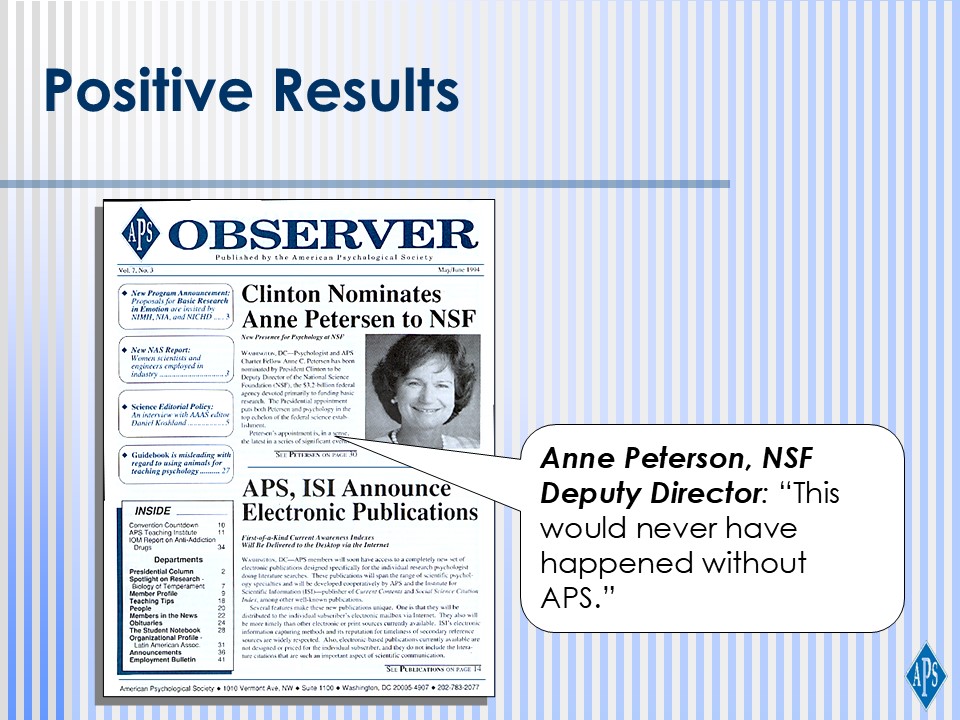
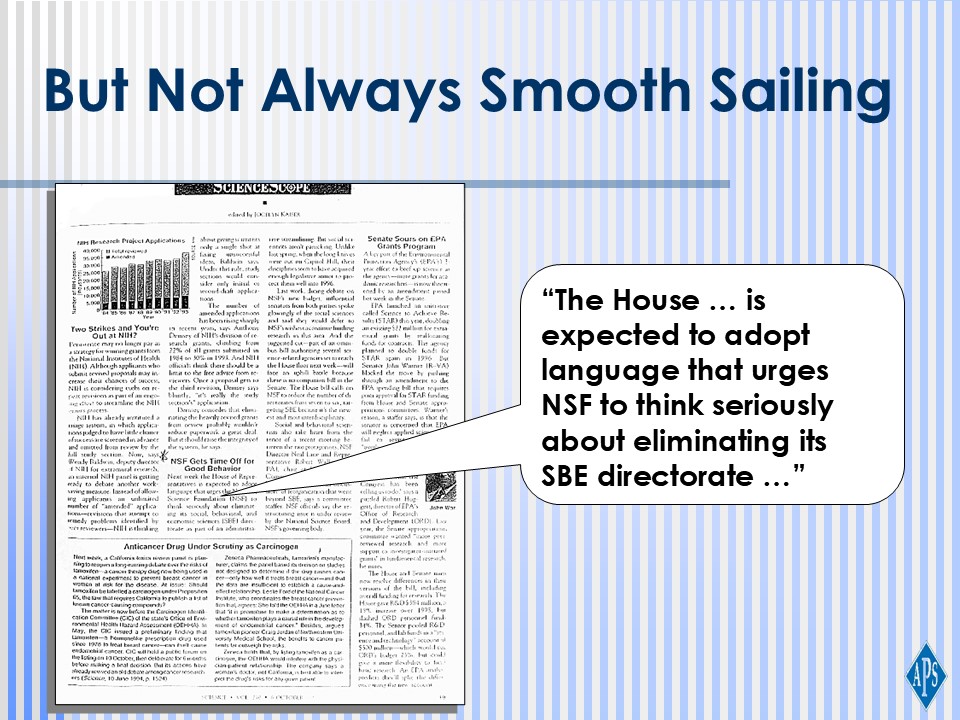
Lots of good things followed but also some not so good things. An example of the good: Psychologist Anne Peterson was nominated by President Bill Clinton to be NSF Deputy Director. She told us, “This never would have happened without APS.” Of the initially bad but ultimately good: There continued to be efforts to defund social and behavioral science, as there had been before the separate directorate was created (which was why we never understood the earlier establishment strategy that hiding behind other sciences at NSF would “protect” us). But with SBE now in place, it was not only the newly empowered behavioral and social science community that defended against these proposed cuts but the leadership of NSF as well. The result was that this time, the attempts to cut the directorate’s funding were not successful. The creation of the directorate was a major reason why.
The story’s not over
The SBE at NSF funds well over $300 million a year in basic research, and psychology gets $60–80 million of that, and that’s not counting where psychology is funded elsewhere at NSF (similar to a university department of psychology vs. psychology in schools of education, computer science, business, departments of neuroscience, etc.) Yes, NSF likely faces major challenges with the current administration, but we believe that SBE will play an important role in meeting those challenges on equal footing with other directorates.
This is necessarily a condensed and simplified version of events leading to the creation of a separate directorate for behavioral and social sciences at NSF. It took time, and there were many moving parts. For a closer and more visual look at events, check out this set of old timey PowerPoint slides from 1992-ish that we used back then to tell this story.

![Slide with text: NSF: Anatomy of a Directorate. Rep. Doug Walgren, Chair, House NSF Authorizations: “APS is the origin of the movement toward a separate directorate. APS really created the legislation that [House Science Chair] George Brown and I introduced.”](https://www.psychologicalscience.org/redesign/wp-content/uploads/2025/05/Slide1.jpg)

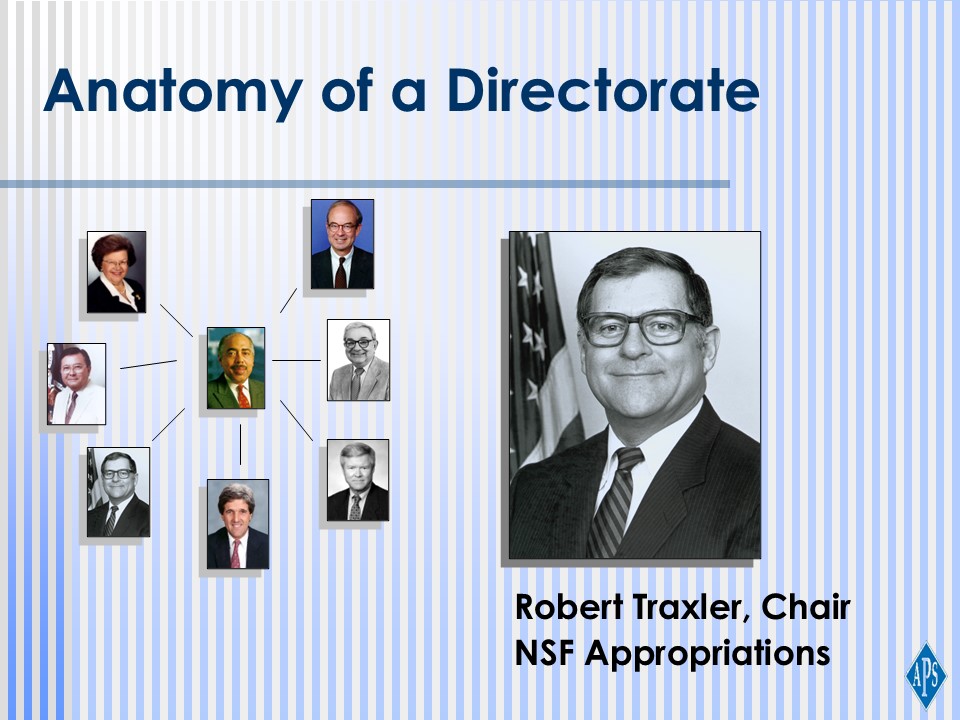
![Slide with text: APS to the House NSF Appropriations Chair. To Rep. Traxler, Chair, House NSF Appropriations: “Following my testimony [on a separate NSF Directorate], you indicated your support and offered to look more seriously into the matter. I want you to know how welcome this is.”](https://www.psychologicalscience.org/redesign/wp-content/uploads/2025/05/Slide6.jpg)
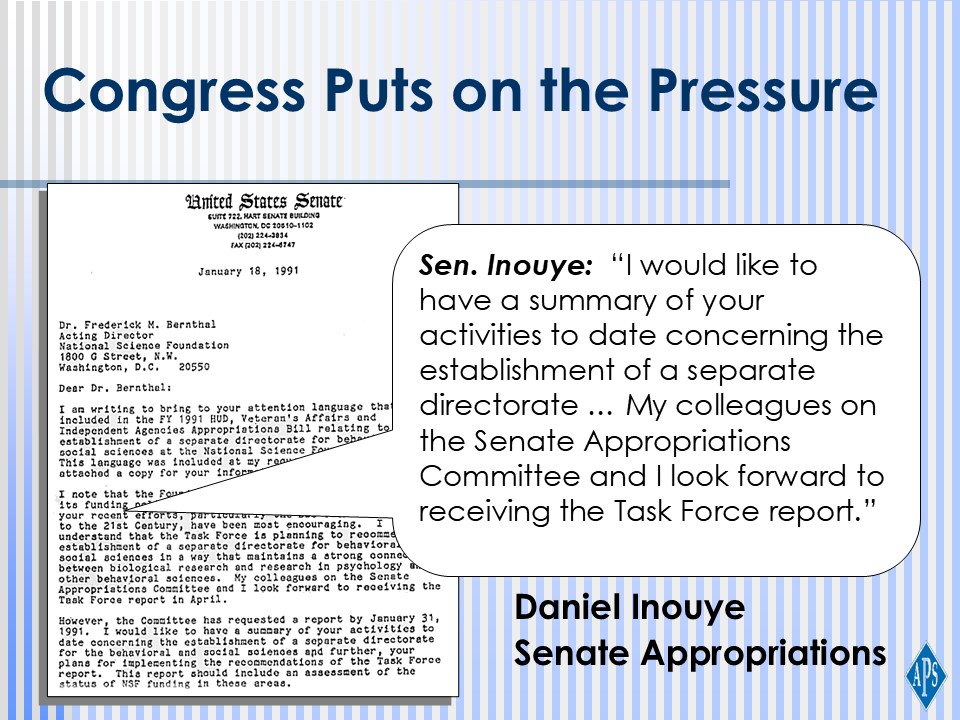
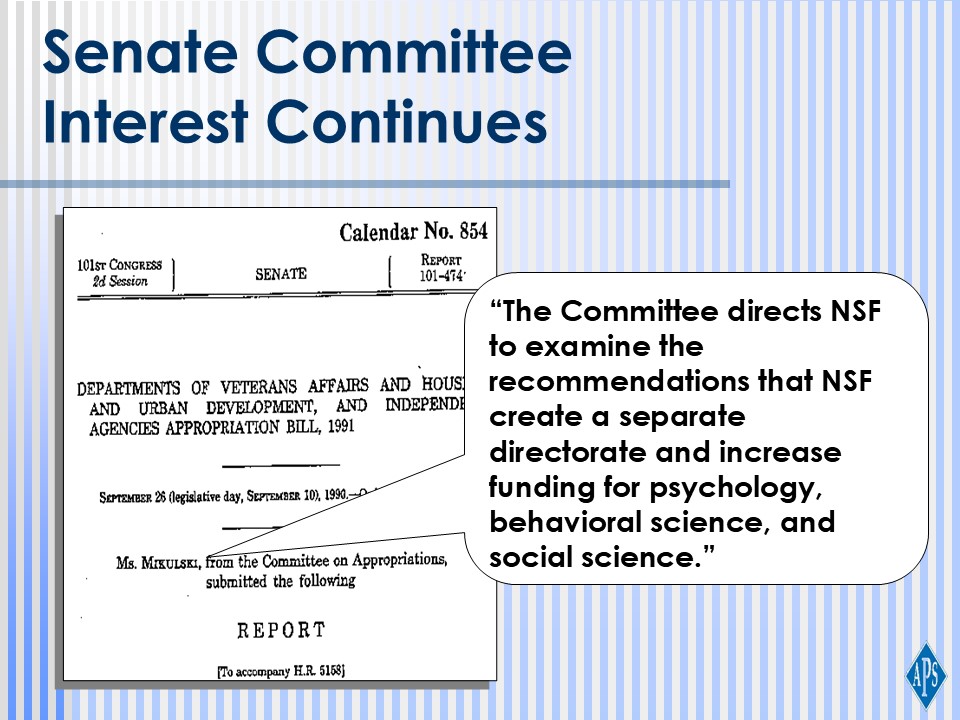
![Slide with text: Congress Puts on the Pressure. “The [Senate Appropriations] Committee is aware that a Foundation-convened task force recommended the establish a separate directorate for behavioral and social science research. The Committee directs the Foundation to respond to this committee…” Barbara Mikulski, Chair Senate Appropriations.](https://www.psychologicalscience.org/redesign/wp-content/uploads/2025/05/Slide11.jpg)
![Slide with text: Congress Puts on the Pressure. Chairs Brown and Walgren: “A thoughtful and balanced assessment of the impact of such a [Behavioral Science] Directorate would be most helpful as Congress considers legislation.” George E. Brown, Chair, House Authorizations.](https://www.psychologicalscience.org/redesign/wp-content/uploads/2025/05/Slide12.jpg)

![Slide with text: The NSF Announcement. “NSF needs to develop these fields through a directorate level focus … The reorganization is an acknowledgement of the rapidly advancing [social, behavioral, and economic sciences.] ”](https://www.psychologicalscience.org/redesign/wp-content/uploads/2025/05/Slide25.jpg)
![Slide with text: The Directorate in the Washington Post. The social sciences have been put on par with [other] disciplines … The change can be attributed to effective lobbying ...](https://www.psychologicalscience.org/redesign/wp-content/uploads/2025/05/Slide26.jpg)
![Slide with text: The Directorate in Science. “Social scientists … have lobbied long and hard for their own directorate. APS points out that the move will put the [behavioral and social] sciences on a par with the other disciplines in NSF hierarchy.”](https://www.psychologicalscience.org/redesign/wp-content/uploads/2025/05/Slide27.jpg)
![Slide with text: Behind the Scenes. “Influential member of Congress Rep. Rick Boucher, who chairs the House Science Subcommittee, in a personal meeting with [NSF Director] Massey, lent his support to the idea of a separate directorate”](https://www.psychologicalscience.org/redesign/wp-content/uploads/2025/05/Slide30.jpg)
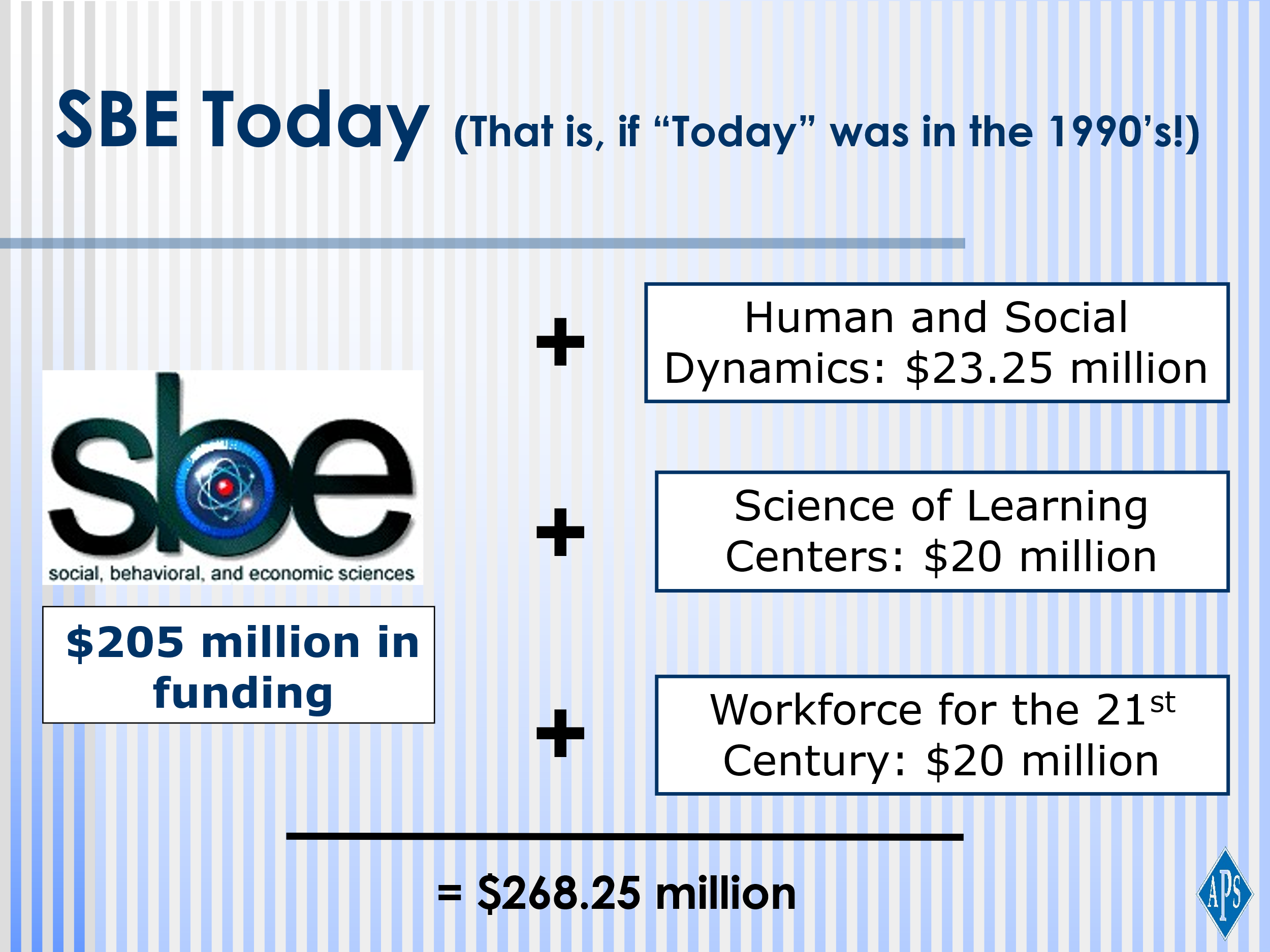
But this success helped put APS on the map as the most effective organization representing the full range of areas within our science. More generally, it underscores the fundamental truth that success in the science policy arena requires direct and sustained engagement with policymakers on the Hill and in agencies. We strongly urge APS Members and leaders to redouble APS’s efforts in Washington, DC and in increasing public awareness of the value and impact of psychological science.
Feedback on this article? Email [email protected] or login to comment.
Siegel, E. (1990, March). Research psychologists identify need for a national strategy at historic APS Summit meeting. Observer, 3(2), p. 1. American Psychological Society.
Behavioral directorate for NSF proposed in Congress. (1990, September). Observer, 3(5), p. 1. American Psychological Society.
NSF task force: New opportunity old approach. (1990, November). Observer, 3(6), p. 7. American Psychological Society.
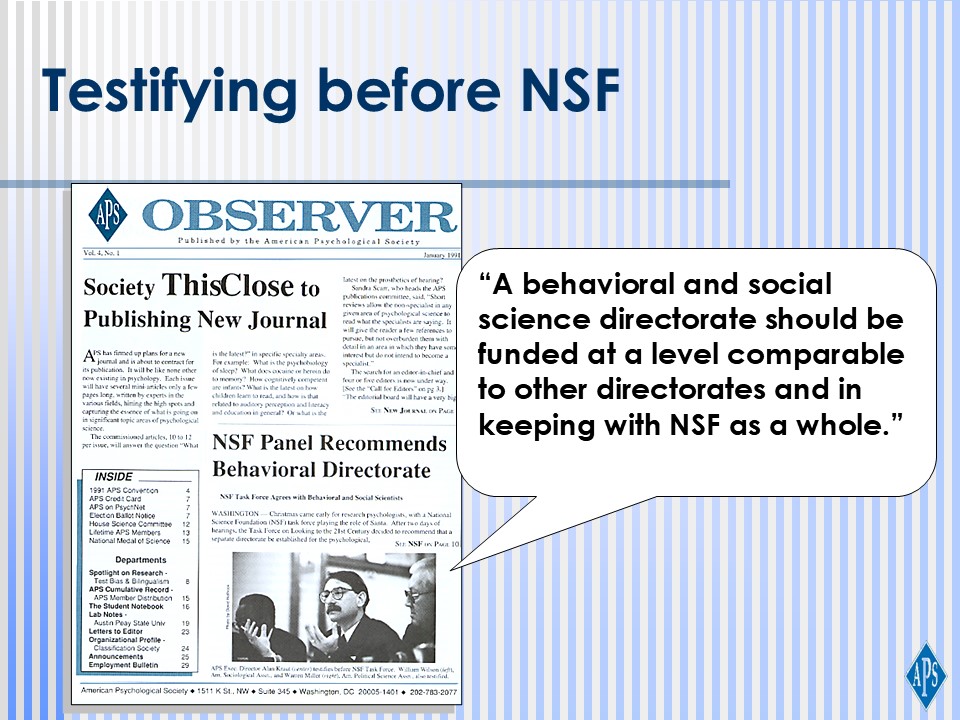
NSF panel recommends behavioral directorate. (1991, January). Observer, 4(1), p. 1. American Psychological Society.
NSF directorate now proposed in Senate. (1991, May). Observer, 4(3), p. 1. American Psychological Society.
NSF panel recommends separate directorate, but status still uncertain. (1991, July). Observer, 4(4), p. 3. American Psychological Society.
NSF director sets plan to reorganize parts of the agency. (1991, October 16). Chronicle of Higher Education, p. A44.
NSF directorate: Yes! (1991, November). Observer, 4(6), p. 1. American Psychological Society.
Brown, G. (1993, January). The brain in the machine. [Guest column]. Observer, 6(1), p. 2. American Psychological Society.
The history of APS: A timeline. (2008, January 12). Observer. Association for Psychological Science.
Cautin, R. (2009). The founding of the Association for Psychological Science: Part 2. The tipping point and early years. Perspectives In Psychological Science, 4(3), 211–223.
All of science stands behind behavioral science at NSF. (2011, August 19). Observer, 24(7). Association for Psychological Science.
Brookhart, S. (2020, October 29). Back to the future: Why APS stands the test of time. Observer, 33(9). Association for Psychological Science.



Comments
Letter to Editor:
On the Origins of the NSF SBE Directorate . . . More to the Story
Like any full accounting of “origins,” the story behind what catalyzed the National Science Foundation (NSF) to establish its Social, Behavioral, and Economic Sciences (SBE) directorate in the early 1990s is inherently detailed and complex. Analogous to tracing the emergence of a new species through biological evolution or documenting scientific advances inspired by Isaac Newton’s metaphorical “standing on the shoulders of giants,” key details warrant inclusion. The essential Who, What, When, How, and Where addressed in the May article beg to be resolved with a tonic Why. So, why was the advocacy community finally galvanized to act, after decades of reports and testimonial lamentations documenting the federal funding of basic/fundamental research in these disciplines? Fully capturing Why is challenging, but below is additional crucial context.
Key Influences
Beyond factors highlighted by co-authors Kraut and Brookhart in the May 2025 Observer, the push for a separate NSF directorate in 1990 was fueled by formative reports and advocacy from key groups, including the Consortium of Social Science Organizations and the Federation of Associations in Behavioral and Brain Sciences (formerly the Federation of Associations of Behavioral, Psychological, and Cognitive Sciences). The movement’s early path was paved by reports in the 1970s and 1980s, notably the National Research Council’s 1976 Social and Behavioral Science Programs in the National Science Foundation: Final Report, led by Nobel Prize-winning psychologist/economist Herbert A. Simon of Carnegie Mellon University (CMU).
A decade later, two additional reports strengthened the case for a directorate:
1. A 1986 U.S. House Science Committee report, titled Research Policies for the Social and Behavioral Sciences: Science Policy Study Background Report, revealed stagnant funding (in constant dollars) for these sciences at NSF.
2. A 1988 Academy of Sciences report, titled The Behavioral and Social Sciences: Achievements and Opportunities, highlighted these fields’ contributions and potential for advancing science and life-enhancing applications.
Advocacy Efforts
Herbert Simon played a pivotal role in advancing the directorate’s creation. In March 1989, testifying before the U.S. House Subcommittee on Science, Research, and Technology — chaired by Rep. Doug Walgren (D-PA) — Simon made a compelling case, as the American Psychological Association (APA) witness, for an NSF directorate dedicated to behavioral and social sciences. His credibility, bolstered by decades of influential research — on economics, cognitive psychology, computer science, political science, and artificial intelligence — made him a formidable witness.
Simon’s CMU position, his and CMU’s status as constituents in Walgren’s Pennsylvania district, and Walgren’s leadership of the subcommittee created a trifecta of strategic advantage in securing congressional support. As described in the May Observer, this groundwork set the stage for Rep. Rick Boucher (D-VA), who leveraged growing congressional momentum to pressure NSF Director Walter Massey into finalizing the directorate — avoiding the need for a potentially messy and drawn-out legislative intervention.
During my tenure as APA science policy staff, I collaborated with Simon on his testimony. While accompanying him at the hearing and subsequently providing input to the congressional appropriations process, I witnessed firsthand the critical role his advocacy played. If ever there was an “active ingredient” [a favorite APS metaphor] that catalyzed the behavioral and social science communities to gather their evidence and fight for the cause, it was Simon’s gravitas, which carried unparalleled weight in this NSF history. His influence, strengthened by documentation in formal reports, proved instrumental in bringing the SBE directorate to fruition.
K. Lee Herring
Strategic Science Communications
Germantown, MD
NSF – Speechwriter for the Director (2010-2013)
NSF – Public Affairs Officer (1997-1999)
APS – Observer Editor; Communications Director (1990-1997)
APA – Legislative & Federal Affairs Officer (1987-1990)
APS regularly opens certain online articles for discussion on our website. Effective February 2021, you must be a logged-in APS member to post comments. By posting a comment, you agree to our Community Guidelines and the display of your profile information, including your name and affiliation. Any opinions, findings, conclusions, or recommendations present in article comments are those of the writers and do not necessarily reflect the views of APS or the article’s author. For more information, please see our Community Guidelines.
Please login with your APS account to comment.