
Member Spotlight: 2026 Spence Awardee Daniel Yon’s Search for a Distinctive Patch in the Research Landscape
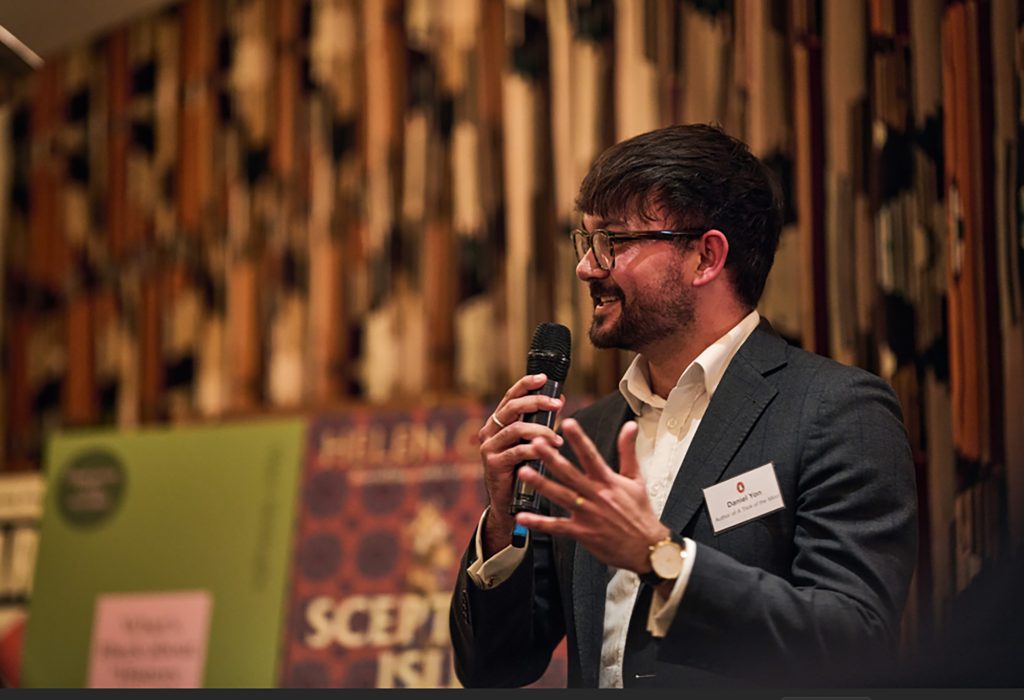
Image above: Yon discusses his book, A Trick of the Mind: How the Brain Invents Your Reality.
Daniel Yon is a professor of cognitive neuroscience and the director of the Uncertainty Lab at Birkbeck, University of London, where he investigates how the human brain observes, tracks, and overcomes uncertainty. The 2026 APS Janet Taylor Spence Award recipient spoke with the Observer‘s Lou Willwood about his multidisciplinary approach to research, his lab’s move up the cognitive hierarchy, and the power of showing up, again and again.
Learn more about Yon and the five other Spence Award recipients.
Your research focuses on how our brains build models of ourselves and the world around us. What led to your scientific interest in this subject?

Like lots of psychologists, I’m interested in how people think about and perceive the world around them. But it’s striking how two people can be exposed to the same information, or the same situation, and nonetheless perceive things differently. I think one of the really seductive possibilities cognitive science offers us is that these differences aren’t just random, or idiosyncratic, but that they can be explained. In part, one powerful way we can explain these differences within and between people is through the idea of models—the kinds of theories our brains construct about how the world works, and how we work, too. Different agents, armed with different models, can see the same world differently—through the lens and the filter their brains have made up for them.
I also think some of my interest in this kind of question comes down to a kind of intellectual greediness. By focusing on how our minds and brains form, use, and update various kinds of internal models, I’ve been able to weave my lab’s work between lots of different aspects of psychology—such as perception, learning, decision making, metacognition, and social cognition, to name a few—that are usually pretty disconnected. So, this research focus has allowed me to be productively unfocused over the years, in ways that I hope have been useful but that has also kept me entertained.
What are some highlights of your research? What has it shown?
One of the satisfyingly recurring themes in my lab’s work is that principles originally born in one bit of cognitive science seem to crop up and apply in other domains, too. In some of our earlier work, I was very interested in how different kinds of predictive models are formed and used in the brain—and this program of work largely found that the predictive models we use for modeling our actions work very similarly to the predictive models we use in perception.
Those initial findings sparked my interest in trying to understand how far Bayesian models of prediction might take us, and which other domains they might apply in. One pivot we’ve made in recent years is to ask more about how our brains deal with uncertainty itself: how we form a model of how stable we think the world is, or how confident we should be in our perceptions, decisions, and choices. What has been quite exciting is to see that the same kinds of predictive principles that guide lower-level aspects of cognition—like perception and action—also apply in these higher-level domains, like metacognition. I think this is beginning to reveal some important, fundamental insights into how these mechanisms work in the mind and brain, and perhaps also how these mechanisms might go awry, for instance, in delusional states like paranoia.
What new or expanded research are you planning to pursue?
In some ways, our research has been progressively moving up the cognitive hierarchy—from (allegedly!) simpler processes like perception and action toward more complex forms of cognition like metacognition and introspection. But what happens when you reach the top of the tree? What’s on top of the top of the hierarchy? Partly under the influence of people like APS Fellow Chris Frith, I’ve become increasingly interested in the idea that the top–down influences controlling these more complex aspects of cognition and awareness might come from outside the brain entirely—from the social world.
One of our newest avenues of research is focusing not only on how we build models of the world and ourselves through our own direct experience, but on how we might be able to share models between interacting minds—such that models embedded in one brain might download into another. In some initial results from this emerging program, we’ve found, for instance, that our beliefs about confidence and uncertainty in ourselves can be shaped by the confidence we see expressed by others we are interacting with, and this kind of social learning of uncertainty can have durable effects on our cognition and behavior even when the other people disappear. One thing that the lab is working on at the moment is trying to understand how deeply this kind of “social calibration” of learning and inference might run.
Besides that, I’m also writing another book.
What is the biggest challenge you have encountered in your career so far?
All the rejections! It’s probably not a particularly original observation, but science is riddled with rejection, over and over again. You don’t get the scholarship, or the grant, or your paper gets rejected, or somebody tells you that you were wrong in front of an audience of hundreds of people, et cetera, et cetera. Particularly when you are starting out, I think this gauntlet of rejections can make you question the quality and the value of your own work and ideas. It took me several years of failed attempts before I got my first grant, for example, and in those lean years it was easy to think the harsh reviewers might be onto something.
I was lucky enough to be introduced to a curative against this kind of imposter syndrome, embedded in the work of APS Charter Member and Fellow Donald T. Campbell. Campbell argued that knowledge is a kind of tiling problem. We want to cover as much of the knowledge landscape using as few people as possible. But in practice, universities or laboratories rarely focus on that. Instead, they try to cultivate students who are replicas of existing professors. (Your PhD has gone well, from this view, if you know almost as much as your supervisor by the time you graduate.) Campbell thought this was an incredible waste. He advocated for something called the fish-scale model of omniscience: We shouldn’t keep churning out replicas, covering the same patch of intellectual territory over and over again. Rather, we should all strive to generate and become like fish scales, with enough overlap to understand and work with our neighbors, but a distinctive patch in the territory that belongs to us alone.
I’ve found this way of thinking helpful inoculation against the dark thoughts that other people might know or be more expert than me. Before Campbell, that was a worry. But after, it’s a delight. If somebody else knows something, or has already worked something out, I don’t have to! Instead, I can focus on trying to occupy a distinctive patch in the landscape, bringing together ideas or techniques that might otherwise go disconnected. In short, being a good little scale on that enormous fish.
What practical advice would you offer to student researchers who want to be in your position someday?
I think a lot of it probably boils down to showing up. In science, and in life more generally, it is easy to become atomized or isolated from the community around you. And it might sometimes seem like there are more urgent things to do than going to the seminar, or the reception, or even just hanging around the office talking to other students, postdocs, and faculty. But if I think about how my career’s unfolded, I owe a lot of the science and the substance to unplanned, serendipitous introductions and interactions. I’m lucky to have a wide network of supportive mentors and collaborators, but most of them weren’t assigned to me by an administrator: They were people I wrote to, or asked questions of at talks, or were gently encouraged (i.e., forced) to introduce myself to at work events. But beyond the network, I can trace back some of what turned out to be our most significant ideas to seemingly throwaway conversations with nobody in particular. Yes, research involves a lot of work, and getting that work done is important. But showing up, and being a part of the broader intellectual community, has been essential for me in shaping the substance of my scientific ideas—and in teaching me how the scientific world works.
Anything else you would like to add?
A Trick of the Mind: How the Brain Invents Your Reality is available in all good bookshops.
Feedback on this article? Email [email protected] or login to comment.



APS regularly opens certain online articles for discussion on our website. Effective February 2021, you must be a logged-in APS member to post comments. By posting a comment, you agree to our Community Guidelines and the display of your profile information, including your name and affiliation. Any opinions, findings, conclusions, or recommendations present in article comments are those of the writers and do not necessarily reflect the views of APS or the article’s author. For more information, please see our Community Guidelines.
Please login with your APS account to comment.