
-
“Puerto Rico Is Strong”: Outreach Campaign to Help Scientific Community in the Caribbean
Following a series of devastating hurricanes in the region, Washington University in St. Louis (WU) and Ciencia Puerto Rico (CienciaPR), a local nonprofit organization promoting the advancement of science, are leading an outreach campaign to assist fellow faculty and students in Puerto Rico and the U.S. Virgin Islands in accessing important information and resources. WU’s Office of the Vice Provost of Faculty and Institutional Diversity has created a small fund to assist in bringing a faculty member in any STEM discipline from Puerto Rico to work in a lab and/or pay for housing.
-
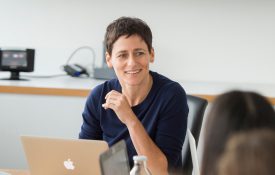
Paluck Named 2017 MacArthur Fellow
Psychological scientist Betsy Levy Paluck is recognized for her innovative research investigating behavior change in social groups.
-
‘Genius Grant’ Winner Used A Soap Opera To Prove A Point About Prejudice
NPR: What will it take for the people of this world to drop their prejudices, to move past intolerance — and just get along? That's a question Princeton psychologist Betsy Levy Paluck — one of the 24 MacArthur Fellows announced on Wednesday — has dedicated her career to answering. Back in 2002, when Paluck was a graduate student at Yale University, her adviser asked: "What does psychology say about how to reduce prejudice and conflict?" She and her adviser were teaching a class about hate speech and political intolerance, and he wanted to give students examples of ways to counteract those things. Paluck searched and searched. And she drew a blank.
-
Psychological Science Underlies Nobel Prize-Winning Work
The Nobel Prize in Economic Sciences awarded to economist Richard H. Thaler has its roots firmly planted in psychological science, particularly in the groundbreaking research of APS William James Fellows Daniel Kahneman and Amos Tversky. The Royal Swedish Academy of Sciences announced the award October 9, 2017 in Stockholm, citing Thaler’s pioneering work showing how human behavior consistently defies economic theory. His findings have inspired many governments and organizations to inject more behavioral research and economics into policymaking efforts.
-
Why policy makers should nudge more
Chicago Booth Review: When policy makers around the world want to influence their constituents’ behavior, they have a few options. They can offer a carrot, such as a tax incentive, stipend, or other reward. They can use the legislative stick by passing a mandate or a ban. But research suggests they should turn more often to a third tool, a “nudge,” which in many cases is the most cost-effective option. Nudging is the word used in behavioral science for structuring policies and programs in ways that encourage, but don’t compel, particular choices. For instance, requiring people to opt out of rather than into a program, such as a retirement savings plan, might nudge them toward participating.
-

Mindfulness and Meditation Need More Rigorous Study, Less Hype
The spread of mindfulness and meditation as wellness tools outpaces scientific evidence, a team of researchers concludes.
