
-
Big Data Gives the “Big 5” Personality Traits a Makeover
From the ancient Greeks to Shakespeare to Hollywood, humans have attempted to understand their fellow man through labeling and categorization. There was Hippocrates’s blood, phlegm, yellow and black bile; the classic dramatic archetypes of hero, ingenue, jester and wise man; and, of course, Carrie, Charlotte, Samantha and Miranda from the famous HBO series More rigorously, psychologists have worked to develop empirical tests that assess core aspects of personality. The “Big Five” traits (extroversion, neuroticism, openness, conscientiousness and agreeableness) emerged in the 1940s through studies of the English language for descriptive terms.
-
Harvard Psychology Professor Discusses How Trauma Affects Memory
NPR's Ari Shapiro speaks with clinical psychologist Richard McNally about memory retention following traumatic events in light of the sexual assault accusations brought against Judge Brett Kavanaugh.
-
New Research From Clinical Psychological Science
Read about the latest research published in Clinical Psychological Science: Examining the Decoupling Model of Equanimity in Mindfulness Training: An Intensive Experience Sampling Study Adi Shoham, Yuval Hadash, and Amit Bernstein Some researchers posit equanimity, or the attitude of embracing either pleasure or pain without reaction, as a mechanism through which mindfulness contributes to well-being. The “decoupling model” suggests that separating desire (wanting and not wanting) from the hedonic nature (pleasant or unpleasant) of an experience may promote equanimity; that is, values and long-term goals may take the place of pleasure in determining desire.
-
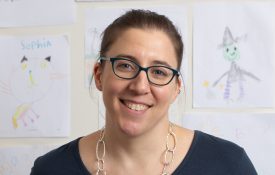
Kristina Olson Named 2018 MacArthur Fellow
APS Fellow Kristina Olson has received the prestigious MacArthur “Genius” Grant for her innovative research on the social and cognitive development of transgender and gender-nonconforming youth.
-
2019—2020 Federal and State Policy Fellowships Call for Applications
The Society for Research in Child Development (SRCD) is seeking applicants for the 2019–2020 Federal and State Policy Fellowships. The fellowships provide researchers with immersive opportunities to use their research skills in child development to inform public policy and to learn more about policy development, implementation, and evaluation at either the federal or state level. All fellowships will run from September 1, 2019 to August 31, 2020. SRCD policy staff members will facilitate the fellowship experience and are available as a resource throughout the year. Federal Policy Fellowships: Congressional and Executive Branches Full-time immersion experiences in Washington, DC.
-

Social Class Determines Whether Buying Experiences or Things Makes You Happier
What is the best way to spend money to increase your happiness? A series of studies suggests that it may depend, in part, on how wealthy you are.
