
Bandura and Bobo
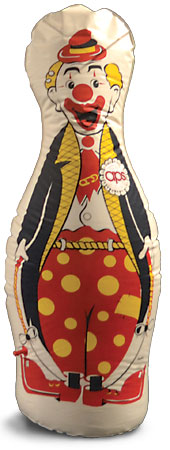 In 1961, children in APS Fellow Albert Bandura’s laboratory witnessed an adult beating up an inflatable clown. The doll, called Bobo, was the opposite of menacing with its wide, ecstatic grin and goofy clown outfit.
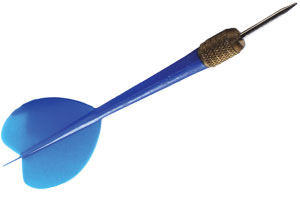
But when it was their own turn to play with Bobo, children who witnessed an adult pummeling the doll were likely to show aggression too. Similar to their adult models, the children kicked the doll, hit it with a mallet, and threw it in the air. They even came up with new ways to hurt Bobo, such as throwing darts or aiming a toy gun at him. Children who were exposed to a non-aggressive adult or no model at all had far less aggression toward Bobo.
Bandura’s findings challenged the widely accepted behaviorist view that rewards and punishments are essential to learning. He suggested that people could learn by observing and imitating others’ behavior.
 “In many respects, this research helped create the shift in psychology from a behavioristic to a social-cognitive approach to learning,” says Cathy Faye, Assistant Director of the Center for the History of Psychology at The University of Akron. Since Bandura donated his original Bobo doll in May 2010, it has been one of the Center’s most popular exhibits.
Faye notes that the Bobo doll experiments were also influential outside of the scientific community. “Bandura’s findings were particularly important in 1960s America, when lawmakers, broadcasters, and the general public were engaged in serious debate regarding the effects of television violence on the behavior of children,” she says.
Today, questions about violent media and video games linger, so Bandura’s research on aggression remains relevant. His Bobo-inspired social learning theory also contributed to the development of cognitive-behavioral therapy. Bandura is a member of an elite group who received both APS lifetime achievement awards: the William James and James Mckeen Cattell Fellow Awards. He was also named among the top five most eminent 20th century psychologists by the Review of General Psychology. It’s an impressive legacy for a project that began with a little creativity and an inflatable clown.



Comments
How can the Bobo experiment be a critique of behaviorism? Children cannot learn from watching unless they have experience, can they? And experience, obviously, is gained through behavior. Behaviorism appears to be merely a version of Russell´s knowledge by acquaintance as opposed to knowledge by description. Whilst description can probably substitute for behavior in a virtual world, it is less likely useful in the real world.
We perceive what we see, is that not an experience where acting out is the result of its cognitive beginning? I would say most people learn from watching, hearing, and doing. While the three are a classroom didactic exercise the other is a practical experience.
I agree with Brian, observation/vicarious learning as represented in the Bobo experiment shapes the behavior we assume will be called for in the future. The behavior is acted out immediately or the experience, our perception of the experience, is molded at that time for future enactment of the behavior, cognitive beginning most definitely.
I can imagine what it was like being one of those children watching the adult kicking and punching the crap out of the doll. Here was the exact opposite of what they had been taught their entire life. It must have been liberating and fun to have free license. Just as you or I might enjoy using a big hammer to smash a wall that has to come down. But not for a moment do I think it leads to aggression or violence. More like catharsis.
If Bandura’s experiments had involved adults hurting cats, I do not believe those children would have imitated that
I DO AGREE With Albert Bandula’s That Man Tend To Imitate The Behaviours Of The Person He Observes Given That In The Social Learning Theory Man Is Bound To Copy The Behaviour Of Those Frequently With Them Hence Parents Adults And Teacher Need To Be Concious Of Their Actions.
I’m a Profesional Clown for 31 yrs. I grew up with that Clown Toy. I liked it. The problem with this Toy is many adults see a Clown as a Thing, not a Person. The symbolism of the Toy can bring out the Dark Side of some adults. “Pseudo Clown O Phobia” as I call it is fashionable. Some Unethical Media Shrinks actually are telling people that they should be scared. This is not about Clowns or Toys. As the Internet came in Junk Science has grown. I’m concerned about turning Clowns into evil characters & and the so-called Psychologists who are doing a major disservice, not just to Clowns but to the Real Science of Psychology.
Bandura and Bobo, is not about violence, but desensitization, in the manner media desensitizes the power of words, as well as actions. Yes children experiencing actual violence are more prone to participate in violence, but there is a percentage of desensitized children that “act out” what they have seen; “trauma trigger” this then effects the group by direct experience. This continues especially for those children mentioned above with no outlet for trauma; mass psychotherapy without boundaries, guidance, or professional observation; only the consequence of the penal system. It is proven society has had a large hand in creating the very individuals, that then fill the penal system with just this type of personality. Not everyone is effected, certainly not everyone is as sensitive, to the trigger: but the numbers are still alarming.
My friend and I want to do a science expo project on this issue of the Bobo Doll and Albert Bandura. And we think that adults should be conscious of their actions and their words because children will learn to be like them.
Hello all, does anyone know where I can purchase a vintage Bobo Doll or have a one made? I am a Psychology Major at Cedar Crest College and am doing a project for Psi Chi. We would love to purchase one but don’t know where to find one. Any advice is greatly appreciated. Thank you.
Evaluating the Bobo Doll experiment: Since the experiment was made using children and relying on these children’s judgement, in my humble opinion, is not a strong result. Children do not have a strong base of morality, they do not fully know what is right or wrong and merely rely and mimic what they hear and see (feeds)from adults. The experiment used a doll and this is understood by children as a toy (an inanimate object which could be deformed, thrown, etc). I believe that their actions were parts imitation and curiosity and at the same time liberation that they could do what they think they could do with the doll without being judged by the adult (since children’s actions are controlled by adults). Secondly, the experiment was a model of ‘conditioning’ and not free will. I think the result of this experiment would be different if adults were the participants. Even if the doll was substituted with a live cat (apologies-just an example), the children will still act out what adults did but it will not be true with adult participants. My conclusion for this experiment is that behaviour is truly learned from experiences (heard and seen) and the younger one learns an action, the more likely that it will be moulded into his being/behaviour/lifestyle. But an adult’s adaptation of new behaviour is his choice.
APS regularly opens certain online articles for discussion on our website. Effective February 2021, you must be a logged-in APS member to post comments. By posting a comment, you agree to our Community Guidelines and the display of your profile information, including your name and affiliation. Any opinions, findings, conclusions, or recommendations present in article comments are those of the writers and do not necessarily reflect the views of APS or the article’s author. For more information, please see our Community Guidelines.
Please login with your APS account to comment.