
-
Exposure to Nature Promotes Cooperation
Pacific Standard: The philosopher Bertrand Russell famously remarked that “the only thing that will redeem mankind is cooperation.” New research finds that one way to encourage mutually beneficial behavior is to shift our focus from mankind to Mother Earth. In the Journal of Environmental Psychology, a team led by Carleton University’s John Zelenski describes three studies in which participants who watched short nature videos (some as brief as two minutes) were subsequently more likely to act in cooperative ways, such as harvesting virtual fish in a way that promotes sustainability. Read the whole story: Pacific Standard
-
Haunted House Science: You Don’t Need Gore To Terrify, If You Know The Brain
Wbur: It’s a classic Halloween activity: the homemade haunted house, replete with cold spaghetti “worms” and bowls of peeled-grape “eyeballs.” Remember? That old tradition gets a 21st-century scientific twist at an elaborate haunted house in Newton that opens for just one night a year — the night before Halloween — to raise money for charity. And it is elaborate not just in its multitudes of living ghouls, its gaggles of graves and squads of skeletons. It is an exercise in scare tactics informed by brain science. “You can be really artful about how you scare people without a lot of gore,” says Northeastern University professor Lisa Feldman Barrett.
-
New Research From Psychological Science
Read about the latest research published in Psychological Science: On Race and Time Gordon B. Moskowitz, Irmak Olcaysoy Okten, and Cynthia M. Gooch People who show high external motivation to control prejudice (EMCP) feel threatened by the possibility that they may be viewed as biased. This threat causes people high in EMCP to feel increased arousal and anxiety in intergroup situations. The researchers were interested to know whether people concerned with appearing biased experience time-perception distortions in intergroup situations, given that arousal has been shown to influence the perception of time.
-
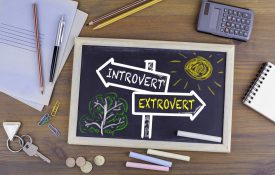
Uncovering the Extravert Advantage
A Duke University psychological study pinpoints a key behavior that helps explain why and how extraverts are so socially adept.
-
Your job is literally ‘killing’ you
The Washington Post: People often like to groan about how their job is "killing" them. Tragically, for some groups of people in the U.S., that statement appears to be true. A new study by researchers at Harvard and Stanford has quantified just how much a stressful workplace may be shaving off of Americans' life spans. It suggests that the amount of life lost to stress varies significantly for people of different races, educational levels and genders, and ranges up to nearly three years of life lost for some groups. ... Those gaps appear to be getting worse, as the wealthy extend their life spans and other groups are stagnant.
-
Can You Get Smarter?
The New York Times: YOU can increase the size of your muscles by pumping iron and improve your stamina with aerobic training. Can you get smarter by exercising — or altering — your brain? This is hardly an idle question considering that cognitive decline is a nearly universal feature of aging. Starting at age 55, our hippocampus, a brain region critical to memory, shrinks 1 to 2 percent every year, to say nothing of the fact that one in nine people age 65 and older has Alzheimer’s disease. The number afflicted is expected to grow rapidly as the baby boom generation ages.
