
-
The Science of ‘I Was Just Following Orders’
The Wall Street Journal: There is no more chilling wartime phrase than “I was just following orders.” Surely, most of us think, someone who obeys a command to commit a crime is still acting purposely, and following orders isn’t a sufficient excuse. New studies help to explain how seemingly good people come to do terrible things in these circumstances: When obeying someone else, they do indeed often feel that they aren’t acting intentionally. Patrick Haggard, a neuroscientist at University College London, has been engaged for years in studying our feelings of agency and intention. But how can you measure them objectively? Asking people to report such an elusive sensation is problematic. Dr.
-

Caring for Others Can Bring Benefits
Accumulating evidence suggests that providing social support for others can benefit caregivers, boosting feelings of social connection.
-
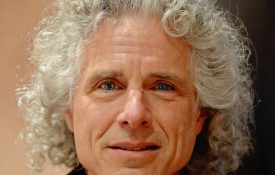
Bill Gates’ Tweets Fuels Sales of Steven Pinker Book
APS William James Fellow Steven A. Pinker has garnered a major boost in sales for one of his many books this week thanks to an admiring tweet from Microsoft founder Bill Gates.
-

New Research From Clinical Psychological Science
A sample of new research exploring: distress, worry, and responses to the Ebola crisis; anxiety-linked attentional bias and mitigation of threat; and neural underpinnings of repetitive negative thinking in autism spectrum disorders.
-
Why Your Sense Of Smell Is Better Than You Might Think
NPR: Smell, the thinking goes, is not our strongest sense. Our lowly noses are eclipsed by our ability to see the world around us, hear the sound of music and feel the touch of a caress. Even animals, we're taught, have a far more acute sense of smell than we do. But one scientist argues the idea of an inferior sense of smell stems from a 19th-century myth. When neuroscientist John McGann at Rutgers started comparing the sense of smell in rodents to what was known about the human sense of smell, he had an epiphany. "Actually we have a really excellent sense of smell," he says.
-
Boredom Is Good for You
The Atlantic: Boredom has, paradoxically, become quite interesting to academics lately. The International Interdisciplinary Boredom Conference gathered humanities scholars in Warsaw for the fifth time in April. In early May, its less scholarly forerunner, London’s Boring Conference, celebrated seven years of delighting in tedium. At this event, people flock to talks about toast, double yellow lines, sneezing, and vending-machine sounds, among other snooze-inducing topics. What, exactly, is everybody studying? One widely accepted psychological definition of boredom is “the aversive experience of wanting, but being unable, to engage in satisfying activity.” Read the whole story: The Atlantic
