

-
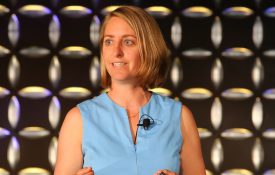
How Our Bodies Do – and Don’t – Shape Our Minds
Individuals’ bodies and their abilities to act within their environments shape their perceptions of their surroundings, says psychological scientist Jessica Witt, Colorado State University. Witt discussed the psychophysics experiments she’s conducted to demonstrate these perceptions during one of four presentations in a Presidential Symposium chaired by Susan Goldin-Meadow.
-
Police Are Less Respectful Toward Black Drivers, Report Finds
The New York Times: Police officers are significantly less respectful and consistently ruder toward black motorists during routine traffic stops than they are toward white drivers, a paper released this week found. The paper, published Monday in the Proceedings of the National Academy of Sciences, detailed the ways in which footage from body cameras worn by members of the Oakland Police Department in California helped illuminate the disparity in treatment. The report was written by group of researchers in the psychology, linguistics and computer science departments at Stanford University, including Jennifer Eberhardt, a psychology professor.
-
Artificial intelligence can now predict suicide with remarkable accuracy
Quartz: When someone commits suicide, their family and friends can be left with the heartbreaking and answerless question of what they could have done differently. Colin Walsh, data scientist at Vanderbilt University Medical Center, hopes his work in predicting suicide risk will give people the opportunity to ask “what can I do?” while there’s still a chance to intervene. Walsh and his colleagues have created machine-learning algorithms that predict, with unnerving accuracy, the likelihood that a patient will attempt suicide.
-

Beilock Named President of Barnard College
APS Fellow Sian L. Beilock, an award-winning scientist who has extensively researched people’s performance under pressure, has been named President of Barnard College effective July 1.
-
You Still Need Your Brain
The New York Times: Most adults recall memorizing the names of rivers or the Pythagorean theorem in school and wondering, “When am I ever gonna use this stuff?” Kids today have a high-profile spokesman. Jonathan Rochelle, the director of Google’s education apps group, said last year at an industry conference that he “cannot answer” why his children should learn the quadratic equation. He wonders why they cannot “ask Google.” If Mr. Rochelle cannot answer his children, I can. Google is good at finding information, but the brain beats it in two essential ways. Champions of Google underestimate how much the meaning of words and sentences changes with context. Consider vocabulary.
-
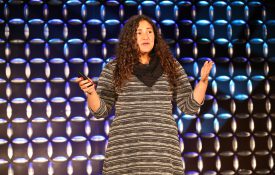
Laurie Santos on What Makes the Human Mind So Special
Psychological scientist Laurie R. Santos of Yale University says that her cognitive experiments with monkeys and dogs suggests that humans’ unique ability to understand others’ mental states can, in many cases, actually cause us to confuse that thinking with our own. See her complete presentation at the 29th APS Annual Convention in Boston.
