• News & Research
    • Research Topics
    • Podcasts & Videos
  • Conventions & Events
    • 2026 APS Annual Convention
    • Webinars & Virtual Events
    • Past and Future Conventions
  • Journals
    • Psychological Science
    • Current Directions in Psychological Science
    • Psychological Science in the Public Interest
    • Perspectives on Psychological Science
    • Clinical Psychological Science
    • Advances in Methods and Practices in Psychological Science
    • Advances in Psychological Science Open
  • Advocacy & Policy
    • Policy & Position Statements
  • The Observer 
    • Archive
    • About the Observer
    • Advertising
    • Contact the Editor
    • Presidential Columns
  • Members
    • Awards & Honors
    • Member Directory
    • Lifetime Members
    • Student Members
    • Teaching of Psychology
    • Donors
  • Career Resources
    • Employment
  • About
    • Diversity, Equity, & Inclusion
    • Board of Directors 2025-2026
    • Staff Directory
    • Ethics Policy & Code of Conduct
APS Homepage
APS
  • Login
  • Join APS
  • Title slide with the text "Opening Keynote Address: Building Emotional Memories: From Neural Process to Narratives. Elizabeth Kensinger, Boston College."

    Keynote Address: Building Emotional Memories: From Neural Process to Narratives

    What details do people build into their memory representations for good or bad experiences? What neural processes do they use to build these representations? How can these memories, and their narrative framings, influence behavior? In this Keynote Address, Kensinger describes how her in-the-laboratory experiments provide answers.

  • Title slide with the text "Psychological Science and Society Plenary Panel Session: Collective Cognition. Chair: APS President Randi C. Martin, Rice University Suparna Rajaram, Stony Brook University, The State University of New York Robert L. Goldstone, Indiana University Bloomington Nancy J. Cooke, Arizona State University Moderator: Angela Gutchess, Brandeis University"

    Psychological Science and Society Plenary Panel Session: Collective Cognition

    This panel brings together speakers carrying out novel research to address how group interaction influences cognitive processing, going beyond the typical approach of studying cognition through observing individuals acting alone.

  • Title slide with the text "2025 APS Annual Awards Ceremony: A Celebration of Excellence."

    2025 APS Awards Ceremony: A Celebration of Excellence

    The 2025 APS Awards Ceremony recognizes recipients of the James McKeen Cattell Fellow Award, James S. Jackson Lifetime Achievement Award for Transformative Scholarship, William James Fellow Award, Mentor Award, and Janet Taylor Spence Award for Transformative Early Career Contributions.

  • Title card with text "Plenary Panel Session: Human Language and Thought in the Era of Large Language Models. Chair: APS President Randi C. Martin, Rice University, Alexander Huth, The University of Texas at Austin, Laura Gwilliams, Stanford University, Anna Ivanova, Georgia Institute of Technology, L. Robert Slevc, University of Maryland, College Park."

    Plenary Panel Session: Human Language and Thought in the Era of Large Language Models

    This symposium brings together leading early career voices whose work engages with the relationship between human language and LLMs.

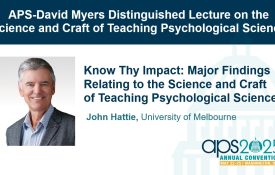
  • Title slide with the text "APS-David Myers Distinguished Lecture on the Science and Craft of Teaching Psychological Science. Know Thy Impact: Major Findings Relating to the Science and Craft of Teaching Psychological Science. John Hattie, University of Melbourne."

    APS-David Myers Distinguished Lecture on the Science and Craft of Teaching Psychological Science: Know Thy Impact: Major Findings Relating to the Science and Craft of Teaching Psychological Science

    In this lecture, Hattie summarizes four key claims: fostering a positive class climate, empowering students to drive their learning, engaging teachers in evaluating their impact, and building collective teacher responsibility for assessing the fidelity and impact of teaching practices.

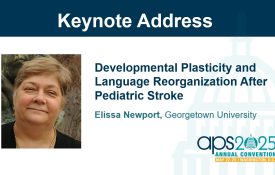
  • Title slide with the text "Keynote Address: Developmental Plasticity and Language Reorganization After Pediatric Stroke. Elissa Newport, Georgetown University."

    Keynote Address: Developmental Plasticity and Language Reorganization After Pediatric Stroke

    Many have suggested that there is plasticity for language in early life, allowing children to acquire language by using other cortical regions when left hemisphere language areas are damaged. Are these claims true? Newport explores in this Keynote Address.

« FirstPrevious...102030...5253545556...607080...NextLast »
  • Who We Are
  • Privacy Policy
  • Contact Us
  • Donate
  • Advertising
  • Follow APS
  • Facebook Logo link to APS's Facebook
  • BlueSky Logo link to APS's BlueSky
  • Youtube Logo link to APS's YouTube
  • Instagram Logo link to APS's Instagram
  • LinkedIn Logo link to APS's LinkedIn
  • Twitter Logo link to APS's Twitter

© Association for Psychological Science

Cookies
We use cookies on our website to give you the most relevant experience by remembering your preferences and repeat visits. By clicking “Accept”, you consent to the use of ALL the cookies. To accept or reject certain categories of cookies specifically please click the Cookie Settings link. Please read our Cookie Policy for more information.
Do not sell my personal information.
Cookie settingsAccept Reject
Privacy & Cookies Policy

Privacy Overview

This website uses cookies to improve your experience while you navigate through the website. Out of these cookies, the cookies that are categorized as necessary are stored on your browser as they are essential for the working of basic functionalities of the website. We also use third-party cookies that help us analyze and understand how you use this website. These cookies will be stored in your browser only with your consent. You also have the option to opt-out of these cookies. But opting out of some of these cookies may have an effect on your browsing experience.
Necessary
Always Enabled
Necessary cookies are absolutely essential for the website to function properly. This category only includes cookies that ensures basic functionalities and security features of the website. These cookies do not store any personal information.
Functional
Functional cookies help to perform certain functionalities like sharing the content of the website on social media platforms, collect feedbacks, and other third-party features.
CookieDurationDescription
__cf_bm30 minutesThis cookie, set by Cloudflare, is used to support Cloudflare Bot Management.
Performance
Performance cookies are used to understand and analyze the key performance indexes of the website which helps in delivering a better user experience for the visitors.
CookieDurationDescription
AWSELBCORS5 minutesThis cookie is used by Elastic Load Balancing from Amazon Web Services to effectively balance load on the servers.
Analytics
Analytical cookies are used to understand how visitors interact with the website. These cookies help provide information on metrics the number of visitors, bounce rate, traffic source, etc.
CookieDurationDescription
at-randneverAddThis sets this cookie to track page visits, sources of traffic and share counts.
CONSENT2 yearsYouTube sets this cookie via embedded youtube-videos and registers anonymous statistical data.
uvc1 year 27 daysSet by addthis.com to determine the usage of addthis.com service.
_ga2 yearsThe _ga cookie, installed by Google Analytics, calculates visitor, session and campaign data and also keeps track of site usage for the site's analytics report. The cookie stores information anonymously and assigns a randomly generated number to recognize unique visitors.
_gat_gtag_UA_3507334_11 minuteSet by Google to distinguish users.
_gid1 dayInstalled by Google Analytics, _gid cookie stores information on how visitors use a website, while also creating an analytics report of the website's performance. Some of the data that are collected include the number of visitors, their source, and the pages they visit anonymously.
Advertisement
Advertisement cookies are used to provide visitors with relevant ads and marketing campaigns. These cookies track visitors across websites and collect information to provide customized ads.
CookieDurationDescription
loc1 year 27 daysAddThis sets this geolocation cookie to help understand the location of users who share the information.
VISITOR_INFO1_LIVE5 months 27 daysA cookie set by YouTube to measure bandwidth that determines whether the user gets the new or old player interface.
YSCsessionYSC cookie is set by Youtube and is used to track the views of embedded videos on Youtube pages.
yt-remote-connected-devicesneverYouTube sets this cookie to store the video preferences of the user using embedded YouTube video.
yt-remote-device-idneverYouTube sets this cookie to store the video preferences of the user using embedded YouTube video.
yt.innertube::nextIdneverThis cookie, set by YouTube, registers a unique ID to store data on what videos from YouTube the user has seen.
yt.innertube::requestsneverThis cookie, set by YouTube, registers a unique ID to store data on what videos from YouTube the user has seen.
Others
Other uncategorized cookies are those that are being analyzed and have not been classified into a category as yet.
SAVE & ACCEPT
Powered by CookieYes Logo