• News & Research
    • Research Topics
    • Podcasts & Videos
  • Conventions & Events
    • 2026 APS Annual Convention
    • Webinars & Virtual Events
    • Past and Future Conventions
  • Journals
    • Psychological Science
    • Current Directions in Psychological Science
    • Psychological Science in the Public Interest
    • Perspectives on Psychological Science
    • Clinical Psychological Science
    • Advances in Methods and Practices in Psychological Science
    • Advances in Psychological Science Open
  • Advocacy & Policy
    • Policy & Position Statements
  • The Observer 
    • Archive
    • About the Observer
    • Advertising
    • Contact the Editor
    • Presidential Columns
  • Members
    • Awards & Honors
    • Member Directory
    • Lifetime Members
    • Student Members
    • Teaching of Psychology
    • Donors
  • Career Resources
    • Employment
  • About
    • Diversity, Equity, & Inclusion
    • Board of Directors 2025-2026
    • Staff Directory
    • Ethics Policy & Code of Conduct
APS Homepage
APS
  • Login
  • Join APS
  • Down to Business: National Entrepreneurship Week and Psychological Science

    “In any given moment, we have two options: to step forward into growth or to step back into safety.” These words, attributed to Abraham Maslow, might summarize what motivates individuals who forego the relative security

  • Courtroom Psychology Tests May Be Unreliable, Study Finds

    Courts are not properly screening out unreliable psychological and IQ tests, allowing junk science to be used as evidence, researchers have concluded. Such tests can sway judges or juries and influence whether someone gets custody of a child or is eligible for bail or capital punishment. ... “There’s huge variability in the psychological tools now being admitted in U.S. courts,” said Tess Neal, an Arizona State University psychology professor and co-author of the study published Saturday in the journal Psychological Science in the Public Interest. “There’s a lot of stuff that looks like it’s junk and should be filtered out by the courts, but it’s not being filtered out," said Neal. ...

  • California Considers Permitting Students Excused Mental Health Days

    Parents, educators and clinicians are seeing an alarming increase in mental health problems among young people. Various national surveys show the rates of depression, anxiety, and suicide on the rise, but what to do about it is less clear. In July of 2019, Oregon passed a bill that allows students to take excused absences for mental health related issues. Students advocated for the bill, saying it would reduce stigma about mental health issues, and encourage young people to seek the treatment they need. Now, the California legislature is considering something similar.

  • ‘Reducing Stigma’: Could Mental Health Days Help California Students?

    Students in California may soon have the option of taking a mental health day. Senate bill 849, written by the California state senator Anthony Portantino, would allow students time out of school to treat or attend to mental health needs without risk of being considered truant, an infraction that could lead to penalties for students and fines for parents. ... Dr Mark Reinecke, a clinical director and psychologist with the Child Mind Institute, is broadly supportive of the bill, which he said reduces stigma and encourages young people to seek help, something that could offer long-term benefits.

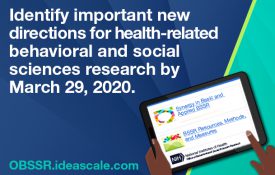
  • Identify Important New Directions For Health-Related Behavioral and Social Science Research

    The NIH OBSSR is seeking broad public input on important new directions for health-related behavioral and social sciences research.

  • The Verdict Is In: Courtrooms Seldom Overrule Bad Science

    A new, multiyear study published in Psychological Science in the Public Interest finds that only 40% of the psychological assessment tools used in courts have been favorably rated by experts. [NEWS Feb. 15, 2020]

« FirstPrevious...102030...446447448449450...460470480...NextLast »
  • Who We Are
  • Privacy Policy
  • Contact Us
  • Donate
  • Advertising
  • Follow APS
  • Facebook Logo link to APS's Facebook
  • BlueSky Logo link to APS's BlueSky
  • Youtube Logo link to APS's YouTube
  • Instagram Logo link to APS's Instagram
  • LinkedIn Logo link to APS's LinkedIn
  • Twitter Logo link to APS's Twitter

© Association for Psychological Science

Cookies
We use cookies on our website to give you the most relevant experience by remembering your preferences and repeat visits. By clicking “Accept”, you consent to the use of ALL the cookies. To accept or reject certain categories of cookies specifically please click the Cookie Settings link. Please read our Cookie Policy for more information.
Do not sell my personal information.
Cookie settingsAccept Reject
Privacy & Cookies Policy

Privacy Overview

This website uses cookies to improve your experience while you navigate through the website. Out of these cookies, the cookies that are categorized as necessary are stored on your browser as they are essential for the working of basic functionalities of the website. We also use third-party cookies that help us analyze and understand how you use this website. These cookies will be stored in your browser only with your consent. You also have the option to opt-out of these cookies. But opting out of some of these cookies may have an effect on your browsing experience.
Necessary
Always Enabled
Necessary cookies are absolutely essential for the website to function properly. This category only includes cookies that ensures basic functionalities and security features of the website. These cookies do not store any personal information.
Functional
Functional cookies help to perform certain functionalities like sharing the content of the website on social media platforms, collect feedbacks, and other third-party features.
CookieDurationDescription
__cf_bm30 minutesThis cookie, set by Cloudflare, is used to support Cloudflare Bot Management.
Performance
Performance cookies are used to understand and analyze the key performance indexes of the website which helps in delivering a better user experience for the visitors.
CookieDurationDescription
AWSELBCORS5 minutesThis cookie is used by Elastic Load Balancing from Amazon Web Services to effectively balance load on the servers.
Analytics
Analytical cookies are used to understand how visitors interact with the website. These cookies help provide information on metrics the number of visitors, bounce rate, traffic source, etc.
CookieDurationDescription
at-randneverAddThis sets this cookie to track page visits, sources of traffic and share counts.
CONSENT2 yearsYouTube sets this cookie via embedded youtube-videos and registers anonymous statistical data.
uvc1 year 27 daysSet by addthis.com to determine the usage of addthis.com service.
_ga2 yearsThe _ga cookie, installed by Google Analytics, calculates visitor, session and campaign data and also keeps track of site usage for the site's analytics report. The cookie stores information anonymously and assigns a randomly generated number to recognize unique visitors.
_gat_gtag_UA_3507334_11 minuteSet by Google to distinguish users.
_gid1 dayInstalled by Google Analytics, _gid cookie stores information on how visitors use a website, while also creating an analytics report of the website's performance. Some of the data that are collected include the number of visitors, their source, and the pages they visit anonymously.
Advertisement
Advertisement cookies are used to provide visitors with relevant ads and marketing campaigns. These cookies track visitors across websites and collect information to provide customized ads.
CookieDurationDescription
loc1 year 27 daysAddThis sets this geolocation cookie to help understand the location of users who share the information.
VISITOR_INFO1_LIVE5 months 27 daysA cookie set by YouTube to measure bandwidth that determines whether the user gets the new or old player interface.
YSCsessionYSC cookie is set by Youtube and is used to track the views of embedded videos on Youtube pages.
yt-remote-connected-devicesneverYouTube sets this cookie to store the video preferences of the user using embedded YouTube video.
yt-remote-device-idneverYouTube sets this cookie to store the video preferences of the user using embedded YouTube video.
yt.innertube::nextIdneverThis cookie, set by YouTube, registers a unique ID to store data on what videos from YouTube the user has seen.
yt.innertube::requestsneverThis cookie, set by YouTube, registers a unique ID to store data on what videos from YouTube the user has seen.
Others
Other uncategorized cookies are those that are being analyzed and have not been classified into a category as yet.
SAVE & ACCEPT
Powered by CookieYes Logo