
-
Do Masks Mask Our Emotions? Not Necessarily, Says One Expert
The United Kingdom is the latest in a long list of countries to make mask wearing mandatory to slow down the spread of Covid-19, with face coverings compulsory on public transport starting Monday. Many more of us are opting to wear a mask while shopping, meeting friends and to medical appointments — even if it's not required. But how does wearing a mask shape how we interact or communicate with others? A smile is an easy way to defuse social tensions, but is this still possible when a mask is covering the bottom half of our face? And will the emotions of the people we encounter be harder to decode?
-

German Research Foundation Funding Opportunity: “The Active Self”
The opportunity, called “Priority Programme ‘The Active Self,’” brings together behavioral scientists from psychological science and robotics to explore these questions.
-
APS Past President Gordon H. Bower (1932-2020)
It is with great sorrow that we mark the passing of APS Past President Gordon H. Bower on June 17, 2020. A Charter Member of APS, he served as President from 1991-1993 and was a longtime psychology professor at Stanford University, where he influenced generations of scientists throughout the field. Among his many recognitions is the U.S. National Medal of Science, which he received in 2005. See Bower's 2009 Inside the Psychologist’s Studio interview. See this longer tribute in the October Observer. Bower’s student Mark Gluck, of Rutgers University, wrote the tribute that follows.
-
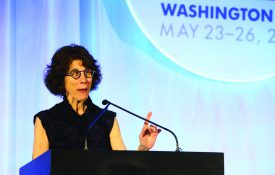
Barbara Tversky Receives Kampé de Fériet Award
APS Past President Barbara Tversky has received the Kampé de Fériet Award for her research on memory, thought, spatial models, and event perception.
-

New Research in Psychological Science
A sample of research on cultural distance, gossip and lying, skill learning, air pollution and anxiety, and the reliability of task-functional MRI measures.
-
The Hard Truth Of Poker — And Life: You’re Never ‘Due’ For Good Cards
For many years, my life centered around studying the biases of human decision-making: I was a graduate student in psychology at Columbia, working with that marshmallow-tinted legend, Walter Mischel, to document the foibles of the human mind as people found themselves in situations where risk abounded and uncertainty ran high. Dissertation defended, I thought to myself, that’s that. I’ve got those sorted out. And in the years that followed, I would pride myself on knowing so much about the tools of self-control that would help me distinguish myself from my poor experimental subjects.
