• News & Research
    • Research Topics
    • Podcasts & Videos
  • Conventions & Events
    • 2026 APS Annual Convention
    • Webinars & Virtual Events
    • Past and Future Conventions
  • Journals
    • Psychological Science
    • Current Directions in Psychological Science
    • Psychological Science in the Public Interest
    • Perspectives on Psychological Science
    • Clinical Psychological Science
    • Advances in Methods and Practices in Psychological Science
    • Advances in Psychological Science Open
  • Advocacy & Policy
    • Policy & Position Statements
  • The Observer 
    • Archive
    • About the Observer
    • Advertising
    • Contact the Editor
    • Presidential Columns
  • Members
    • Awards & Honors
    • Member Directory
    • Lifetime Members
    • Student Members
    • Teaching of Psychology
    • Donors
  • Career Resources
    • Employment
  • About
    • Diversity, Equity, & Inclusion
    • Board of Directors 2025-2026
    • Staff Directory
    • Ethics Policy & Code of Conduct
APS Homepage
APS
  • Login
  • Join APS
  • The New (Malevolent) Ageism

    The Huffington Post: America is a rapidly graying society. This demographic trend has been underway for a while -- and anticipated for a long while -- yet some of its implications are just now coming into focus. Most notably, the aging of America will almost certainly trigger a retirement crisis, with elderly boomers competing for limited financial and medical resources -- and working longer just to stay afloat. The elderly have never been honored in American society. They have more often been stereotyped, stigmatized and pitied as outdated and weak, both physically and mentally.

  • Compassion Can Be Cultivated

    Pacific Standard: Can people be taught to act more altruistically? Newly published research, measuring both brain activity and behavior, suggests the answer just may be yes. “Our findings support the possibility that compassion and altruism can be viewed as trainable skills rather than stable traits,” a research team led by Richard J. Davidson and Helen Weng of the University of Wisconsin-Madison writes in the journal Psychological Science. Specifically, they report that taking a course in compassion leads to increased engagement of certain neural systems, which prompts higher levels of altruistic behavior. Read the whole story: Pacific Standard

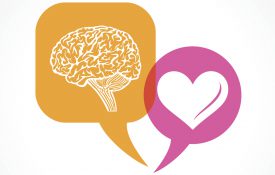
  • Brain and heart in message bubble

    Brain Can Be Trained in Compassion, Study Shows

    A study shows that training adults in compassion can result in greater altruistic behavior.

  • New Research From Psychological Science

    Read about the latest research published in Psychological Science. Deliberation's Blindsight: How Cognitive Load Can Improve Judgments Janina A. Hoffmann, Bettina von Helversen, and Jörg Rieskamp When one is under a high cognitive load, why does task performance increase in some cases but decrease in others? Participants performed a multiple-cue judgment task in which they switched from a rule-based to a similarity-based judgment strategy as cognitive load increased. This switch in strategy harmed their performance on linear judgment tasks but improved their performance on nonlinear judgment tasks.

  • Still Charting Memory’s Depths

    The New York Times: MONTREAL — In many ways, the Obama administration’s new plan to map the human brain has its origins in the work of Brenda Milner, the neuropsychologist whose detailed observations of an amnesia patient in the 1950s showed how memory is rooted in specific regions of the brain. “Prior to Brenda Milner’s discoveries, many behaviorists and some cognitive psychologists followed the lead of Freud and Skinner in abandoning biology as a useful guide to the study of memory,” the Nobel laureate Dr.

  • You are less beautiful than you think

    Salon:  In April 15, 2013, Dove launched a 3-minute video entitled “Dove Real Beauty Sketches.” The video achieved instant popularity and has been watched millions of times — a successful viral campaign which has been widely talked about. In the video, a small group of women are asked to describe their faces to a person whom they cannot see. The person is a forensic artist who is there to draw pictures of the women based on their verbal descriptions. ... The most direct evidence that the Dove commercial is misleading comes from the work of Nicholas Epley of the University of Chicago and Erin Whitchurch of the University of Virginia. Read the whole story: Salon

« FirstPrevious...102030...1,6571,6581,6591,6601,661...1,6701,6801,690...NextLast »
  • Who We Are
  • Privacy Policy
  • Contact Us
  • Donate
  • Advertising
  • Follow APS
  • Facebook Logo link to APS's Facebook
  • BlueSky Logo link to APS's BlueSky
  • Youtube Logo link to APS's YouTube
  • Instagram Logo link to APS's Instagram
  • LinkedIn Logo link to APS's LinkedIn
  • Twitter Logo link to APS's Twitter

© Association for Psychological Science

Cookies
We use cookies on our website to give you the most relevant experience by remembering your preferences and repeat visits. By clicking “Accept”, you consent to the use of ALL the cookies. To accept or reject certain categories of cookies specifically please click the Cookie Settings link. Please read our Cookie Policy for more information.
Do not sell my personal information.
Cookie settingsAccept Reject
Privacy & Cookies Policy

Privacy Overview

This website uses cookies to improve your experience while you navigate through the website. Out of these cookies, the cookies that are categorized as necessary are stored on your browser as they are essential for the working of basic functionalities of the website. We also use third-party cookies that help us analyze and understand how you use this website. These cookies will be stored in your browser only with your consent. You also have the option to opt-out of these cookies. But opting out of some of these cookies may have an effect on your browsing experience.
Necessary
Always Enabled
Necessary cookies are absolutely essential for the website to function properly. This category only includes cookies that ensures basic functionalities and security features of the website. These cookies do not store any personal information.
Functional
Functional cookies help to perform certain functionalities like sharing the content of the website on social media platforms, collect feedbacks, and other third-party features.
CookieDurationDescription
__cf_bm30 minutesThis cookie, set by Cloudflare, is used to support Cloudflare Bot Management.
Performance
Performance cookies are used to understand and analyze the key performance indexes of the website which helps in delivering a better user experience for the visitors.
CookieDurationDescription
AWSELBCORS5 minutesThis cookie is used by Elastic Load Balancing from Amazon Web Services to effectively balance load on the servers.
Analytics
Analytical cookies are used to understand how visitors interact with the website. These cookies help provide information on metrics the number of visitors, bounce rate, traffic source, etc.
CookieDurationDescription
at-randneverAddThis sets this cookie to track page visits, sources of traffic and share counts.
CONSENT2 yearsYouTube sets this cookie via embedded youtube-videos and registers anonymous statistical data.
uvc1 year 27 daysSet by addthis.com to determine the usage of addthis.com service.
_ga2 yearsThe _ga cookie, installed by Google Analytics, calculates visitor, session and campaign data and also keeps track of site usage for the site's analytics report. The cookie stores information anonymously and assigns a randomly generated number to recognize unique visitors.
_gat_gtag_UA_3507334_11 minuteSet by Google to distinguish users.
_gid1 dayInstalled by Google Analytics, _gid cookie stores information on how visitors use a website, while also creating an analytics report of the website's performance. Some of the data that are collected include the number of visitors, their source, and the pages they visit anonymously.
Advertisement
Advertisement cookies are used to provide visitors with relevant ads and marketing campaigns. These cookies track visitors across websites and collect information to provide customized ads.
CookieDurationDescription
loc1 year 27 daysAddThis sets this geolocation cookie to help understand the location of users who share the information.
VISITOR_INFO1_LIVE5 months 27 daysA cookie set by YouTube to measure bandwidth that determines whether the user gets the new or old player interface.
YSCsessionYSC cookie is set by Youtube and is used to track the views of embedded videos on Youtube pages.
yt-remote-connected-devicesneverYouTube sets this cookie to store the video preferences of the user using embedded YouTube video.
yt-remote-device-idneverYouTube sets this cookie to store the video preferences of the user using embedded YouTube video.
yt.innertube::nextIdneverThis cookie, set by YouTube, registers a unique ID to store data on what videos from YouTube the user has seen.
yt.innertube::requestsneverThis cookie, set by YouTube, registers a unique ID to store data on what videos from YouTube the user has seen.
Others
Other uncategorized cookies are those that are being analyzed and have not been classified into a category as yet.
SAVE & ACCEPT
Powered by CookieYes Logo