
-
Study Finds Evidence That Text-Based Therapy Eases Depression
One of the most popular mental health innovations of the past decade is therapy via text message, which allows you to dip in and out of treatment in the course of a day. Say you wake up anxious before a presentation: You might text your therapist first thing in the morning to say that you can’t stop visualizing a humiliating failure. ... “We were pleasantly surprised to see that it was as good as weekly video therapy,” said Patricia A. Areán, a former professor at the University of Washington School of Medicine and a co-author of the study, of text-based psychotherapy. “We didn’t really find any differences in the outcomes.”
-
Here’s How Much You Need to Exercise to Feel a Little Bit Better
You may already know that moving your body is good for your mind. The good news is that you don’t necessarily need to sign up for a marathon or climb a mountain to reap the mental health benefits — the amount of exercise you do doesn’t matter as much as getting any at all. ... “Even if you only have 30 seconds or even two minutes, you can do something and move around and still help with your mood,” said C.J. Brush, an assistant professor of kinesiology at Auburn University.
-
Chimps Can Weigh Evidence and Update Their Beliefs Like Humans Do
... Most impressively, the animals even accounted for clues that undermined earlier evidence. If they heard something bouncing around inside box 1, they would assume, at first, that it was an apple—but then the experimenter would pull out a stone. Realizing they had been misled, the chimps would immediately opt for Box 2, even though it appeared uninspiring a moment before. This was “the cherry on top,” says study co-author Jan Engelmann, a comparative psychologist at the University of California, Berkeley.
-
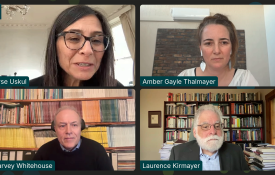
Global Summit Brings Psychological Scientists Together for Second Year
More than 500 scientists from 35 countries gathered in late October for APS’s second Global Psychological Science Summit.
-
Is It Healthy to Grieve Before a Loss?
... That honesty may help your overall healing process, added Mary-Frances O’Connor, a professor of psychology at the University of Arizona who studies grief and is the author of “The Grieving Body.” Research on late-stage cancer patients found that when the people around these patients worked to accept the loss of their loved one, they adjusted better to bereavement after the death. ... You can use a period of anticipatory grief as an opportunity to figure out if there are any issues you need to work through, such as things that have gone unsaid, Dr. O’Connor said. When someone is in hospice care, Dr.
-
Has Gordon Flett Found the Secret to Feeling Like You Matter?
Psychology professor Gordon Flett has shown that the amount a person feels they "matter" could be the key factor in how positive they feel about their life. He also argues there are evidence-based ways that anyone can begin to boost their "mattering" metric and dramatically reshape their relationship to work, the world and themselves.
