• News & Research
    • Research Topics
    • Podcasts & Videos
  • Conventions & Events
    • 2026 APS Annual Convention
    • Webinars & Virtual Events
    • Past and Future Conventions
  • Journals
    • Psychological Science
    • Current Directions in Psychological Science
    • Psychological Science in the Public Interest
    • Perspectives on Psychological Science
    • Clinical Psychological Science
    • Advances in Methods and Practices in Psychological Science
    • Advances in Psychological Science Open
  • Advocacy & Policy
    • Policy & Position Statements
  • The Observer 
    • Archive
    • About the Observer
    • Advertising
    • Contact the Editor
    • Presidential Columns
  • Members
    • Awards & Honors
    • Member Directory
    • Lifetime Members
    • Student Members
    • Teaching of Psychology
    • Donors
  • Career Resources
    • Employment
  • About
    • Diversity, Equity, & Inclusion
    • Board of Directors 2025-2026
    • Staff Directory
    • Ethics Policy & Code of Conduct
APS Homepage
APS
  • Login
  • Join APS
  • The Anatomy of a Panic Attack

    Panic attacks revolve around terror. Though people mainly associate them with the mind, they’re actually constellations of symptoms, both physical and cognitive. Your brain is seized by fear; your body responds, and it can be hard to make sense of it all. What is a panic attack? Most experts define a panic attack as a sudden onset of intense fear, as opposed to a condition like general anxiety, which usually manifests as almost constant worry. People having panic attacks are bombarded by mental and physical symptoms, which can vary from person to person. ...

  • We Could All Learn a Thing or Two From Fans of Lousy Sports Teams

    When I attended a Washington Wizards open practice at D.C.’s Capital One Arena earlier this month, the focus was more on spectator entertainment than Rocky-style workouts. The season opener was a week away, and the players ran drills at half speed and engaged in silly skills competitions for fans, including a basketball version of Connect Four. But as a lifelong Wiz devotee, I was having an awestruck, love-you-man moment. Here I was posing for a photo with Phil freakin Chenier. Franchise royalty. My childhood idol. Back in the 1970s, when Chenier was draining jumpers and sporting a Richard Pryor mustache, the team routinely chased titles. These days? Not so much.

  • Stop Hurting Your Own Feelings: Tips on Quashing Negative Self-Talk

    Do you ever hurt your own feelings? For me, it's a common occurrence. A curt reply to that thoughtful work email, zero responses to that happy hour invitation – little slights like these get my inner critic going. What a dumb thing to say! Of course they don't like you. Who do you think you are? This kind of negative self-talk can get in the way of creating strong relationships with ourselves and others. But there are ways to stop this spiral of thinking, says psychologist Ethan Kross. In moments of hurt or confusion, pause to consider other possibilities. ...

  • Zoom and Alcohol Don’t Mix—Looking at Yourself During Online Social Gatherings May Worsen Mood; Alcohol May Increase This Effect

    The more a person stares at themselves while talking with a partner in an online chat, the more their mood degrades over the course of the conversation, a new study finds. Alcohol use appears to worsen this effect.

  • Failure and Flourishing. Part 3 of 3 With David Myers

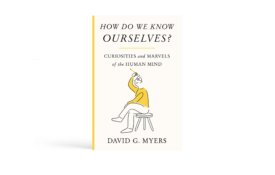
    In the final discussion with social psychologist David Myers, APS’s Ludmila Nunes talks with him about the third section of his book, in which he applies his psychological insights to the larger world around us. 

  • Why Do Our Brains Believe Lies?

    It’s been an election cycle packed with misinformation and conspiracy theories. So why do so many people believe the lies? Blame the brain. Many of the decisions we make as individuals and as a society depend on accurate information; however, our psychological biases and predispositions make us vulnerable to falsehoods. As a result, misinformation is more likely to be believed, remembered and later recalled — even after we learn that it was false. “On every level, I think that misinformation has the upper hand,” said Nathan Walter, a professor of communication studies at Northwestern University who studies the correction of misinformation. ...

« FirstPrevious...102030...200201202203204...210220230...NextLast »
  • Who We Are
  • Privacy Policy
  • Contact Us
  • Donate
  • Advertising
  • Follow APS
  • Facebook Logo link to APS's Facebook
  • BlueSky Logo link to APS's BlueSky
  • Youtube Logo link to APS's YouTube
  • Instagram Logo link to APS's Instagram
  • LinkedIn Logo link to APS's LinkedIn
  • Twitter Logo link to APS's Twitter

© Association for Psychological Science

Cookies
We use cookies on our website to give you the most relevant experience by remembering your preferences and repeat visits. By clicking “Accept”, you consent to the use of ALL the cookies. To accept or reject certain categories of cookies specifically please click the Cookie Settings link. Please read our Cookie Policy for more information.
Do not sell my personal information.
Cookie settingsAccept Reject
Privacy & Cookies Policy

Privacy Overview

This website uses cookies to improve your experience while you navigate through the website. Out of these cookies, the cookies that are categorized as necessary are stored on your browser as they are essential for the working of basic functionalities of the website. We also use third-party cookies that help us analyze and understand how you use this website. These cookies will be stored in your browser only with your consent. You also have the option to opt-out of these cookies. But opting out of some of these cookies may have an effect on your browsing experience.
Necessary
Always Enabled
Necessary cookies are absolutely essential for the website to function properly. This category only includes cookies that ensures basic functionalities and security features of the website. These cookies do not store any personal information.
Functional
Functional cookies help to perform certain functionalities like sharing the content of the website on social media platforms, collect feedbacks, and other third-party features.
CookieDurationDescription
__cf_bm30 minutesThis cookie, set by Cloudflare, is used to support Cloudflare Bot Management.
Performance
Performance cookies are used to understand and analyze the key performance indexes of the website which helps in delivering a better user experience for the visitors.
CookieDurationDescription
AWSELBCORS5 minutesThis cookie is used by Elastic Load Balancing from Amazon Web Services to effectively balance load on the servers.
Analytics
Analytical cookies are used to understand how visitors interact with the website. These cookies help provide information on metrics the number of visitors, bounce rate, traffic source, etc.
CookieDurationDescription
at-randneverAddThis sets this cookie to track page visits, sources of traffic and share counts.
CONSENT2 yearsYouTube sets this cookie via embedded youtube-videos and registers anonymous statistical data.
uvc1 year 27 daysSet by addthis.com to determine the usage of addthis.com service.
_ga2 yearsThe _ga cookie, installed by Google Analytics, calculates visitor, session and campaign data and also keeps track of site usage for the site's analytics report. The cookie stores information anonymously and assigns a randomly generated number to recognize unique visitors.
_gat_gtag_UA_3507334_11 minuteSet by Google to distinguish users.
_gid1 dayInstalled by Google Analytics, _gid cookie stores information on how visitors use a website, while also creating an analytics report of the website's performance. Some of the data that are collected include the number of visitors, their source, and the pages they visit anonymously.
Advertisement
Advertisement cookies are used to provide visitors with relevant ads and marketing campaigns. These cookies track visitors across websites and collect information to provide customized ads.
CookieDurationDescription
loc1 year 27 daysAddThis sets this geolocation cookie to help understand the location of users who share the information.
VISITOR_INFO1_LIVE5 months 27 daysA cookie set by YouTube to measure bandwidth that determines whether the user gets the new or old player interface.
YSCsessionYSC cookie is set by Youtube and is used to track the views of embedded videos on Youtube pages.
yt-remote-connected-devicesneverYouTube sets this cookie to store the video preferences of the user using embedded YouTube video.
yt-remote-device-idneverYouTube sets this cookie to store the video preferences of the user using embedded YouTube video.
yt.innertube::nextIdneverThis cookie, set by YouTube, registers a unique ID to store data on what videos from YouTube the user has seen.
yt.innertube::requestsneverThis cookie, set by YouTube, registers a unique ID to store data on what videos from YouTube the user has seen.
Others
Other uncategorized cookies are those that are being analyzed and have not been classified into a category as yet.
SAVE & ACCEPT
Powered by CookieYes Logo