• News & Research
    • Research Topics
    • Podcasts & Videos
  • Conventions & Events
    • 2026 APS Annual Convention
    • Webinars & Virtual Events
    • Past and Future Conventions
  • Journals
    • Psychological Science
    • Current Directions in Psychological Science
    • Psychological Science in the Public Interest
    • Perspectives on Psychological Science
    • Clinical Psychological Science
    • Advances in Methods and Practices in Psychological Science
    • Advances in Psychological Science Open
  • Advocacy & Policy
    • Policy & Position Statements
  • The Observer 
    • Archive
    • About the Observer
    • Advertising
    • Contact the Editor
    • Presidential Columns
  • Members
    • Awards & Honors
    • Member Directory
    • Lifetime Members
    • Student Members
    • Teaching of Psychology
    • Donors
  • Career Resources
    • Employment
  • About
    • Diversity, Equity, & Inclusion
    • Board of Directors 2025-2026
    • Staff Directory
    • Ethics Policy & Code of Conduct
APS Homepage
APS
  • Login
  • Join APS
  • Why a Cognitive Scientist Put a Head Cam on His Baby

    When Luna was seven months old, she began wearing, at the behest of her scientist father, a hot-pink helmet topped with a camera that would, for about an hour at a time, capture everything she saw, heard, and said. Her dad, Brenden Lake, is a cognitive scientist at New York University, where he thinks about  better ways to train artificial intelligence. At home, he trains human intelligence, by which I just mean that he’s a dad. On a recent Sunday morning, he held up a robot puppet and asked Luna, who was meting out her wooden toys, “That’s for robot?” “Oh, goodness!” he added in a silly Muppet voice. ... That said, AI models could also inspire new ideas about how children learn.

  • The Calming Power of Rituals

    Have you ever tried telling yourself to calm down—perhaps while half-panicked, staring at yourself in the mirror of a restroom next to the conference room where you’re leading a meeting in two minutes…one minute…? Or have you ever suggested to your irate significant other, “You need to calm down”? How did that work out? It might seem as if a straightforward reminder should be effective. We are surrounded by motivational mantras (“Keep Calm and Carry On”) aimed at keeping us placid. But those efforts are trying to suppress a strong human mechanism known as arousal—a psychological and physical state of high tension that includes the activation of the limbic and sympathetic nervous systems.

  • How to Build Your Network at Professional Events

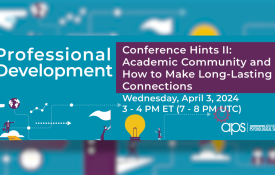
    The April 2024 Professional Development workshop hosted experts who explored how to prepare for the APS Annual Convention in May and provided tips and tricks for networking and building relationships in the field.

  • Discussing politics even with a disagreement in opinion can lead to good conversation

    New research pointed out avoiding talking about politics because a disagreement can be unnecessary. The common expectations of tension or discomfort from these conversations may not be the reality and can go better than expected.

  • The APS podcast, Under the Cortex, logo

    Parental Engagement Enhances Children’s Therapy Experience and Outcomes

    Podcast: What methods effectively alleviate children’s anxiety? How do parents influence the treatment process? Can parents positively affect the treatment outcomes? Under the Cortex explores.

  • Why Labeling Some People as ‘Gifted’ Actually Hurts Us All

    ne of the greatest musical geniuses of our time is Itzhak Perlman—but carrying the weight of that title as a child wasn’t easy. The virtuoso violinist describes his early musical education as the “triangle of hell,” with pressure from (and between) his teacher and his parents. Their motto: do as I say. When Perlman got to Juilliard, he was shocked when he was encouraged by his new teacher to be more expressive and self-reflective. Now, in the program for young musicians that he runs with his wife Toby, he uses a similar style with his own students, encouraging each to become the best version of themselves. ... Our intentions in labeling kids as gifted are largely positive.

« FirstPrevious...102030...126127128129130...140150160...NextLast »
  • Who We Are
  • Privacy Policy
  • Contact Us
  • Donate
  • Advertising
  • Follow APS
  • Facebook Logo link to APS's Facebook
  • BlueSky Logo link to APS's BlueSky
  • Youtube Logo link to APS's YouTube
  • Instagram Logo link to APS's Instagram
  • LinkedIn Logo link to APS's LinkedIn
  • Twitter Logo link to APS's Twitter

© Association for Psychological Science

Cookies
We use cookies on our website to give you the most relevant experience by remembering your preferences and repeat visits. By clicking “Accept”, you consent to the use of ALL the cookies. To accept or reject certain categories of cookies specifically please click the Cookie Settings link. Please read our Cookie Policy for more information.
Do not sell my personal information.
Cookie settingsAccept Reject
Privacy & Cookies Policy

Privacy Overview

This website uses cookies to improve your experience while you navigate through the website. Out of these cookies, the cookies that are categorized as necessary are stored on your browser as they are essential for the working of basic functionalities of the website. We also use third-party cookies that help us analyze and understand how you use this website. These cookies will be stored in your browser only with your consent. You also have the option to opt-out of these cookies. But opting out of some of these cookies may have an effect on your browsing experience.
Necessary
Always Enabled
Necessary cookies are absolutely essential for the website to function properly. This category only includes cookies that ensures basic functionalities and security features of the website. These cookies do not store any personal information.
Functional
Functional cookies help to perform certain functionalities like sharing the content of the website on social media platforms, collect feedbacks, and other third-party features.
CookieDurationDescription
__cf_bm30 minutesThis cookie, set by Cloudflare, is used to support Cloudflare Bot Management.
Performance
Performance cookies are used to understand and analyze the key performance indexes of the website which helps in delivering a better user experience for the visitors.
CookieDurationDescription
AWSELBCORS5 minutesThis cookie is used by Elastic Load Balancing from Amazon Web Services to effectively balance load on the servers.
Analytics
Analytical cookies are used to understand how visitors interact with the website. These cookies help provide information on metrics the number of visitors, bounce rate, traffic source, etc.
CookieDurationDescription
at-randneverAddThis sets this cookie to track page visits, sources of traffic and share counts.
CONSENT2 yearsYouTube sets this cookie via embedded youtube-videos and registers anonymous statistical data.
uvc1 year 27 daysSet by addthis.com to determine the usage of addthis.com service.
_ga2 yearsThe _ga cookie, installed by Google Analytics, calculates visitor, session and campaign data and also keeps track of site usage for the site's analytics report. The cookie stores information anonymously and assigns a randomly generated number to recognize unique visitors.
_gat_gtag_UA_3507334_11 minuteSet by Google to distinguish users.
_gid1 dayInstalled by Google Analytics, _gid cookie stores information on how visitors use a website, while also creating an analytics report of the website's performance. Some of the data that are collected include the number of visitors, their source, and the pages they visit anonymously.
Advertisement
Advertisement cookies are used to provide visitors with relevant ads and marketing campaigns. These cookies track visitors across websites and collect information to provide customized ads.
CookieDurationDescription
loc1 year 27 daysAddThis sets this geolocation cookie to help understand the location of users who share the information.
VISITOR_INFO1_LIVE5 months 27 daysA cookie set by YouTube to measure bandwidth that determines whether the user gets the new or old player interface.
YSCsessionYSC cookie is set by Youtube and is used to track the views of embedded videos on Youtube pages.
yt-remote-connected-devicesneverYouTube sets this cookie to store the video preferences of the user using embedded YouTube video.
yt-remote-device-idneverYouTube sets this cookie to store the video preferences of the user using embedded YouTube video.
yt.innertube::nextIdneverThis cookie, set by YouTube, registers a unique ID to store data on what videos from YouTube the user has seen.
yt.innertube::requestsneverThis cookie, set by YouTube, registers a unique ID to store data on what videos from YouTube the user has seen.
Others
Other uncategorized cookies are those that are being analyzed and have not been classified into a category as yet.
SAVE & ACCEPT
Powered by CookieYes Logo