• News & Research
    • Research Topics
    • Podcasts & Videos
  • Conventions & Events
    • 2026 APS Annual Convention
    • Webinars & Virtual Events
    • Past and Future Conventions
  • Journals
    • Psychological Science
    • Current Directions in Psychological Science
    • Psychological Science in the Public Interest
    • Perspectives on Psychological Science
    • Clinical Psychological Science
    • Advances in Methods and Practices in Psychological Science
    • Advances in Psychological Science Open
  • Advocacy & Policy
    • Policy & Position Statements
  • The Observer 
    • Archive
    • About the Observer
    • Advertising
    • Contact the Editor
    • Presidential Columns
  • Members
    • Awards & Honors
    • Member Directory
    • Lifetime Members
    • Student Members
    • Teaching of Psychology
    • Donors
  • Career Resources
    • Employment
  • About
    • Diversity, Equity, & Inclusion
    • Board of Directors 2025-2026
    • Staff Directory
    • Ethics Policy & Code of Conduct
APS Homepage
APS
  • Login
  • Join APS
  • How to Break the Cycle of ‘Sameness’ and Push Yourself in Midlife

    1. Find your “will to live.” 2. Keep asking THE question: What is something challenging you’ve always wanted to try or be, but now worry you’re too old to do? 3. Stop believing your competencies are fixed. Adding the word “yet” to your mindset can help, according to the well-known Stanford psychologist Carol Dweck. In other words, think, “I’m not an artist, pianist, surfer, runner, entrepreneur … yet.” 4. Be okay looking foolish. 5. Define your “crop.”

  • 5 Ways to Make Friends (Without Joining a Book Club)

    To meet your neighbors, try doing them small kindnesses, said Julianne Holt-Lunstad, a professor of psychology and neuroscience and the director of the Social Connection and Health Lab at Brigham Young University. Compliment their gardening skills, or offer to bring in their trash bins. Why? Dr. Holt-Lunstad’s research has found that these acts can encourage conversations and reduce feelings of loneliness. Pushing yourself to be more social, said Dr. Holt-Lunstad, is like exercise: Even if you know it’s good for you, it can be uncomfortable. ... Dr. Holt-Lunstad also recommended reflecting on the people who have helped you in your life: a coach, a teacher, a neighbor.

  • Journal Collection Examines Psychological Science in Pandemics

    In a special Perspectives on Psychological Science collection, researchers discuss how psychological science can help policymakers and the public understand and address the spread of infectious disease while preserving constructive social interactions and learning.

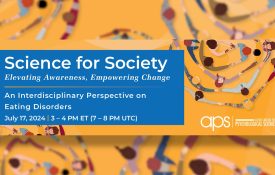
  • Science for Society: An Interdisciplinary Perspective on Eating Disorders

    Disordered eating affects millions of people worldwide. As of 2018, 8% of the global population were estimated to have eating disorders (Galmiche et al., 2019). This webinar provides an interdisciplinary perspective that incorporates qualitative and quantitative data from researchers and clinicians.

  • Teens Have a Lot of Good Coping Strategies — And They Often Just Need to Be Heard

    Maybe a hug from a parent no longer solves problems for a teen as it did in their childhood. But when it comes to teenage mental health, adults can do a lot to help, according to new data. ... Social media and other screen-based entertainment often is talked about in terms of the risks, but “the potential benefits of social media to a large proportion of teens have received insufficient attention,” said Dr. Laurence Steinberg, a professor of psychology and neuroscience at Temple University in Philadelphia. He was not involved in the survey research.

  • Want to Live a Long Life? Start Prioritizing Your Friends

    Your social network may influence your health as much as your exercise routine. ... To get a measure of the social health boost's overall importance, Julianne Holt-Lunstad, a psychologist at Brigham Young University, in Provo, Utah, compiled the findings of 148 studies. Together they covered 300,000 participants and had looked at the benefits of social integration and the hazard of social disconnection. She then compared the effects of loneliness with the risks of various other lifestyle factors, including smoking, drinking alcohol, exercise and physical activity, body mass index (a measure of obesity), air pollution and taking medication to control blood pressure.

« FirstPrevious...102030...109110111112113...120130140...NextLast »
  • Who We Are
  • Privacy Policy
  • Contact Us
  • Donate
  • Advertising
  • Follow APS
  • Facebook Logo link to APS's Facebook
  • BlueSky Logo link to APS's BlueSky
  • Youtube Logo link to APS's YouTube
  • Instagram Logo link to APS's Instagram
  • LinkedIn Logo link to APS's LinkedIn
  • Twitter Logo link to APS's Twitter

© Association for Psychological Science

Cookies
We use cookies on our website to give you the most relevant experience by remembering your preferences and repeat visits. By clicking “Accept”, you consent to the use of ALL the cookies. To accept or reject certain categories of cookies specifically please click the Cookie Settings link. Please read our Cookie Policy for more information.
Do not sell my personal information.
Cookie settingsAccept Reject
Privacy & Cookies Policy

Privacy Overview

This website uses cookies to improve your experience while you navigate through the website. Out of these cookies, the cookies that are categorized as necessary are stored on your browser as they are essential for the working of basic functionalities of the website. We also use third-party cookies that help us analyze and understand how you use this website. These cookies will be stored in your browser only with your consent. You also have the option to opt-out of these cookies. But opting out of some of these cookies may have an effect on your browsing experience.
Necessary
Always Enabled
Necessary cookies are absolutely essential for the website to function properly. This category only includes cookies that ensures basic functionalities and security features of the website. These cookies do not store any personal information.
Functional
Functional cookies help to perform certain functionalities like sharing the content of the website on social media platforms, collect feedbacks, and other third-party features.
CookieDurationDescription
__cf_bm30 minutesThis cookie, set by Cloudflare, is used to support Cloudflare Bot Management.
Performance
Performance cookies are used to understand and analyze the key performance indexes of the website which helps in delivering a better user experience for the visitors.
CookieDurationDescription
AWSELBCORS5 minutesThis cookie is used by Elastic Load Balancing from Amazon Web Services to effectively balance load on the servers.
Analytics
Analytical cookies are used to understand how visitors interact with the website. These cookies help provide information on metrics the number of visitors, bounce rate, traffic source, etc.
CookieDurationDescription
at-randneverAddThis sets this cookie to track page visits, sources of traffic and share counts.
CONSENT2 yearsYouTube sets this cookie via embedded youtube-videos and registers anonymous statistical data.
uvc1 year 27 daysSet by addthis.com to determine the usage of addthis.com service.
_ga2 yearsThe _ga cookie, installed by Google Analytics, calculates visitor, session and campaign data and also keeps track of site usage for the site's analytics report. The cookie stores information anonymously and assigns a randomly generated number to recognize unique visitors.
_gat_gtag_UA_3507334_11 minuteSet by Google to distinguish users.
_gid1 dayInstalled by Google Analytics, _gid cookie stores information on how visitors use a website, while also creating an analytics report of the website's performance. Some of the data that are collected include the number of visitors, their source, and the pages they visit anonymously.
Advertisement
Advertisement cookies are used to provide visitors with relevant ads and marketing campaigns. These cookies track visitors across websites and collect information to provide customized ads.
CookieDurationDescription
loc1 year 27 daysAddThis sets this geolocation cookie to help understand the location of users who share the information.
VISITOR_INFO1_LIVE5 months 27 daysA cookie set by YouTube to measure bandwidth that determines whether the user gets the new or old player interface.
YSCsessionYSC cookie is set by Youtube and is used to track the views of embedded videos on Youtube pages.
yt-remote-connected-devicesneverYouTube sets this cookie to store the video preferences of the user using embedded YouTube video.
yt-remote-device-idneverYouTube sets this cookie to store the video preferences of the user using embedded YouTube video.
yt.innertube::nextIdneverThis cookie, set by YouTube, registers a unique ID to store data on what videos from YouTube the user has seen.
yt.innertube::requestsneverThis cookie, set by YouTube, registers a unique ID to store data on what videos from YouTube the user has seen.
Others
Other uncategorized cookies are those that are being analyzed and have not been classified into a category as yet.
SAVE & ACCEPT
Powered by CookieYes Logo