
-
The Social Ritual That Made Me a Better Man
… This wasn’t just in my head. In a 2017 study led by the evolutionary psychologist Robin Dunbar, researchers at the University of Oxford found that nights out with friends support mental and emotional well-being. Other
-
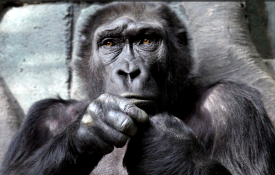
Like Humans, Great Apes Think Differently From Each Other
A new study assesses how cognitive skills of great apes vary between individuals.
-
We’ve Misunderstood Human Nature for 100 Years
One day in the summer of 1924, an anthropologist named Raymond Dart made an incredible discovery — and drew a conclusion from it about human nature that would mislead us for a century. Dart was
-
Why Do We Have Eyebrows and Other Types of Facial Hair?
We humans seem to have an on-again, off-again relationship with facial hair. Prehistoric cave drawings reveal the myriad tools our ancient ancestors used to shave: shark’s teeth, sharpened flints and even clam shells. Nowadays, beards are
-
You Can Only Maintain So Many Close Friendships
The Oxford evolutionary psychologist Robin Dunbar is best known for his namesake “Dunbar’s number,” which he defines as the number of stable relationships people are cognitively able to maintain at once. (The proposed number is
-

New Research in Psychological Science
A sample of research on theory-of-mind development in deaf children, male variability in cooperation, hypnosis and visual tasks, attitude formation, early training and musical skills, whether children prioritize saving animals, and the use of moral language in the U.S. Congress.
